
Johnson County parents see a growing threat to public schools
When Jessica Nance and husband Brian Rood jumped the state line into Johnson County at the close of the 20th century, the political atmosphere over public schooling was different from what Kansans know today.
Schools were the big draw, everyone in the suburban county knew. K-12 education funding wasn’t the worry it has become.
“If people think we’re living here for any other reason, they’re confused. It’s the schools,” said Nance, of Overland Park, who has two children attending Trailwood Elementary.
Last week Nance and other parents could only watch as state lawmakers wrestled over ways to keep schools across Kansas from running out of money this summer.
A proposed legislative solution was reached, but for some Johnson County families the long view remains troubling: Top-quality schools that many once took for granted seem more imperiled with each new emergency in Topeka.
The reasons for the latest crisis are numbingly complicated, rooted in a funding mechanism that the Kansas Supreme Court has ruled unconstitutional for favoring affluent districts over poorer ones.
The high court demanded that lawmakers enact a new financial formula by June 30, the end of the fiscal year, or “the schools in Kansas will be unable to operate” because no satisfactory structure would be in place to fund them.
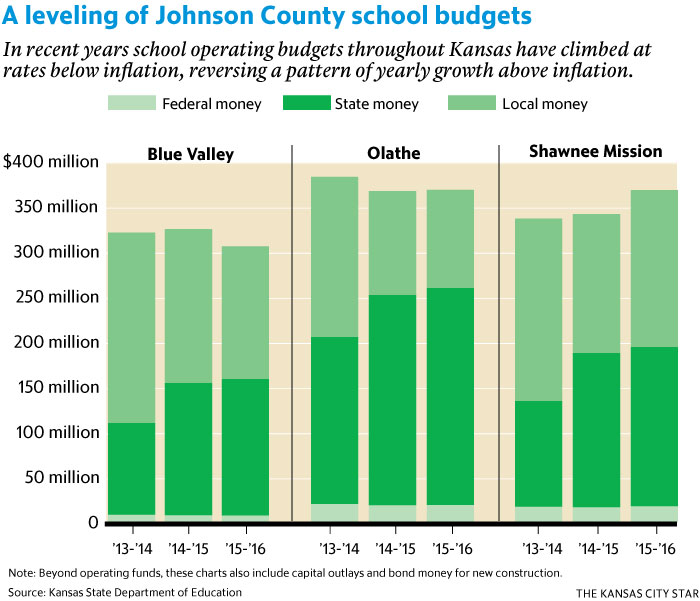
The justices may yet reject the fix that the Legislature sped through last week. If they agree to it, funds for the coming fiscal year essentially will be frozen at 2015-16 levels and districts such as Shawnee Mission will escape with “the best scenario we’re going to have,” said Superintendent Jim Hinson.
And it’s just a one-year fix, so expect more of the same uncertainty next year.
While sixth-graders such as Evan Deedy are unlikely to wrap their brains around the legal, economic and political complexities of school funding fights, even Evan gets the bottom line.
“My friends were talking about how if they were in kindergarten, they might say, ‘Yay, no school,’ ” said Evan, who attends Belinder Elementary in Prairie Village. “But being sixth-graders, we feel education is important. We’ve matured” since kindergarten.
Some parents and educators question whether decision makers in Topeka have done the same.
In the past several years since Kansas conservatives stepped up efforts to cut taxes and deride schools for being inefficient, Evan’s mother, Judith Deedy, has become more politically active than she ever wished to be.
“I hate politics, truly,” said Deedy, whose family moved into Mission Hills in 2004. A Yale University-trained lawyer from Illinois, she paid no attention to the legislative goings-on in Kansas until a few years ago when she and other concerned parents launched Game On for Kansas Schools.
Originating out of Belinder, the advocacy group has 11,000 Facebook followers. Kids of the parents who lead the group represent more than two dozen area schools.
“I knew people at Yale who went to Shawnee Mission schools,” Deedy said. “We knew the school district by its reputation. We didn’t look at the state’s tax rates.”
The mother of three district students, Deedy spent much of last week listening to live audio feeds from the statehouse.
Mounting tension
Concerns about schools possibly closing escalated earlier this month after Shawnee Mission district leaders met with the editorial board of The Kansas City Star. In an article that lit up the newspaper’s website, the officials said they couldn’t promise that teachers would get summer paychecks.
They expressed uncertainty that buildings would open in August if state lawmakers failed to replace the 2015 block grant funding law with something the court would find more equitable to all districts.
Hinson said at the time that legislators and educators were “so polarized” and unable to discuss the school funding problem “like rational adults.”
A measure of rationality prevailed Thursday when lawmakers overwhelmingly approved a plan that rearranged pots of revenue so no district would lose money and a few poorer districts would receive extra funds to a total tune of about $2 million — a tiny fraction in a state where spending on K-12 schools tops $6 billion a year.
Blue Valley and Shawnee Mission school officials supported the measure. The Kansas City, Kan., district opposed it. And other groups voiced doubts that the plan would pass constitutional muster, leaving the possibility of a summer shutdown.
“There is that tension between keeping the schools open and really needing to fix the question of equity,” said David Smith, spokesman for Kansas City Kansas Public Schools.
Adding to the tension is the desperate condition of state coffers. One court estimated that equalization would require at least an extra $50 million in aid.
“Changes to the tax law back in 2012, we said at the time, were going to create a problem where the state can’t meet its obligations,” Smith said. “Now we’re at that point. But the kids all over Kansas shouldn’t have to pay for it by lacking equal educational opportunity.”
Alan Rupe, an attorney for a group representing plaintiff school districts, said the plan passed last week does nothing to correct inequity: “The rich would still have the ability of getting richer and the poor remain the same. … We’re going to move as quickly as we can to get this matter back to the court.”
Asked whether the states’ public schools might still lose funding come July 1, he said, “I think the likelihood is the same as before.”
Rupe cited a “disconnect” in Johnson County when it comes to residents and school officials recognizing that the state requires that kids have equal educational opportunities no matter where they live.
“And here’s why: It’s the law,” he said. “We have a statewide system for funding.”
Hinson took issue: “At some point you do need to define equity. … It can’t just be an attack on Johnson County.”
What is ‘good enough’?
Many Johnson County families see the need for every Kansas child to have equal learning opportunities, but they blame a tightfisted legislature for not making that a reality.
Nance, a musician who performs with her husband in the Kansas City Symphony, said she doesn’t share some of her neighbors’ views that local voters should be able to override the state formula if they wish to spend more to improve their children’s education.
“Other kids also deserve a good education,” she said, and longstanding funding inequities need to be addressed. But Nance said the best approach in Topeka would be to consider increasing education spending across the board, which lawmakers appear in no mood to do in the face of revenue shortfalls.
The state constitution requires “adequate” funding of public schools.
“I really don’t think adequate is good enough,” Nance said.
That’s another question on the Kansas Supreme Court’s docket: Is state funding adequate? If fixing the equity question would cost $50 million, bringing school funding to an adequate level could require a $500 million infusion, a district court has suggested.
The conservative Kansas Policy Institute think tank, which has an office in the Blue Valley district, says most Kansans think that schools in general aren’t efficient enough in their use of public dollars.
“By a measure of 2 to 1,” the institute said when it released a poll last week, “Kansans prefer that existing taxpayer money be used rather than impose higher taxes” to meet court orders.
“Funding for schools has always been off the tracks,” institute president Dave Trabert said.
“What school districts like to talk about is what they want. What they need is a different matter,” he added. “Johnson County on the whole may be wealthier than other Kansas counties, but that doesn’t mean there isn’t growing poverty here. A lot of people have no means to afford these demands for higher taxes.”
Parents Deedy and Nance say they’re hearing more of this criticism of how schools spend, especially in light of the recent recession and flat wages tightening household budgets.
“There was a time when we all regarded our schools as points of pride. You wanted them to be showcases for your communities,” Deedy said. “I used to think people were reasonable on this issue. Who wouldn’t support public schools?”
Will it pass the court’s test?
Todd White picked a tumultuous month to assume his duties as superintendent of the Blue Valley district.
After his first school board meeting in that role on Monday, White wondered aloud if legislators could move fast enough to address the threatened school shutdown before adjourning at week’s end for a monthlong recess.
Western Kansas districts have been upping the volume on cries for relief from inequity, he noted, because of diminished property values caused by the slowdown in the oil and natural gas economy.
“Can you imagine what it would do to the economy if all the teachers, cafeteria workers and school bus drivers across the state suddenly stopped getting paid?” White said.
After legislators took action, White on Friday said he felt “somewhat” more optimistic.
“Yes, I feel better that we had two chambers put together what I think is the best option available,” he said. “Will it pass the Supreme Court test? Truthfully, I’m not sure.”
By then Blue Valley West High School senior Isaac Witte, a decorated cellist, will have safely graduated.
Witte and six other district students were honored Monday for having been all-state selections in the musical arts for three straight years.
The crowded boardroom reflected why families settle in the Blue Valley district. Dozens of supportive friends, teachers and family members applauded the young honorees engaged in activities that financially troubled schools have been forced to slice back.
Witte’s parents, Peter Witte and Robin Johnson, hope it never comes to that in Blue Valley. Exposure to the fine arts means “these kids are getting a complete education,” said Peter Witte, who is dean of the University of Missouri-Kansas City Conservatory of Music and Dance. “And the arts are a huge business.”
Isaac Witte said playing cello and understanding music helps him write better. He feels able to do math in creative and analytical ways.
As for funding fights in Topeka and their potential effect on learning, Witte said few classmates have brought up the issue.
It is complicated.
“I haven’t heard them say a lot,” he said. “But I think more should.”
Rick Montgomery: 816-234-4410, @rmontgomery_r
This story was originally published March 26, 2016 at 6:45 PM with the headline "Johnson County parents see a growing threat to public schools."