
Kansas City budget confronts ugly vacant houses and other neighborhood concerns
Hideous vacant houses and other neighborhood concerns were front and center Thursday as the Kansas City Council passed a new budget for 2016-2017.
The plan calls for spending $10 million over the next two years to tear down as many as 800 of the most dangerous abandoned homes in the city. But under a new program, some of those decrepit homes may be saved if people buy them for $1 and spend the thousands of dollars needed to fix them up.
The new budget takes effect May 1 and totals $1.5 billion, up 3.5 percent from this current fiscal year. Government activities, including basic services and capital improvements, but not water and aviation, increase 5 percent to $1 billion.
Revenue growth is more robust this year than in the past seven years, finally reflecting an improving economy and providing a chance to help neighborhoods, said Mayor Sly James.
“This was a relatively pleasant budget,” James said, noting that it’s the first one since he was elected in 2011 where revenues weren’t sagging and the city wasn’t forced to make cuts and layoffs. “It’s the only one where we actually had money.”
The new budget does assume that Kansas City voters on April 5 will agree to renew the 1 percent earnings tax, which is expected to generate nearly $240 million for basic services such as police, fire and trash collection next fiscal year.
The budget also calls for continued water and sewer rate increases to pay for a federally mandated $2.5 billion sewer upgrade, as well as numerous water main replacements.
Water rates are scheduled to rise 3 percent and sewer rates 13 percent beginning May 1, so average monthly household water bills are expected to increase from $102 this year to $110 over the next year.
But unlike past years, the council did not officially adopt the new water and sewer rate structure Thursday while they were approving the budget. Some questions remain about a proposed 1 percent payment from water into the general fund to cover parks and recreation water use, so the water and sewer ordinances were postponed.
While the city’s overall budget is $1.53 billion, the general fund for basic services is projected to be about one-third of that, with another third going for water and aviation (supported by user fees) and the final third for capital improvements, convention and tourism, and other special programs supported by sales taxes, other voter-approved levies and grants.
The budget adoption came on the same day that the council approved a multiyear wage agreement with the firefighters union. The budget includes money for that first year of raises.
The biggest general fund highlight that City Manager Troy Schulte and James have cited is the plan to spend $10 million over two years to speed up demolition of hundreds of the most dangerous vacant houses in the city.
The city has tried for years to deal with a massive dangerous-buildings backlog, but other budget constraints interfered. The idea gained even more traction this year after Police Chief Darryl Forté suggested that getting rid of vacant eyesores could help crime-ridden neighborhoods.
But while demolition is the budget focus, the council on Thursday also introduced a resolution, to be voted on later, that seeks to evaluate the dangerous buildings and see if they can’t be salvaged and reused before they are subjected to the wrecking ball.
Other priorities like code enforcement also finally got a bit of a boost after years of reductions.
“The budget as a whole is tailored toward the resources we’ve been cutting over the last decade,” Schulte said. “Hopefully it’s a multiyear effort to continue to reinvest in our neighborhoods.”
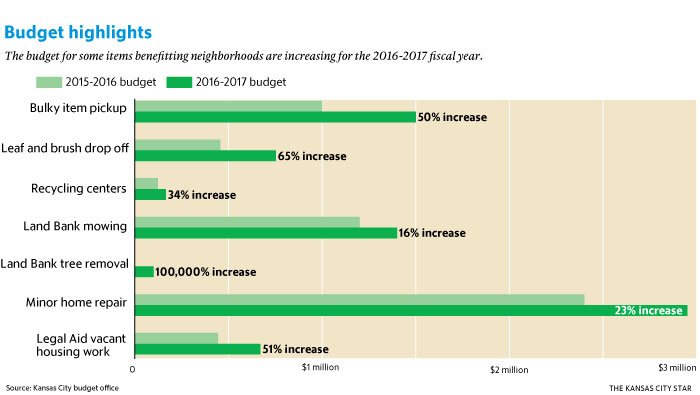
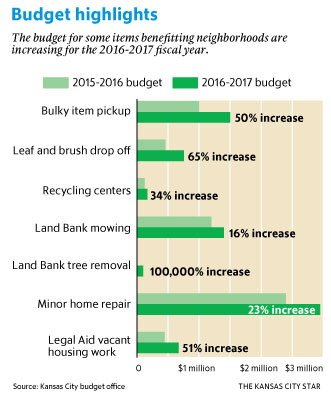
Budget highlights supporting the neighborhoods include:
▪ The police budget increases from $230.8 million this year to $242.5 million next year.
▪ Minor home repair funds bump up nearly $500,000, from $2.4 million this year to $2.95 million next fiscal year.
▪ Funds for Legal Aid neighborhood services increase by $225,000, from $444,764 to $669,764. This pays for two more attorneys and a paralegal and should boost abandoned housing case resolutions from 60 per year to more than 100 per year.
▪ Bulky item collection, which has been a source of neighborhood frustration, would see spending increase from $1 million to $1.5 million, allowing for more regular service in the neediest areas.
▪ The budget also increases funding for vacant lot mowing, leaf and brush centers, and adds a few new code inspectors for neighborhood preservation, dangerous-building inspection and illegal dumping enforcement.
Lynn Horsley: 816-226-2058, @LynnHorsley
This story was originally published March 24, 2016 at 4:57 PM with the headline "Kansas City budget confronts ugly vacant houses and other neighborhood concerns."