
Gov. Sam Brownback touts Kansas welfare reforms, takes dig at Bernie Sanders
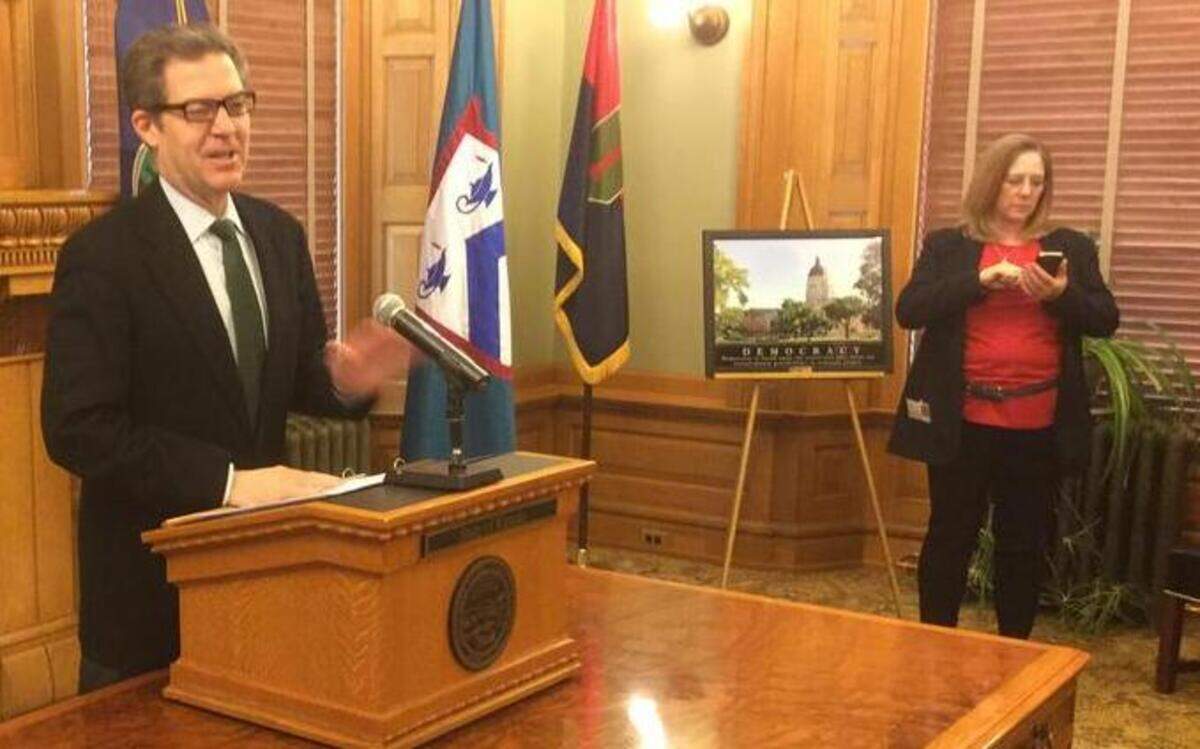
Gov. Sam Brownback of Kansas touted his welfare reforms at a statehouse news conference Thursday, a day after Democratic presidential candidate Bernie Sanders took a political swipe at the Republican.
In a wide-ranging exchange with the news media, Brownback said he will vote for Donald Trump if the real estate mogul wins the Republican nomination.
“I’ll support the Republican nominee over Bernie Sanders or Hillary Clinton,” said Brownback, who has backed Sen. Marco Rubio for the nomination.
Sanders on Wednesday called out Brownback at a Bartle Hall rally that drew thousands.
“In Kansas, you’ve got a governor who likes to beat up on the poor,” Sanders told the crowd. “It’s always an easy target to beat up on the poor, to talk about welfare abuse among the poor.”
Brownback’s office shot back in a statement: “It’s hardly surprising a socialist from Vermont disagrees with the governor’s welfare-to-work reforms. In Kansas, we believe higher incomes and more employment for those leaving food stamps is a good thing.”
At the news conference, Brownback criticized Sanders’ welfare policies as a throwback to failed poverty programs going back 50 years.
“We lost the war on poverty,” Brownback said.
The governor cited a study by the Foundation for Government Accountability, a conservative think tank, that tracked 41,000 able-bodied Kansas adults without dependents leaving the food stamp program.
Work requirements under Brownback led to more employment, higher incomes and less poverty, the study concluded. Nearly half of the adults were employed within a few months of leaving food stamps, and incomes rose 127 percent within a year, the study said.
“We have enacted some simple reforms that have moved people out of poverty in the state of Kansas,” Brownback said.
Brownback defended his administration’s recent actions relating to bond financing that have put him at odds with the Legislature.
Lawmakers have sought to put the brakes on sales tax revenue bonds, or STAR bonds — specifically a project to relocate the American Royal, the renowned horse and livestock exhibition, from Kansas City to western Wyandotte County.
Brownback said he agreed the STAR bonds process had gotten “loose” and needed review, but he objected to a legislative budget agreement that halted, at least temporarily, any American Royal project.
Brownback said he would work with the Legislature to revise the STAR bonds process, noting that a House committee will consider proposals to tighten the program’s rules.
“We’ll work with them,” he said. “We’ve got ideas too.”
Brownback said he was meeting with legislators and attorneys on the recent state Supreme Court ruling that threatened to shut down Kansas public schools for the 2016-2017 school year if the Legislature does not fix funding issues by June 30.
The state’s high court ruled in one portion of the ongoing Gannon v. Kansas case that school districts were not funded equitably. The remedy is expected to cost the state about $100 million, which was not addressed by the Legislature in its recent budget revisions.
Asked if he took the court’s threat of a shutdown seriously, Brownback said, “I take them seriously on the issue of equalization.”
On whether he thought the court was bluffing: “I’m not going to comment on that.”
He added, “The court made a ruling, and they put a hard deadline on it, but I think you have to respect the process. It takes time.”
About addressing the state’s sales tax on groceries, one of the highest in the country, Brownback said, “I’ve been open to it, but you have to pay for it.”
According to estimates, every cent reduction in the sales tax on groceries — which are taxed at the state’s sales tax rate of 6.5 percent — would cost about $66 million in revenue.
A House proposal would cut grocery taxes to 2.6 percent but would pay for it by restoring income taxes on more than 300,000 businesses exempted under the Brownback-led tax policy. Brownback has credited the exemption with increasing the number of jobs in the state.
Brownback mentioned the option of a grocery tax rebate program as a more targeted approach for lower-income residents rather than cutting or eliminating the grocery sales tax.
But a grocery tax rebate program was repealed under Brownback in 2012 and replaced with an income tax credit program for lower-income households. Critics said the tax credit program was smaller and benefited only those who owed income taxes.
Edward M. Eveld: 816-234-4442, @EEveld
This story was originally published February 25, 2016 at 3:40 PM with the headline "Gov. Sam Brownback touts Kansas welfare reforms, takes dig at Bernie Sanders."