
Police pursue changes to reduce deadly chases
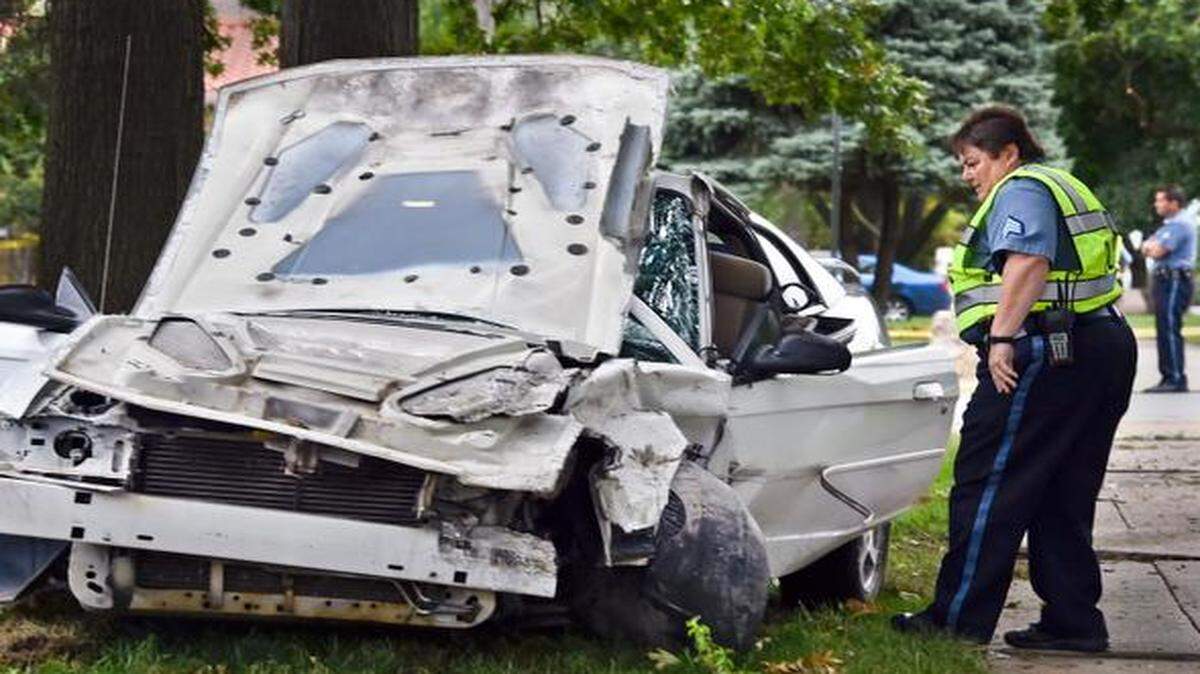
Police chases scared Geraldine Strader.
Twice this year in Kansas City, Kan., where she lived, innocent people were killed by drivers fleeing after police tried to stop them, and Strader expressed her anger over those cases, says her daughter Kathleen Brandt.
Then on Aug. 19, it happened to Strader.
The 79-year-old retired school librarian was busy running errands when the driver of a Cadillac who had fled police slammed into her Toyota. She was ejected and later died at a hospital.
Police across the country are changing policies and trying new technology to make police chases less deadly.
The decision not to chase, for example, is one that is being made more and more often by police departments.
“Generally, police agencies are more cautious about continuing pursuits than they have been in the past,” said Geoffrey Alpert, a University of South Carolina professor who studies high-risk police activities.
But it’s not simple.
In Strader’s case, a police officer had tried to stop the stolen Cadillac two minutes earlier and about 21/2 miles away. When the driver sped away, the officer did not pursue, according to police.
In addition, even critics acknowledge some police chases are necessary. Just this week, Kansas City, Kan., police chased a man suspected in a homicide across the state line and into North Kansas City, where he was arrested after a noninjury wreck.
Another driver, fleeing the same day from a shooting, had police on his tail when he crashed into and injured another motorist in northeast Kansas City.
But some who follow the issue closely say they are still occurring far too often in cases where the only crimes are traffic offenses or stolen cars.
“Violent felonies should be the only reason to have a high-speed pursuit,” said Jonathan Farris, chairman of the national nonprofit organization PursuitSafety.
Advocating for ways to reduce injuries and deaths from traffic pursuits is personal for Farris.
His son was killed in a suburb of Boston in 2007 when a man fleeing from a state police officer who tried to stop him for traffic charges sped into the taxi Paul Farris was riding in.
“Too often, these are pursuits that did not need to happen,” Jonathan Farris said.
A big problem is the lack of statistical data about the frequency of pursuits and the number that end in injury or death to officers, suspects and bystanders, he said.
The National Highway Traffic Safety Administration collects data on fatalities, but law enforcement agencies have no mandatory reporting duty.
Some numbers show that on average, one person is killed each day, but because the information is reported on a voluntary basis, Alpert said they are under-reported.
A study by the International Association of Chiefs of Police published in 2008 found that the most common reason for initiating police pursuits was traffic offenses, at 42 percent. Possible stolen vehicles accounted for 18 percent, and about 15 percent involved suspected drunk drivers.
Only 8.6 percent involved suspects in violent felonies, according to the IACP study.
The study showed 23.5 percent of pursuits had a “negative outcome,” resulting in injuries or property damage.
Local fatalities
In the Kansas City area this year, there have been at least half a dozen fatalities involving drivers fleeing from police. In several cases, the officers had reportedly discontinued the pursuit before the collisions:
▪ A Kansas City man was killed in January when his car was broadsided by a car that ran a red light. An Independence police officer had attempted to pull a car over for speeding and had pursued it for several minutes until the officer stopped the chase about five blocks before the collision occurred.
▪ In February, a Kansas City, Kan., woman was killed when a driver fled from an officer who attempted to stop him for suspected drug activity. The man drove for only a few blocks before running a red light and hitting the woman’s car.
▪ Another Kansas City, Kan., incident in April claimed the life of an 8-year-old girl. An officer had pulled the driver over for a seat belt violation, but the person drove away. The officer began to pursue, but less than a minute later, the driver ran a red light and hit the van carrying the girl.
▪ In June, Raytown police tried to pull a car over for speeding but discontinued the pursuit when the driver ran several red lights and almost struck vehicles. The car continued on and overturned, killing a passenger.
▪ In August, a 21-year-old Kansas City, Kan., man was killed in Kansas City when the car he was driving veered into a culvert and overturned. Independence police had tried to pull him over on a traffic violation, but the officer had discontinued the pursuit when he drove into Kansas City.
▪ In Strader’s case, a Kansas City, Kan., officer spotted the stolen Cadillac near 18th Street and Central Avenue and attempted to pull it over. But when the driver sped off, the officer stopped the pursuit.
A few minutes later, another officer driving near 38th Street and Parallel Parkway saw the Cadillac speeding, according to police reports. But as the officer began a U-turn to follow it, the Cadillac collided with Strader’s Toyota before the officer had turned on his lights or sirens.
Members of Strader’s family continue to have questions about the circumstances of the crash.
Brandt said that in the days following her mother’s death, the family received conflicting accounts from police about exactly what happened. They have received some police reports, but she said she is waiting for a fuller accounting of how police handled the situation.
“Right now I have questions, but I don’t have any answers,” she said. “My mother’s life was not worth an older model Cadillac.”
A person was arrested and charged with manslaughter in Strader’s death. Interim Police Chief Ellen Hanson said that once the legal process runs its course, all information that can be released will be made available to the family.
At the time of Strader’s death, Kansas City, Kan., police had suspended all chases except in cases where suspects in serious felonies were involved.
Hanson ordered that suspension to reassess the department’s chase policy because of the two fatal crashes earlier in the year.
This week, Hanson said that review was still ongoing but said the final policy would likely reflect the serious-felony threshold now in place.
The policy in some area cities including Kansas City and Kansas City, Kan., requires officers in the field to get permission from a supervisor before engaging in a pursuit. Factors such as the seriousness of the crime, time of day, weather conditions and the amount of traffic are all taken into consideration.
Kansas City Police Sgt. Kari Thompson said the department has a “very strict” policy that allows for chases only in cases involving suspects in violent crimes such as murder, rape, aggravated assault and robbery.
In Independence, officers can start a pursuit on their own discretion, but a supervisor can terminate the pursuit at any time, according to Officer Tom Gentry.
Farris of PursuitSafety said the majority of departments still allow for officer discretion in the decision to chase.
When adrenaline kicks in, it’s often difficult for officers to set aside their instinct to catch the bad guy, he said.
GPS tracker
New technologies being tested in some areas show promise in preventing injuries or deaths in pursuits and still allowing police to catch criminal suspects.
A system called StarChase uses an adhesive-tipped GPS transmitter that is fired from specially fitted patrol cars at a fleeing vehicle. Once the transmitter is fixed to the vehicle, the officer can back off and the suspect vehicle can be tracked remotely.
“StarChase is a wonderful tool for law enforcement,” Alpert said.
Earlier this summer, Alpert wrote a report on the system for the National Institute of Justice based on the experiences of officers in Arizona and Texas who have used it in the field.
He looked at 36 cases where the system was successfully deployed and found that on average within two minutes, fleeing drivers who were “tagged” slowed down to within 10 miles per hour of the posted speed limit.
“When a tag is successfully deployed, there have been no follow-on high-speed pursuits, loss of life, injuries or property damage,” according to the report.
While additional evaluation and testing is needed, Alpert said, it has the ability to be a “game changer” for law enforcement officers.
Perhaps the biggest drawback to wider use of the system is the cost. Each system costs about $5,000.
Several area police officials said that although they would be interested in the system, the cost is prohibitive.
PursuitSafety wants to see more police departments use the system, and Farris said he has been meeting with congressional officials in Washington to explore ways to provide grant funding to pay for them.
Still, the biggest unknown in any potential police chase scenario is how suspects will act. Will they stop and give up, or continue driving dangerously even without police on their tail?
The 2008 IACP study found that 72 percent of pursuits end because of some reason that is completely out of the hands of the officer.
This story was originally published September 12, 2014 at 10:54 PM with the headline "Police pursue changes to reduce deadly chases."