
Kansas City faces clash with state of Missouri over proposal to raise minimum wage
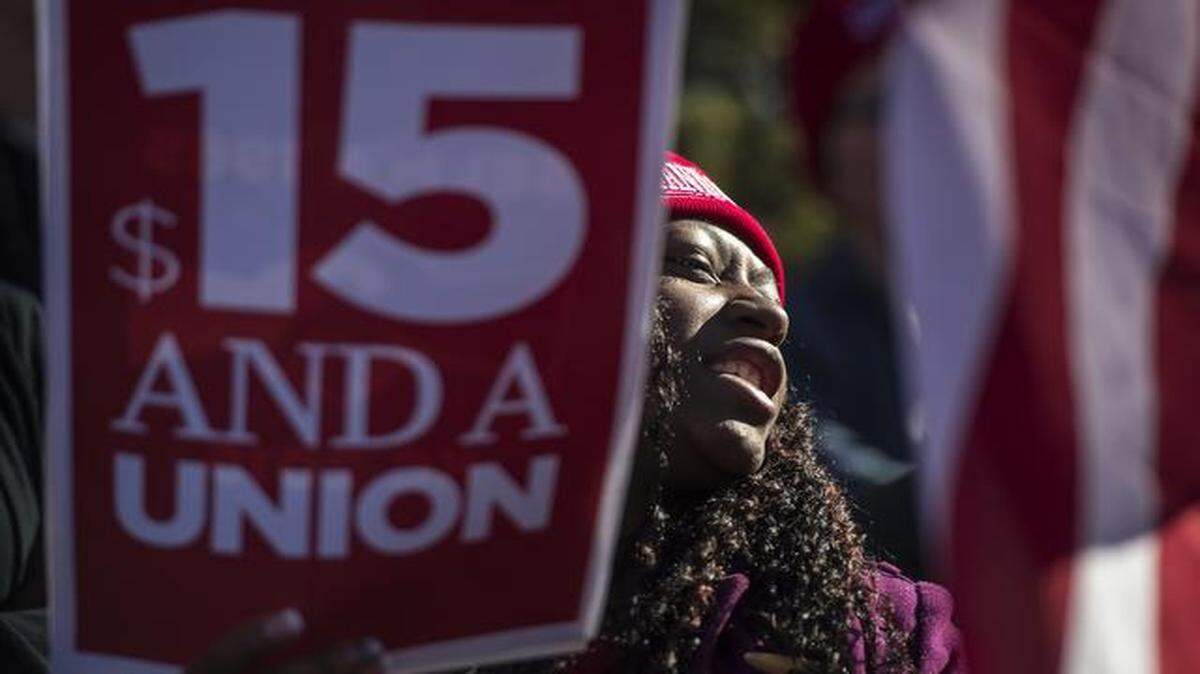
Campaigns to raise the minimum wage are sweeping the country, and Kansas City has just joined in with a proposal to gradually boost minimum pay in the city to $15 an hour by 2020.
City officials say they are sympathetic to a crusade here from civil rights and religious leaders trying to improve the plight of the working poor.
But there’s a big problem, say Kansas City Mayor Sly James and other lawyers on the City Council. They’re convinced any push to raise the local minimum wage violates state law.
“I think it’s clear we cannot,” said Councilman Ed Ford, a lawyer who points to language in Missouri law that plainly forbids the adoption of local minimum wage ordinances. “We can do only those things that the state allows us to do."
James knows Seattle has received lots of attention nationally for boosting the minimum wage to $15 an hour over the next few years. But Seattle is in a state that doesn’t preempt that type of local control, as Missouri does.
“What Seattle is doing is great,” James said in a recent meeting. “But we ain’t Seattle.”
Those arguments aren’t stopping local groups, led by the Southern Christian Leadership Conference of Greater Kansas City, which say city leaders have a moral imperative to challenge state laws that impede helping poor people.
“Every advancement that has been social, of civil rights, economic rights…has been because people had to fight for those rights and had to have courage in the face of knowing that there would be opposition,” said Vernon Howard, executive vice president of social justice for the Kansas City SCLC.
Howard said that beginning in January 2014, the local SCLC began working on the rebirth of the “poor people’s campaign.” It’s intended to build on the initiative that Martin Luther King Jr. was focusing on when he was assassinated in 1968. The SCLC is joined by local chapters of the NAACP, Urban League, Urban Summit, Black United Front, Baptist Ministers Union, MORE2 and others.
Howard said all these organizations see too many struggling people in the urban core, in their church pews and at their food pantries.
“It’s the desperation of the people that we minister to in our pews and our community every week,” he said. “We’ve got to do something. We can’t wait.”
The group worked with 3rd District Councilman Jermaine Reed, who on March 26 introduced an ordinance with little fanfare. It would bump Kansas City’s mandatory minimum wage from the current state-set minimum of $7.65 per hour to $10 per hour as of Sept. 1, with incremental increases to $15 an hour by September 2020.
“A lot of employers have stepped up to the plate and offered their employees a living wage,” Reed said. “It’s important that we do increase it to keep up with the changing times.”
But that may take awhile at the city level.
The measure went to the council’s planning, zoning and economic development committee hearing on April 1, but didn’t get a vote. James has since moved the measure to the full City Council, saying this issue is too important for a single committee to consider. Hearings before the full council have not yet been scheduled, pending further study of the proposal’s legal ramifications.
Howard said the civil rights coalition hopes the council will act on its own, but it’s not stopping there. The group, he said, is also close to gathering nearly 4,000 valid signatures of registered voters needed to compel the council to put this initiative on a local ballot.
Ford said the council may well have to put this proposal on a municipal ballot, but he predicted that if voters pass it, it would still be tossed out in court.
In an address to council members, Urban League President Gwen Grant urged them not to flinch from a legal battle that’s worth fighting.
“There was always a law that had to be challenged,” she said. “The minimum wage doesn’t provide adequately for one person, let alone a family.”
In other cities that have considered raising their mandatory minimum wage, there’s been considerable pushback from the restaurant and business communities. That’s not yet happened in Kansas City.
Ford said that’s because the business community knows the city can’t do this.
“So why should they waste any efforts?” he said.
James and City Attorney Bill Geary have also warned about unintended consequences if the city were to raise the minimum wage. It could bump people just above the eligibility level for state-subsidized child care or Medicaid benefits.
Howard and Reed dismissed that argument.
“Do we want to keep people stuck in a cycle of dependence and poverty, or do we want to begin to take the hard road to allow people to be independent,” Howard said, “and raise the bottom so that workers can have dignity.”
Kansas City has taken note that St. Louis has a narrower law on the books requiring employers who have contracts with the city or who receive incentives to pay a “living wage,” which currently comes to more than $12.35 per hour for a family of three.
Geary and others think something like that local St. Louis law, affecting just employers getting contracts with Kansas City, would be easier to defend in court. But proponents of a higher Kansas City minimum wage say the St. Louis approach doesn’t affect enough employers.
Councilman Jim Glover, another lawyer, has asked why the local civil rights organizations don’t lead a statewide petition initiative effort. He suggested they could seek voter approval for a state law giving cities the local control to adopt their own minimum wage.
But Howard and others point out that even if they succeeded in a statewide initiative, the Missouri General Assembly could simply change it and undermine it.
James and others worry that the local civil rights effort could prompt a backlash from the state.
Local civil rights leaders say they can’t be deterred by that fear, but a clampdown from the General Assembly is a distinct possibility — with the state imposing even greater restrictions on cities regarding employment benefits and terms of employment as well as pay.
Bills pending in the House and Senate prohibit cities from requiring any employer to provide either minimum pay or benefits that exceed the requirements of federal and state law. Both bills are to be considered Tuesday. The bills’ prospects are uncertain, but they still have a chance until the session ends May 15.
Both bills are backed by the Missouri Chamber of Commerce, according to Tracy King, vice president of governmental affairs for the group.
King said the Missouri chamber is aware of the Kansas City initiative, but was motivated even earlier by concerns about the higher minimum wage trend nationally. Most laws have been in cities on the West Coast, in New Mexico or in the Washington, D.C., area.
King said the Missouri chamber believes strongly that allowing cities to establish their own minimum wage will create a patchwork of regulations that would tarnish Missouri’s reputation as a business-friendly state. She said the chamber wants a uniform state workplace standard on this issue, as exists in 13 other states.
She pointed out that many higher minimum wage laws are coming from cities in California.
“We don’t want to be the next California,” she said.
Jefferson City correspondent Jason Hancock contributed to this report.
To reach Lynn Horsley, call 816-226-2058 or send email to lhorsley@kcstar.com.
This story was originally published April 10, 2015 at 5:54 PM.