
EarthWorks gets Joco kids connected to the Earth
One look at Lily Beaham’s face as she tenderly holds a tarantula is enough to explain the mission of a nonprofit tucked away under limestone in northern Kansas City.
The 8-year-old Pembroke Hill student from Fairway looks in awe at the creature, before handing it back to a program specialist at EarthWorks.
“It was so soft and light,” she says, eyes wide. “I kind of want one now.”
Her classmates, as children from dozens of other schools in Kansas and Missouri have done, learned something on this November afternoon that no teacher could impart as poignantly.
After a day at EarthWorks, they know tarantulas and bats are not evil, blood-sucking creatures. They know a harmless bullsnake’s trick to sound like a fierce rattlesnake. They know what happens when fire rages through grassland.
But mostly — by the end of the day — they know that planet Earth is fragile and needs a lot of TLC.
Terri Swartz-Shelton, of Teach & Learn Experientially, emphasizes the word “experientially.” She is president and CEO of the organization, which encompasses two groups: EarthWorks and Exchange City, a hands-on educational program housed next door that allows fifth- through seventh-graders to “run” a city over the course of a day. In fact, the success of Exchange City was the inspiration for EarthWorks, which focuses on nature.
Both programs stress STEM (science, technology, engineering and math) skills and experiential learning. Because, Swartz-Shelton notes, while standardized tests might indicate whether a child has an aptitude for science or math, they also might overlook those who learn better hands-on.
“Sometimes I still walk out there, look at those kids and I get choked up,” said Swartz-Shelton. “I believe strongly in the STEM initiative, and we’re reaching kids here.”
To understand the mission of EarthWorks, it’s important to put it in context. It shares the 32,000-square-foot space in SubTropolis, a massive underground business complex, with Exchange City, an organization that’s been around since the 1979-80 school year.
Economics and commerce are the focus of Exchange City; EarthWorks, which was founded in 1994, offers children a glimpse into the animals and habitats of the Midwest.
Swartz-Shelton, a longtime educator, says she always brought her fifth-graders to Exchange City during her many years as a teacher. Ten years ago, she changed career paths when she took a job as development director of Teach & Learn Experientially. She now oversees both EarthWorks and Exchange City, a job she holds dear. A lean staff of only three full-time and nine part-time employees work for Teach & Learn, and each person knows how to do everything, from teaching to cleaning up. Her biggest challenge is working to ensure more kids are able to participate, and that means raising money.
“In 2008, Exchange City was elsewhere and we decided it made no sense to have these organizations in two locations,” she said. “The day Exchange City moved in here, the economy crashed.”
But from lemons, said Swartz-Shelton, comes some mighty fine lemonade. What better time to teach kids about an economy after all?
It’s easy to see that this leader is a multitasker: She handles interruptions — from a volunteer with a quick question to a phone call from a donor — with calm grace.
She notes that since the programs’ inception, more than 800,000 kids have been through EarthWorks and Exchange City, with an average of about 13,000 kids a year.
Donors like the Kauffman Foundation make Teach & Learn possible, but she also cherishes the smaller gifts.
“Look at this note,” she said, waving a check for $100. “It’s from someone who doesn’t even live here.”
The donor’s instructions are carefully handwritten and included with the check: The Teach & Learn group is to let the woman’s grown son know that it’s a donation in honor of his birthday. It’s a sign of how many lives the organization has touched, Swartz-Shelton says.
LeAnn Smith, executive director of Science Pioneers, says EarthWorks and Exchange City reflect a national push to help educate kids in the science and math fields.
Kansas City has a wealth of such STEM programs, she says.
“We’re very fortunate to have programs like EarthWorks, FIRST Robotics and other programs like ours that teach kids about science, technology, engineering and math,” said Smith, whose nonprofit group, founded in 1956, oversees the Greater Kansas City Science and Engineering Fair.
Fourth-graders from Ridgeview Elementary School in Liberty are visiting in mid-November, and the chatter of young voices echoes throughout the large space around lunchtime.
They’ve already split into groups and rotated through some of EarthWorks’ five habitats, each tucked into niche-like rooms in the cave. In each “environment,” the children get to see live animals, and they run experiments they’ve prepared for in the classroom before the field trip.
Even lunch is a learning experience at EarthWorks. The children are instructed that everything in their lunch must be recyclable, and after sandwiches and chips are consumed, they take a break to create artwork out of everything from paper bags to recyclable bottles.
After the break, the young artists go on to visit the habitats they’ve yet to explore.
Ridgeview Elementary teacher Jaysa Hartman explains that before the big event, her students spent six weeks studying a habitat of their choosing and a job — from entomologist to hydrologist — within that habitat.
“This is great because we spend time teaching them about these habitats, and today they’re immersed,” Hartman says. “They do experiments here we may not have the time or resources to do in the schools.”
After lunch, 10-year-old Charlie Marshall is heading from a cave — one of the five habitats — and into the forest.
“I think the snakes are cool, but I don’t want to touch one,” says the boy with a shrug. “This is a fun day away from school.”
It’s a sentiment echoed by many in the room. While one group learns how seeds travel, another experiments with crickets to see if they like a dry or moist environment. In the caves, a pro is discussing bats, and a young voice rings out.
“Will they suck your blood and kill you?”
The answer is a clear “no” — nor will the tarantula that a few brave kids will get a chance to hold, or the snake they may touch.
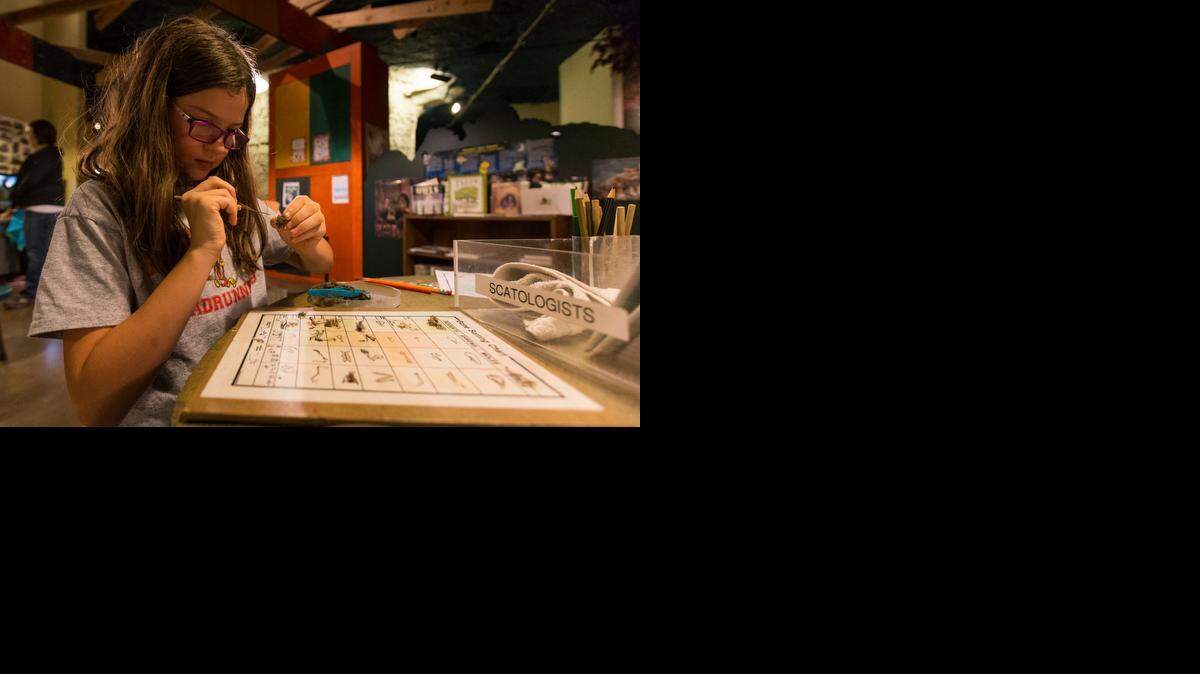
An owl pellet in the hands of 10-year-old budding biologist Emma Slate is a treasure, and she looks at it with as much wonder as an adult holding a precious gemstone.
“We were dissecting the pellets, and I found ribs from small animals and feathers,” says the girl, peering up from her find with wide eyes. She prods the pellet one last time, digging around, before sighing. “I love doing experiments, and it’s great to do them with my team.”
Teamwork is an essential tool at EarthWorks.
“We teach team building and cooperative learning,” said Swartz-Shelton. “At the end of the program, we bring a natural disaster to each area, and they have to spend the rest of the time together trying to figure out how to save that environment.”
She ticks off each habitat’s simulated natural disaster: forest and prairie have fire, the cave floods, the soil experiences a dust bowl, and the pond suffers an algae bloom.
A week later, the EarthWorks team is prepared for students from the Barstow School and the Pembroke Hill School. EarthWorks is geared to third- and fourth-graders, but it can be tailored for those from prekindergarten through fifth grade, who might visit during special programs, day trips and after-school programming.
Third-graders from both Barstow and Pembroke are studying the snapping turtle and snakes.
Kendall Lacy, mother of 8-year-old Barstow student Taylor, says her son has spent weeks learning about an environment and an animal.
The Fairway mom is a volunteer, and she says she’s learned as much as her son from EarthWorks.
“It’s been a neat experience watching them learn a habitat,” she says. “They become the teacher when they know the subject.”
Maddox Jaco, an 8-year-old Barstow student, says his favorite environment is the pond.
“I love the plants and the trees,” says Maddox, who lives in Waldo. “When I grow up, I want to be a football player. Or maybe a microbiologist.”
His animal was the badger, and he’ll fill anyone’s ear with facts about the animal — from its size to its diet.
Parent Tracy Sampat pauses near a giant sculpture of Earth at the center of the space and echoes the sentiments of many — children and adults.
“I had no idea this existed,” says the Overland Park mom.
Her friend and neighbor, Soni Patel, adds, “I’m just thrilled there’s a place like this where they can learn about habitats in their own backyard.”
The giant Earth that the children gather around at the end of the program revolves and clearly enchants the kids. It was created from all recycled material by artist Holly Hughes, and its image graces much of the marketing and fundraising information sent out. It appears, like Noah’s Ark, that nearly every animal is represented in some form.
“It’s what we’re all about — protecting the planet,” said Swartz-Shelton.
“Sometimes, when I’m having a rough day, I take a moment to sit next to it. There’s always something on it I’ve not noticed before, and it’s a great reminder of what’s really important.”