
To serve and learn: Ride along with Overland Park’s Citizens Police Academy
As the lights went down I felt the cold gun in my hand and the eyes of my classmates on my back.
First came the target practice so that I could get a feel for the weapon. The only light came from a huge classroom screen in front of me. A row of plates appeared on the screen as an instructor showed me how to grip and aim. One by one I hit the targets with growing confidence.
Then the screen changed to reveal the location of the encounter: a school classroom. My worst fear.
The booming voice stated that we were on an active shooter call. My awareness was on high alert as my “partner” and I stepped silently down the hall with the rest of our team on the screen. We heard pops of gunfire in the distance. We cautiously crept past lockers and classroom doors, barely breathing. The bursts became louder.
Up ahead I spotted the tip of an assault rifle coming out from a perpendicular hallway. The shooter was firing his weapon straight ahead and I shouted “active shooter!” The gunman was firing toward a target down his hall and I had the perfect shot at him. If he turned on me I would be dead. I fired my weapon.
My first shot hit his legs, next shot missed and then I shot him in the chest. I almost felt a surge of pride as the shooter started to fall. I took out the bad guy! And as he slowly collapsed toward the ground, I began to see the letters on the back of his jacket. POLICE. The screen went black. Silence. I was crushed and drained.
I had been determined to treat this experience as real as possible and I was horrified. The lights came up. My fellow classmates blinked at me.
I had shot a police officer.
The fact that it was a virtual officer didn’t offer me much solace. I really didn’t anticipate how intense the training would be when I entered the police academy. The Citizens Police Academy.
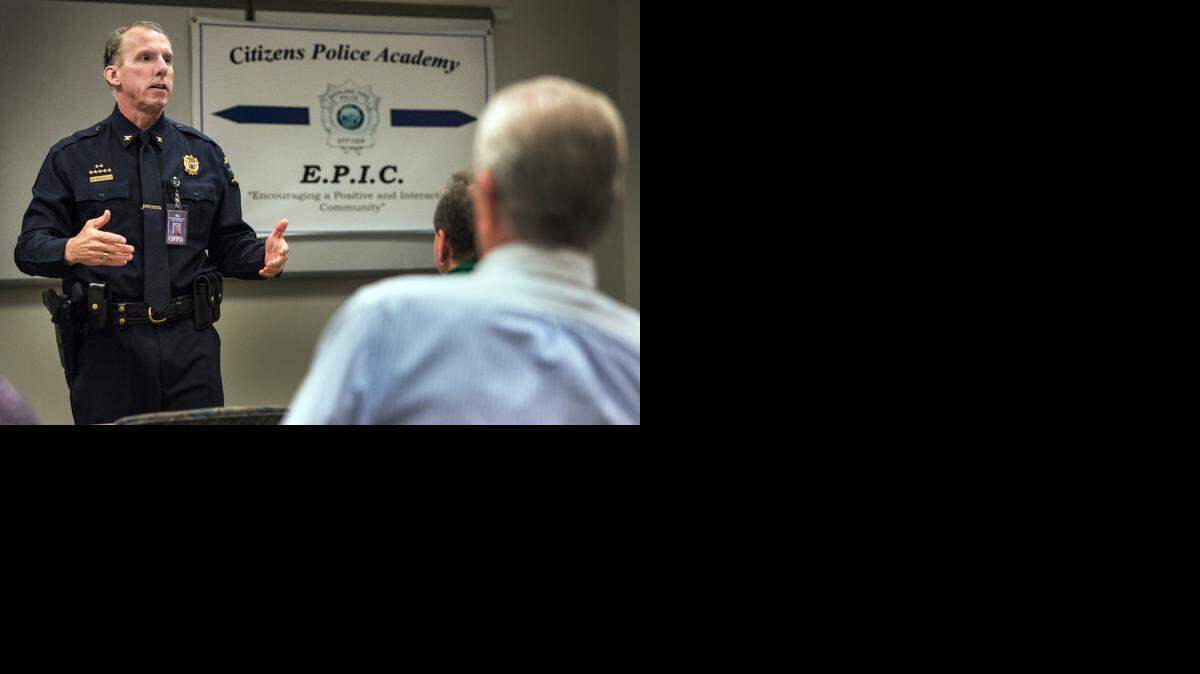
The Overland Park Police Department offers a Citizens Police Academy as a way to educate residents about their profession so that they can return to their neighborhoods better informed. This helps foster a closer relationship between police and community. With 250 officers, Overland Park has the second-largest police department in the state.
The concept of a Citizens Police Academy is not a new one. The Devon and Cornwall Constabulary began offering a night school for citizens in Exeter, England, in 1977. In 1985, the Orlando Police Department in Florida became the first to offer a Citizen Police Academy in the United States.
In the summer of 2009, the Overland Park Police Department re-instituted its Citizens Police Academy and offers it once a year. You are not required to be an Overland Park resident and there is no fee charged to attend the academy.
“A former officer and I saw the opportunity to shed a more favorable light on policing in Overland Park,” Officer Rich Guieb said. “As such, we developed the title of ‘E.P.I.C.’ The acronym stands for Encouraging a Positive and Interactive Community. I believe in EPIC because the philosophy of sharing creates a level of understanding which reinforces the public’s trust.”
Many law enforcement agencies in the area offer a citizens police academy, including Olathe, Leawood, Lenexa, Kansas City, as well as the Johnson County sheriff’s office and the FBI in Kansas City. Courses range from 8 to 12 weeks and some require the applicants to live in the city providing the course.
“We want you to learn what we do and why we do it,” said Overland Park Police Chief Frank Donchez Jr.
Our class of 27 citizens, the largest ever, met every Tuesday for 31/2 hours from the middle of September to mid-November.
On our first day we were each given our blue Overland Park Police Department folders holding a code of conduct, our name placard and an organized schedule for the entire eight weeks. Looking around the classroom I saw a good mix of young and old, both men and women. Some were from Overland Park, some from the surrounding area.
One gentleman identified himself as the neighborhood watcher. He was retired and enjoyed being the eyes and ears of his subdivision. He told the story of phoning neighbors in the middle of the night to let them know their garage door was open. They knew who was calling before he even identified himself. A late afternoon nap allows him to watch over the neighborhood when everyone else is fast asleep.
Another man, Ed Varhola, had recently moved here from Pittsburgh, Pa., and wanted to understand what police in a city like Overland Park did with their time. That lightened things up.
Regina Browning lives near one of the Police Department facilities and has always wondered what they did in that building she jogs by in south Overland Park.
Coming into the program I had some basic questions: What are the requirements for and attitude of the department that wields so much power? What could I learn about the department so that I could feel safer and more secure? And finally, what are the current threats and are we adequately prepared?
I wanted to learn more because of situations in places like Ferguson, Mo., where police and citizen tension is high and mutual trust and respect is low.
After introductions in that first class, we got right down to business: the requirements to become a police officer.
The city receives 700 to 1,000 applications every year and getting a ticket to the Overland Park Police Academy requires completing a process that mere mortals would find extremely difficult.
Think you might be too old to attend the academy? According to police academy instructor Officer Elizabeth Selman, there is no age limit. The oldest person to go through the academy was 54 years old.
Police Capt. Mark Fitzgerald of personnel went over the requirements and process.
The evaluation begins with an ability test that includes running, climbing a short fence, traversing up and down a set of stairs and a dummy drag (15 feet) that must be completed in 72 seconds. If passed, the next step is a three-hour computer test. Expect an FBI standard background check and a full drug disclosure. By this point at least a quarter of the initial applicants have dropped off.
If you make it, you complete a full personal history to be used for questioning during a four-hour polygraph test. The candidate pool at this point is now down 50 percent.
Applicants are assigned a number and reviewers do not know the name, age, race or gender of the candidates so that an unbiased assessment can be made. Three independent reviewers will look at all of your scores and personal history (including your polygraph test) and make a recommendation on whether you should proceed. If at least two of the three recommend that you continue, your information will be sent to a background investigator who will interview your neighbors, family, spouse, ex-spouse, former employers, or others to confirm the information that you have provided. Those same three reviewers will again make a recommendation.
Next up is a final panel interview, which usually includes two police majors, deputy chief, human resources and a civil servant. If you make it through the panel interview, you must pass the psychological and physical exams.
Candidates are then ranked according to how well they performed. Conditional offers of employment are made to the top applicants and they receive an invitation to the Police Academy.
In 2013, only 22 offers were made.
Did you make it? Congratulations! You now will be earning the starting police officer salary of $3,306 per month. You’ll probably work nights and holidays for 10 years and it will take you a minimum of 13 years to achieve top pay. After seeing everything we task our officers with, I’m not sure it’s enough.
During the eight weeks of the citizens academy, upward of 25 officers came to speak with us and present information. Several of my classmates commented on the positive enthusiasm each officer had for the job.
“One thing I’ve noticed about every single officer we’ve seen is the passion. Even after years of service you can just see it,” Varhola noted.
It was evident in the way they carried themselves, the details they offered about their work and the stories they shared with us about their experiences in the line of duty.
When Donchez, who just recently became chief, was asked why he wanted to come to Overland Park from Davenport, Iowa, he said one of the reasons was “the enthusiasm of the department. You see it and feel it.”
The requirements of the position and the open and transparent attitude of the officers gave me a level of confidence in the Overland Park police force that had exceeded my expectations.
My question about feeling safer and more secure was covered by many of the presenters. During the Communication and Dispatch unit there was a rare privilege to tour the Dispatch and Command Center — civilians and media are not typically allowed in the area. With 10,000 square feet of space, 11 big-screen displays around the perimeter of the large room and multiple smaller displays in pods within, this room becomes an emergency crisis operations center when activated.
Each of those big screens can display up to 16 images at a time. There are 500 to 600 cameras around city and in businesses that can be dialed up and viewed as needed. In the event of a large-scale emergency, this facility would become operational in minutes. It was comforting to see the resources in the facility and learn the organization behind it.
As Officer Tim Lynch, captain of the communications section, discussed the different functions of dispatch, in the next room, the large screens behind him displayed taped images of various intersection accidents. Seeing the images of a real car crash with the location 135ST AND ANTIOCH printed below brought a different perspective of my neighborhood. Other displays showed real time images of intersections. It felt a bit creepy watching, knowing that earlier in the day I would have been on that camera.
“Do they use the cameras to watch for red light violations?” asked classmate Jeffrey Shaw. No. Could they? Dispatch can pull up any camera at any time. They also can communicate with patrol officers. So, while it’s possible, it’s not probable or practical.
But this department tracks everything. Every stop an officer makes is recorded. If an officer even pulls out a gun —doesn’t use it, just pulls it out — it’s tracked and recorded. In fact any “response to resistance” (today’s terminology for “use of force”) is tracked and recorded; if an officer has over 15 “incidents” in a year it triggers a review.
The amount of information presented in each class was staggering. It was clear that transparency and open communication was the goal. While it’s nice to know that our law enforcement officers have tools and technology to do their jobs, it was also comforting to know that checks and balances were in place to safeguard that power and strength.
My final question was whether we are prepared for threats. Turns out those threats range from stray dogs to weapons of mass destruction. One look at the list of courses that we covered and I can see we are prepared for threats big and small: animal control, police tactical unit, investigations, patrol operations, communications/dispatch, crime scene investigation, legal issues, community policing, school resource officer, crime prevention, crime analysis, K-9, building check practical exercises, intro to firearms, domestic violence, court testimony, special unit training, police use of force and police volunteer program.
We started the intro to firearms class with an overview of all of the tools on the belt worn by police officers: a Taser, pepper spray, the nightstick and the .40-caliber Glock. We went on to the other weapons that the officers use: the semi-automatic shotgun and the AR-15 (an assault rifle).
Officer T.R. Allen discussed that guns are used when “my life or someone else’s life” is in danger and depending on the threat: They are a response to resistance.
Once we had the weaponry covered we went down to the Simulation Room. This was a very visual way to get a feel for the wide array of threats that officers need to respond to. You’ve already heard about the “active shooter” threat where my fellow officer met his demise at my hands. But there are so many different threats covered in the Sim Room that this unit alone can give you a grand overview of the long list of scenarios the department is prepared for.
I watched my classmates face incredibly difficult simulations where they played the virtual officer. Tensions were high and reaction times were low. The visibly distraught man with the bomb strapped to his stomach: Do you shoot him or wait to see what happens? The war vet with PTSD wielding a machete: Shoot? Some sim situations were not confrontational — a routine traffic stop or issuing a ticket. But as you pulled up to the scene, you had to be prepared for anything.
In addition to my active shooter scenario, my “partner” and I were also called to the scene of a disabled vehicle. As we pulled up we could see two men and a woman behind a pick-up truck beside the road. The men began arguing and I shouted for them to step away from their truck and off the road. My tightly gripped gun was still pointed safely at the floor as they continued arguing. In less than a second, one of the men grabbed a pipe from the truck bed and whacked the other man in the stomach. “Drop the weapon!” I waited — no response. One final snap of the pipe toward the woman’s face and the screen went black. Neither of us had pulled the trigger.
Officer Guieb summed it up: “Unfortunately, police officers routinely work with members of society who are not at their ‘best.’ We are tasked with being counselors, referees, social workers, problem solvers and investigators, which all needs to be done in a matter of moments.”
If the classroom coursework and the simulation room examples weren’t enough to prove the wide array of threats the department is prepared for, we were given a “tour” of the equipment used for the SWAT team, bomb squad suits and robots, the dive team truck and all of that gear, the mobile command center and the bullet-proof “bear” assault vehicle.
Overland Park has a weapons of mass destruction team, a K-9 unit and a team of four snipers. Those snipers are sometimes used to provide protection when the president or other high level officials are visiting. Recently, one of the officers noted, they provided security during the funerals of the Jewish Community Center shooting victims.
Technology also plays a huge role in the police department today. Squad cars used to come equipped with just a police radio. According to Curtis Fisher, an academy attendee and also a fleet services technician for the department, “there’s so much technology in each vehicle that a squad car out for repair is just as likely to be out for a technology fix as for engine work.” There’s also a cyber-crimes unit doing research and leg work online to aid and assist the officers on the street.
Programs like the Citizens Police Academy give the police force another tool: its citizens. Training them at the Citizens Police Academy just adds to the force, and for a minimal cost to the department. Most of the officers who speak at the academy do so during their regular shifts.
Crime prevention requires deterring, detecting, delaying and responding. Observant and aware Overland Park citizens aid officers in an unofficial capacity. As then-acting police chief Mark Kessler said on opening night, if you “see something, say something.”
One academy graduate has been active with the City Council. Prior to attending the academy, he was just a voice at the meetings. Now he has been a voice of “reason” when discussions of equipment and personnel come up. Another graduate is a volunteer for the department. His background and education are in banking and finance, so his expertise is helpful when white collar crimes are committed in the city.
As I reflect on the academy and all of the things that I learned, there is one highlight that still brings a smile to my face. After that devastating scene in the simulation room — you know, where I shot that police officer? A 25-year veteran of the force came over to me as everyone was packing up and leaving for the night.
He whispered in my ear, “Don’t feel bad. The first time I did that simulation I shot the officer, too.”
This story was originally published November 18, 2014 at 6:00 AM with the headline "To serve and learn: Ride along with Overland Park’s Citizens Police Academy."