
Kansas State School for the Blind: Unleashing the power of independence
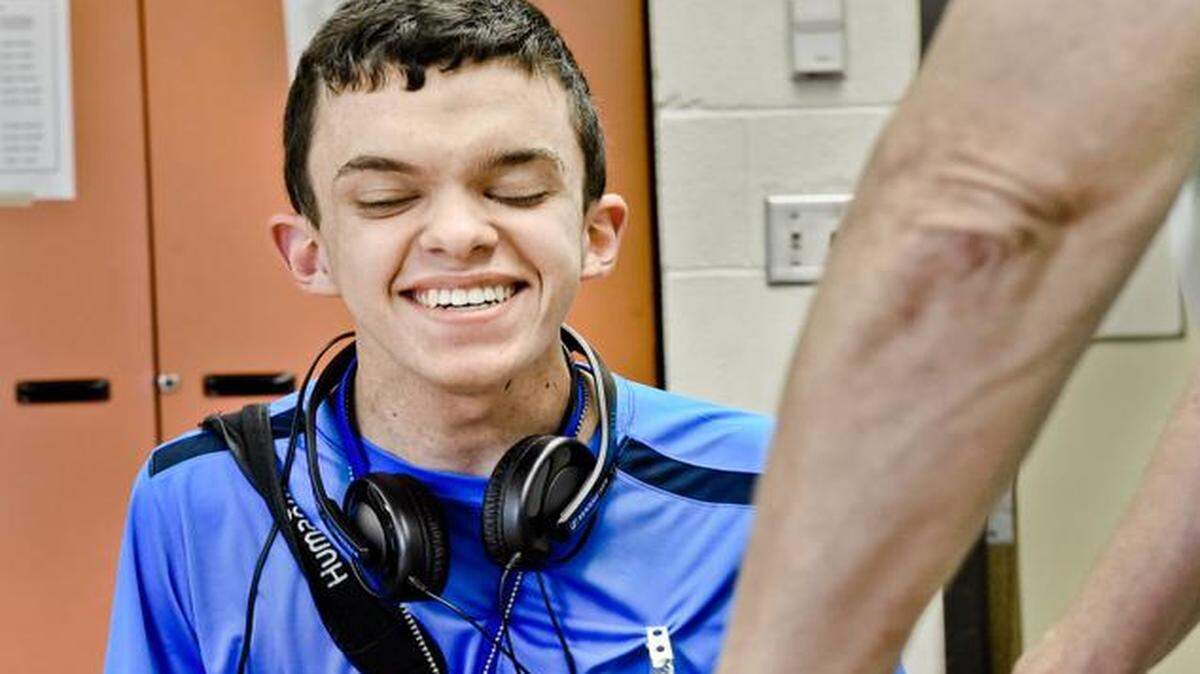
When it comes to shadowing Fabien Siffrin, it’s easiest just to follow his lead.
You quickly learn to trust the 17-year-old’s sense of direction, despite the fact that he’s blind.
Siffrin is one of 38 full-time students at Kansas State School for the Blind, where the mascot is a soaring eagle and the philosophy is firmly grounded in empowering each individual to achieve their dreams.
As far as Siffrin — a resident in the school’s dormitory where there are separate wings for male and female students — is concerned, there aren’t enough hours in the day to chase those dreams. He moves fast, talks fast and thinks fast.
As class is dismissed one sultry late summer afternoon, Siffrin wasted no time, bounding from his chair toward a cluster of long, white canes situated in a corner by the doorway.
The lanky 17-year-old’s hands patiently rifled through a tangle of beads and charms dangling from colorful ribbons on a half-dozen canes, searching for the crystals and cross signifying his walking instrument.
“Here it is.” Siffrin, satisfied he identified the correct cane, grabbed it and briskly navigated the school’s corridors, destined for the library.
“Canes all look alike,” he laughed.
“This one,” Siffrin said of the stick extended in front of his tall, slender frame, “is my car, and it’s in turbo mode.”
Established in 1867, Kansas State School for the Blind is perched on a hilly, leafy 10-acre campus at 1100 State Ave. in Kansas City, Kan. Like any other learning institution, the school focuses on preparing students for a viable career — except that its student body is blind and visually impaired, and, aside from a small on-campus population, is scattered throughout the state.
Approximately 120 students participate in the school’s on-campus programs such as Boys and Girls Weekend, Braille Challenge and Orientation and Mobility Camps annually, with another 1,000 students receiving services through myriad outreach programs.
The school, which serves ages 3 to 21, has four curricular areas, including preschool, elementary, secondary and life skills. Classes are small with high levels of personalized attention given to each student by faculty members and 13 instructors. Seven more teachers work with school districts, other teachers and blind and visually impaired students across the state in outreach programs.
The school also works with babies from birth to age 3 through Infant Toddler Networks locally and beyond the area — work done in the child’s home using a primary coaching model with the baby and parents.
Kansas State School for the Blind also hosts Head Start classes for the Kansas City, Kan., School District: Two half-day classes and one full-day class with 35 students who are not visually impaired.
A day spent at Kansas State School for the Blind with students who study in the classroom, learn life skills by baking cookies or performing chores, practice for the Braille Challenge or participate in competitive athletics yields more similarities than differences between blind and visually impaired youngsters and those with sight.
They’re all kids, trying to learn and find their place in life, and prepare for a future.
Whizzing past classmates and teachers in the hallways of Kansas State School for the Blind, Siffrin expertly rounded corners with confident strides, the roller ball tip on the end of the cane gliding silently along the polished floors.
Reaching the library, Siffrin bent to retrieve a wooden block from the floor and, propping the door open, motioned to enter the brightly lit room.
Settling into a chair, Siffrin eagerly shared what inspires him.
“Music,” he said. “I’ve played the piano since I was 6 and I’m going to learn the violin. Last year I accompanied the Resurrection West youth choir, which was so cool.”
Siffrin paused for effect.
“It would be a bit arduous for me to play during a church service, mainly because I couldn’t see the cues.”
Siffrin ticked off a list of hobbies and interests.
He listens to audio books, favoring mysteries. He just learned how to make a cheeseburger skillet dinner. He has a monster sweet tooth and could live on chocolate, revealing that his dorm refrigerator contains a stash from his recent trip to Germany.
Siffrin loves art and describes in detail a piece he created while attending the West Virginia Schools for the Deaf and Blind.
“It was a self portrait using papier-mache, balloons and sand and won first place in an art competition,” said Siffrin, who moved to Johnson County with his parents two years ago when his father, an engineer, accepted a new job.
“I called it textural art.”
According to Siffrin, the biggest myth about blind and visually impaired people is that their inability to drive a car prohibits them from achieving other things.
“It’s true, I can’t drive — yet.” Siffrin tapped an index finger on the table to emphasize the point. “I think in my lifetime, though, technology will advance to self-driving cars. But just because I don’t drive doesn’t mean I don’t do.”
Leaning forward, Siffrin lowered his voice, a mischievous smile lighting up his expressive face.
“And, I just want you to know, I’m not offended by any question.”
Clearly nonchalant about his blindness, Siffrin told he story of losing his eyesight at 18 months old as a result of neurofibromatosis, a genetic disorder that causes tumors to grow on nerve tissue.
“The doctor removed a brain tumor,” he said, his big brown eyes moving involuntarily from side to side. “There are kids my age who can’t see and definitely aren’t happy about it. But there’s nothing I can do about my sight — and there’s nothing I can’t do because I’m blind.”
As if on cue, Madeleine Burkindine, superintendent of Kansas State School for the Blind and its Olathe sister school, Kansas State School for the Deaf, entered the library to remind Siffrin he had 10 minutes to report to track practice.
“I run the 60-meter dash,” said Siffrin. “And I need to run now so I’m not late.”
Siffrin scooted into the bustling hallway, his cane revved up and ready to go.
“Oh,” he said, turning his head, “see you later.”
Life skills teacher and athletic coach Tim Schierbeck, who has taught at the school for 18 years, and assistant coach Nicole Drake, both of Overland Park, positioned themselves at opposite ends of the Eagles’ six-lane track.
They clapped and encouraged student athletes maneuvering the asphalt surface to the finish line.
“Keep going, Fabien!”
Siffrin ran a red-gloved hand along a wire stretching the length of the track. A slight breeze rustled through the trees, moving the late afternoon’s thick, humid air.
Siffrin’s brow was dotted with sweat droplets, his face etched in deep concentration as his hand followed the wire.
Burkindine stood near Drake, watching Siffrin run toward them.
“We have competitive sports teams here, just like any other school,” she said. “Track, wrestling and goalball, a game specifically designed for blind and visually impaired individuals.”
Drake reached out and gave Siffrin a congratulatory pat on the back as he picked up his water bottle from the ground, taking a long sip.
“Nice work,” said Drake, a former Leawood Middle School coach now in her first full year at Kansas State School for the Blind.
Siffrin’s classmate and roommate, Frank Miller of Overland Park, who also attends Shawnee Mission South and is visually impaired, gave a high five.
“Time to get ready for dinner,” said Siffrin, picking up his cane and walking with Burkindine up the hill. “I hear we’re having hot dogs tonight.”
Burkindine started as a teacher at the school in 1973.
“This school is part of me,” she said. “I have taught, been the principal, was named the superintendent in 2007 and four years ago, when the administrative function of the school combined with Kansas School for the Deaf for efficiency purposes, I became superintendent of both.”
Governed and accredited by the Kansas State Board of Education, the school is a secondary service provider that assists school districts across Kansas in providing education through varied outreach programs and services.
“Blind and visually impaired students are referred to us for evaluation and consideration of placement,” said Burkindine. “Our ultimate goal through strategic partnerships with other schools, and in working with students who have more intensive needs than their districts can provide, is simple. We want to ensure kids are able to assume responsible roles in society and lead fulfilling lives.”
Students such as Siffrin may attend Kansas State School for the Blind for various reasons, such as learning braille and other communication modes, orientation and mobility, adaptive technology, daily living skills, vocational and transitional skills, social skills and more. Other students throughout Kansas receive braille and large-print educational materials from the school.
“Learning braille for literacy’s sake is essential,” said Burkindine.
Burkindine has experienced many peaks and valleys in her 41 years at the school, including fiscal challenges.
“We are funded by the state and receive minimal federal grant money,” she said. “Our KC Blind All-Stars Foundation, a 501(c)(3), accepts contributions from corporations, individuals, sponsorships and so forth.”
But perhaps the most daunting problem Burkindine and her staff face is building community awareness about the school.
“Many people don’t know we exist or don’t understand what we do and the services we provide,” she said.
In 2009, Gov. Kathleen Sebelius signed an executive order when the economy plummeted — a tense period when Burkindine and her colleagues had to prove the school’s worth.
Sebelius created an 11-member Facilities Closure and Realignment Commission to scrutinize six state-run institutions, including Kansas State School for the Blind and Kansas State School for the Deaf, which operated independently.
The commission’s goal was to determine cost savings by suspending, merging or streamlining programs.
“We were put under a microscope and thankfully, the decision was made to realign us with the deaf school and not close us,” said Burkindine. “Today I am proud to say that we serve 1,000 blind and visually impaired students across the state in some way, whether it’s through summer school, short courses, parent weekends or evaluations and transition programs, and we are constantly evolving to meet the demands of school districts and students.”
Despite a narrow escape from the chopping block, Kansas State School for the Blind still faces challenges, including an infrastructure that needs restoration here and there.
“Our swimming pool is out of commission right now, needing some expensive repairs,” said Burkindine. “Also, the school’s running track is on a hill, and part of the edge is crumbling, so we roped off the sixth lane. It costs a lot to reinforce, so we don’t use that outside lane.”
Burkindine cited two school assets essential to its success: a robust curriculum and a dedicated faculty that comprise the resource center, outreach services, instructional services, extended day program and dietary and health services.
“We are a hub of vision expertise that connects other vision professionals, listens to schools’ needs and identifies solutions, resources and services to stem gaps and shortages,” she noted. “In addition, the school participates in work-study programs in the community.”
Last May five transition students graduated from Kansas State School for the Blind, underscoring the school’s emphasis on developing independence and skills to use throughout life.
The school’s transition program is comprehensive and individualized and provides students the skills and experiences to make an effective transition from high school to adulthood and working world. Students may participate in graduation ceremonies in their local school and then come to Kansas State School for the Blind for targeted training.
Interested students attend a three-day assessment and orientation the spring semester prior to enrollment.
“Along the way these students learned adult responsibilities and practiced self-advocacy,” said Burkindine.
Burkindine’s office is filled with neatly arranged piles and countless mementos spanning four decades and one year of service at Kansas State School for the Blind.
“I never imagined I would spend my entire career in one place,” said Burkindine. “But the people I work with are extremely loyal and committed to these kids are amazing. It takes all the staff collaborating to educate and prepare these students for a career in the 21st century.”
The superintendent checked her watch.
“Let’s go see Helen.”
Helen Hahn sat at the head of the table in her classroom. Visually impaired, she has been a fixture at Kansas State School for the Blind for 19 years, teaching and mentoring students and coaching the school’s Braille Challenge.
Hahn has had several cornea transplants during her lifetime — including a Boston Kerathoprosthesis, or KPro — but has very limited vision.
“My sister gave me money for the KPro, when it was experimental,” said Hahn. “I told her she didn’t make a very good investment, but that I do have more vision than before, and people learned some things from doing the procedure.”
Hahn had 30 minutes until a cab would pick her up for a nightly ride to her Brookside home.
“One of the most difficult things for a child, teen or adult with a vision problem is relying on others for transportation.”
Hahn’s husband of 25 years, Steve — also visually impaired and an instructor at the school — share a ride in the morning with another teacher.
“If we both had to go a distance and opposite ways each day, I don’t know if we could afford to work,” she said. “Transportation is very expensive, and something people just take for granted.”
Hahn’s passion for teaching blind and visually impaired students is on par with Burkindine’s.
“Students benefit from immersion in learning braille, technology and daily living skills and working at their own pace,” she said. “Those basic skills are imperative in life, and my hope is that every child who learns here is better because of the time all of us spend together.”
In addition to the students, Hahn enjoys working with parents and hearing their concerns, triumphs and sorrows.
“I’m lucky,” she said, “that I get to work in a dynamic environment.”
There are three things Hahn wants sighted people to understand about those who are blind and visually impaired.
“First, relax and don’t be afraid to approach them, ask questions,” she said. “Second, remember that first and foremost they are a person — they’re just like you, so find some common ground.”
Finally, Hahn stresses that in employment situations, it’s important to have high expectations and give a blind or visually impaired person a chance to meet them.
“One of the saddest things for a disabled person is to have their skills underestimated,” she said. “They may need adaptive equipment or other modifications to perform a job, but for the most part, they are capable.”
One of Hahn’s proudest accomplishments is the Kansas Sunflower Regional Braille Challenge, a reading and writing contest for braille students from Kansas and surrounding states.
“It highlights the importance of braille reading and writing, and offers positive motivation to help teachers and families counteract declining literacy rates,” she said.
The braille bug bit Hahn after two Kansas State School for the Blind students competed in the National Braille Challenge sponsored by the Braille Institute eight years ago.
Each year at least one or two students go to the national competition that attracts more than 1,000 students from the United States and Canada.
Through perseverance and fundraising, the school launched the Kansas Sunflower Regional three years ago. In 2014, 45 kids between grades one through 12 participated in the competition on the school campus.
Sixty students from regional championships around the country — 12 in each of five age groups — were invited to the national competition where they competed against one another for top honors.
Brooke Petro, 7, of Leawood, represented Kansas State School for the Blind in June.
Hahn beamed when she talked about Brooke traveling to Los Angeles for the National Braille Challenge and winning second place in the apprentice category and the Braille Superstar Award for excellence in reading comprehension.
“That was a breathtaking moment,” she said.
Steve Hahn poked his head in the door.
“Time to go,” he said. “Cab is here.”
The two walk hand-in-hand, down the hallway, to the waiting car.
Brooke Petro sat at a table in Helen Hahn’s classroom with three classmates poised for kickoff of the day’s Braille Challenge practice.
Now a second-grader at Nativity Parish School in Leawood, Brooke started attending three weeks of summer school at Kansas State School for the Blind after kindergarten. Because of her advanced braille reading skills, she was asked to participate in the Braille Challenge her kindergarten year, although she couldn’t technically compete until first grade.
Now the defending Braille Superstar Award winner, Brooke recalls how in May 2014 she discovered she made the cut for the National Braille Challenge.
“My mom and dad saw a list of contestants on the Internet,” she said. “I was really excited.”
This day, Brooke presented Hahn with a $166 check for the school.
“This is part of what I won,” she said, handing the check to Hahn. “We talked about it as a family, and I decided this is what I wanted to do, to give back.”
Brooke, a Katy Perry fan — “‘Firework’ is my favorite song” — and an avid reader — currently she’s tackling the Laura Ingalls Wilder series — knows a thing or two about sharing. She accumulates 10 service hours a year by helping her mom, Lyn, bag and deliver toys to the Seton Center in Kansas City, a social services organization in the city’s urban core.
She also helps bake for St. Mary’s Food Kitchen in Kansas City, Kan., and acts as a dessert table monitor during Leawood Nativity parish’s annual Lenten Friday fish fry.
Lyn is thrilled with the Kansas State School for the Blind and what it has added to her daughter’s life.
“Brooke has made wonderful friends here and she is always excited to see them,” said Lyn, who is married to well-known Kansas City sports radio personality Soren Petro. “Although Nativity is incredible, the staff there doesn’t have the special knowledge the faculty at the Kansas State School for the Blind has for Brooke’s needs.”
Lyn watched Brooke practice with her Braille Challenge buddies in Hahn’s classroom.
“This place is full of people with empathy and understanding for a visually impaired child,” she said. “And the Braille Challenge gives Brooke an academic goal to strive toward and she, along with the other competitors, work very hard.”
Lyn recited a Helen Keller quote that has significant meaning to her experience as a parent of a Kansas State School for the Blind student.
“There’s a saying I’ve heard throughout the years, ‘Love is the color that only the blind can see,’” she said. “The minute you walk in this school, you feel a spirit from every staff member and teacher. They are here to help these kids accomplish. The kids feel the positive energy and love.”
Lyn watched from the sidelines as Hahn praised Brooke for her work during the day’s practice session.
“It’s indescribable what the Kansas State School for the Blind does beyond teaching,” said Lyn. “Visually impaired kids learn that they can be OK in life. That’s powerful stuff.”
Fabien Siffrin sat on the floor of his dorm room at Kansas State School for the Blind, in front of a small refrigerator whose door was propped open. The teen lives in the school’s dormitory — which has 50 or so students living in the comfortable rooms throughout the year — where he a shares a room with two classmates Monday through Friday and spends weekends with his parents at their Olathe home.
Siffrin pulled out a stack of German-made chocolate, his hands running over the smooth, colorful waxed paper protecting each unwrapped candy bar.
“Chocolate before dinner—yes, I think so,” he said, offering guests a piece.
Ben Diaz, an instructional assistant who helps residents like Siffrin with daily living skills, knocked on the door. He was carrying an electric steamer.
“Ready to try this?”
Siffrin and roommate 15-year-old Frank Miller crowded into the dorm room’s bathroom as Diaz demonstrated how to use the appliance. He took Siffrin’s hand, directing it to the switch, and then let him get the feel of the machine.
Siffrin pushed the steamer across the floor and into the corners of the room, listening intently to Diaz’s instructions.
“Remember, you want to avoid walking over the wet floor that you’ve just cleaned, so go this direction first.”
Following the impromptu housecleaning lesson, Siffrin walked to the dorm’s community area and, sitting at the upright piano, played a tune he recently learned, “Open the Eyes of My Heart.”
Students floated in and out, some sitting quietly, others continuing down the hall to the dinner.
Jannette Desselle of Lone Jack, Mo., gave a tour of a private two-bedroom apartment located near dorm director Jeff Young’s office, inside the entrance to the dorm.
“Students living in the dorm can apply to live in the apartment for a month or two and must pass a safety test prior to moving in,” she said. “Living in this space gives them an opportunity to experience independent living, including cleaning, paying bills and cooking meals.”
Desselle, who has worked full time at the school since 2001 and recently earned a master’s degree, is training to become a rehabilitation teacher at Kansas State School for the Blind.
“Some students get lonely living in the apartment and don’t like this,” she said. “But others might live with a roommate and adapt well. It’s real life that we simulate, because students will probably have both experiences at some point in their lives.”
Sitting in an overstuffed leather chair in the communal room, watching Siffrin play and greeting students passing by on their way to dinner, Desselle smiled.
“It gives Fabien so much pleasure to perform,” she said. “Look around — this is why I’m here. Everyone comes here at different levels, and works to become as independent as they can. The staff supports one another. It’s a big family.”
Observers of Siffrin’s impromptu concert clapped.
“Thank you,” he grinned. “Now let’s go eat.”
Siffrin picked up his turbocharged cane and headed toward the cafeteria.
For more information on Kansas State School for the Blind, visit www.kssb.net.