
Planned restrictions don’t float with fans of Ozark rivers
Just to be clear, no park rangers have been burned out of their houses.
That happened in the years after the federal government took land in 1964 to establish the Ozark National Scenic Riverways down along the Current and Jacks Fork rivers. People didn’t like losing their farms.
A half century later, the National Park Service has poked that sore again with new rules about what people can and cannot do in this 80,000-acre park. Officials say a carte blanche over the past few years threatens the park’s natural beauty and wilderness.
Riders on horseback have blazed more than 100 miles of unauthorized trails, causing erosion and high levels of E. coli in the rivers, park officials say. ATVs splash through the water so riders can party on the gravel bars. Visitors carve out their own access points into the park — even one through a farmer’s hayfield.
And the last time the rules were updated, no one was putting a 200-horse motor on a johnboat.
Specifics of the new “general management plan” aren’t final. But whatever it says, some people aren’t going to like it because it comes at a boom time for anti-government fervor in the country — just more Washington telling citizens what to do.
The two rivers and park, which draw 1.5 million visitors each year, were meant for recreation, critics argue. And they accuse the park service and “Sierra Club types” of attacking their culture and ruining their fun and businesses.
Environmental groups, on the other hand, wish the proposal would go even further to crack down on some activities.
Park officials describe the conflict as “resource management versus recreation.”
There’s also some environmental correctness versus rural grit, and a sense of collective good versus rugged individualism.
In recent months, protesters packed public meetings. Park service employees hear mutterings in restaurants; their uniforms make them feel like they are viewed as an occupying army.
And President Barack Obama looms large.
At a debate in May in front of the Shannon County Courthouse in Eminence, Mo., Lt. Gov. Peter Kinder called for the federal government to turn the park over to Missouri. The Republican railed about British tyranny, quoted the Declaration of Independence and threw in Obamacare and Benghazi.
Thomas Cox, a member of the opposition group Voice of the Ozarks, also attacked the park service: “They want to take man out of the wilderness and we say, ‘No.’ They’ve gone from conservation to environmentalism. This is our river. The people are with me.”
Not everyone, said Josh Reeves, whose family lives on the Jacks Fork. He thinks a lot of locals would welcome more oversight of the park. The more radical voices, Reeves believes, are simply part of the anti-government rage of the times.
“I don’t see much difference between them and the supporters of Cliven Bundy,” said Reeves, referring to the Nevada rancher who faced off in April against federal agents over grazing fees.
The plan, more than 500 pages, limits more than prohibits. For example, it likely will call for the park to keep and maintain 40 miles of those 100 miles of outlaw horse trails, adding to the already established 23 miles. But instead of seeing a gain of 40, critics see a loss of 60.
The plan will likely address ATVs, boat motor size and access points. Several thousand acres could be designated as wilderness. The plan will ban cliff jumping and could reduce the number of canoes, rafts and tubes that vendors can put on the river.
“On a Saturday, most reasonable people would conclude we have a problem,” said park superintendent Bill Black.
But U.S. Rep. Jason Smith, a Salem Republican, said his constituents don’t want any more federal regulations, regardless of what “Washington bureaucrats and big-city environmentalists” think. Smith has filed a bill calling for Missouri to take over the park.
But the federal government is not in the practice of giving away national parks. Gov. Jay Nixon has indicated no interest in the park, which has an operating budget of $6 million a year and 120 employees and needs $34 million in repairs.
Then there’s Black. Talk about timing. Two years ago, at the twilight of a long career with the National Park Service, he had the luck to be sent to the Ozarks National Scenic Riverways — just in time to update the park’s general management plan, which must be done every 20 years.
And that meant becoming the face of the U.S. government to the folks around the hills of Van Buren and Eminence.
He’s 63 and walks with a limp. One night years ago when he was a young ranger in the Great Smoky Mountains National Park, he jumped over a 2-foot rock wall to avoid the headlights of car burglars. Turned out the drop on the other side was 32 feet straight down.
The broken back ended his ranger days and put him behind a desk.
“By no means is it a lovefest down here,” Black said one recent day in his office in Van Buren. “It’s still too close to when granddaddy lost the farm to the federal government.”
But he may have the perfect temperament for the job. Last year during the government shutdown, Kinder came from Jefferson City and pushed aside the barriers to the park, which had been ordered closed like other national parks.
“We let him do it,” Black said. “Then after he left, we put them back.”
Rival viewpoints
Right below the U.S. 60 bridge at Van Buren sits The Landing.
It’s a hotel, restaurant and bar and a place where you can rent about anything that will float in the river. It’s big business for Tom Bedell, who owns the place along with four other rental places on the lower river headed to Big Spring.
“I’ll put about 40,000 people on the river this summer,” Bedell said recently.
A clue to his take on the park service’s new plan could be the sign on his office door: “IF YOU VOTED FOR OBAMA, DO NOT ENTER.”
He doesn’t want any new restrictions, certainly nothing that would decrease float traffic on the river. He’s not alone. Of 4,500 public comments submitted to the park service, an overwhelming majority opposed new rules. The comment period is closed.
“There is a lot of animosity down here,” Bedell said. “People don’t like government right now. And it’s not just here. It’s happening all over the country.”
Then he smiled.
“My vendor permit is up this year, so that’s all I’m going to say,” he said.
He did add he would like to see the park taken over by the Missouri Department of Conservation. His brother, Don Bedell, is the chairman of the commission that oversees the department and appoints its director.
John Hickey, director of the Missouri chapter of the Sierra Club, talks about a national treasure that deserves the same care as Yellowstone and the Grand Canyon. Instead, he sees ATVs on gravel bars and horses putting enough E. coli in the Jacks Fork to have a section put on a list of polluted waterways.
“People can have their own opinions, but they can’t have their own facts,” he said. “They say the river’s fine. Well, you can’t see E. coli. Now you can do something or ignore what is happening down there. The Sierra Club has to do something.”
On the water
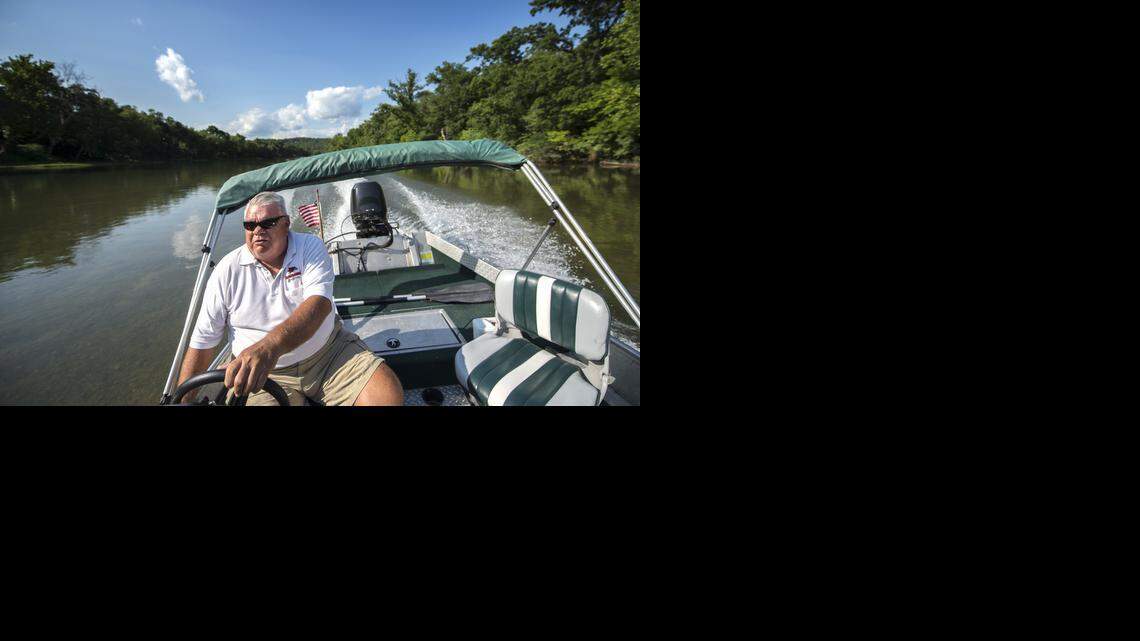
Cox cranked the 60-horse motor and the boat rose from the water, barely skimming across the top as it tore up the Current River.
He swerved around jagged driftwood that protruded from the water like German hedgehogs at Normandy.
“The parks service won’t remove that stuff — they don’t want to disturb it,” Cox yelled before adding with two scoops of scorn — “It’s natural.”
He’s 64, the retired energy manager at Southeast Missouri State University. He and his wife, Gail, often load up the boat, put lawn chairs in the shallow water and sit and read. He’s on the Carter County Republican Central Committee.
He and his wife worry the new rules could hurt poor people in the area.
“The ground’s not good for anything except raising snakes and goats,” Gail Cox said. “It’s the river.”
The environmental concerns are all bunk, Thomas Cox said. The rivers are strong, not a delicate biosphere.
“It’s alive, it fixes itself all the time,” he said. “But they bring in some Ph.D. type and he looks at a bunch of numbers and says, ‘Oh my, this has to stop.’ ”
He argues on Facebook with Sierra Club members. And what does he think about Black?
“Oh, we wave and say hello when we see each other.”
His wife nodded. “Yes, but it’s kind of like George W. (Bush) and William Jefferson” Clinton, she said with a chuckle.
Back on the Current, Cox’s 18-foot boat zipped past tubers, canoers, swimmers and fishermen. None seemed to object to the wake or noise. Many of them waved. Cox saw a man he knew sitting on the shore beneath a tree.
Mark Crawford had been fishing with his grandson and a three-legged dog named Ginger. He agrees with Cox about the National Park Service.
“If we can’t send them back to Washington, D.C., then they need to just leave things the way they are.”
Farther down river, Cox cut the throttle and the boat rested in calm water. The sun sat on the evening’s edge, and a great blue heron swooped low along the bank.
“I love this river,” he said. “I’ve been floating it since I was 8. Probably younger, but I can’t remember.”
Then he leaned close to make an ideological point about government overreach: “That was back when your parent could put you in a boat if you were under 8.”
Two more scoops.
Back in the woods
Park ranger Austin Konkel left the blacktop and pulled onto a road heading into the woods, or what he called a road anyway.
Looked to be made with a chain saw. A lunar rover may have turned back.
“I’ve been here 12 years and I’m still finding new roads,” Konkel said at the wheel of a government Ford Explorer.
He picked his way through gullies and over stumps down to the river where floaters had stopped to swim. Several riders on horseback appeared on the other bank. No horse trails are supposed to be in that area.
But Konkel let them be. Any crackdown would not start until the new plan is announced.
“Just a honeycomb of trails through here,” he said, heading deeper into the woods. “Some tramp down 8 inches. They’re not being maintained and when they get too deep, the riders just move over and start a new one.”
He has seen 50 horses and 30 ATVs at the same gathering. The park has had reports of horses running through picnic areas.
Konkel stopped at a bog at the edge of a meadow.
“See how the four-wheelers been going through that?” he asked. “They could go around, but they like the mud.”
Konkel and other rangers face public tension every day. But it’s nothing like in the 1970s, when arsonists set fire to one park building and the homes of two rangers.
One thing, though, hasn’t changed.
“No matter how long you’ve been here, if your daddy wasn’t born here, you can never be a local,” Konkel said.
Decision time
Fifty years ago, most folks here — though not those who’d lost their land through eminent domain — loved the National Park Service.
The area had long feared the Army Corps of Engineers would dam the Currrent River for hydroelectric power. Or that big money would come along, buy up all the land and turn it into a Lake of the Ozarks-like development.
But the honeymoon faded. Black knows he’s not going to make everyone happy with the new plan, but he figures if everyone is a little put out, maybe he did OK. He said he might rethink a proposal to ban motors on a section of the river because it would make life difficult for giggers and trappers.
He doesn’t want to make anyone mad. Mostly good, friendly people down here, he said.
Part of the problem is the mood of the country, he said. Last year’s government shutdown didn’t help. Then there was National Blueways System, a highly criticized plan that eventually failed. It began in 2012 to link rivers as “recreational trails.”
Black said he wanted to delay the unveiling of the new rules for the Ozarks park to get away from the Blueways controversy.
“But apparently we didn’t get away far enough.”
To reach Donald Bradley, call 816-234-4182 or send email to dbradley@kcstar.com.
This story was originally published July 26, 2014 at 6:44 PM with the headline "Planned restrictions don’t float with fans of Ozark rivers."