
At KC Police Athletic League, feeding kids is ‘most important thing we do’
The Star is partnering with Harvesters again on a virtual food drive to feed KC kids. To donate, go to http://feedingkckids.harvestersvfd.org.
An ambulance crew worked on the middle school student, trying to figure out why he had collapsed on the field during football practice.
They soon realized it wasn’t the heat. And it wasn’t his heart.
“We basically found out he hadn’t eaten in three days,” said Sgt. Brad Deichler, a supervisor of the Police Athletic League of Kansas City, which draws about 100 kids a day in east Kansas City. “And he wasn’t telling anyone because he didn’t want his friends to know.”
Officers who work with the department’s athletic league have known for years what some of their kids face. One-parent homes without heat or electricity, or both parents out of work. Kids forced to stay on a friend’s couch for days because mom couldn’t pay the rent.
One more struggle, for some, is not having enough food. Despite knowing that reality, that summer day on the field more than two years ago was a turning point for police league organizers.
They realized they needed to do more than just hand out the food donated occasionally by league supporters and the granola bars and other snacks they’d tuck in kids’ backpacks for later. They had to have something more every day.
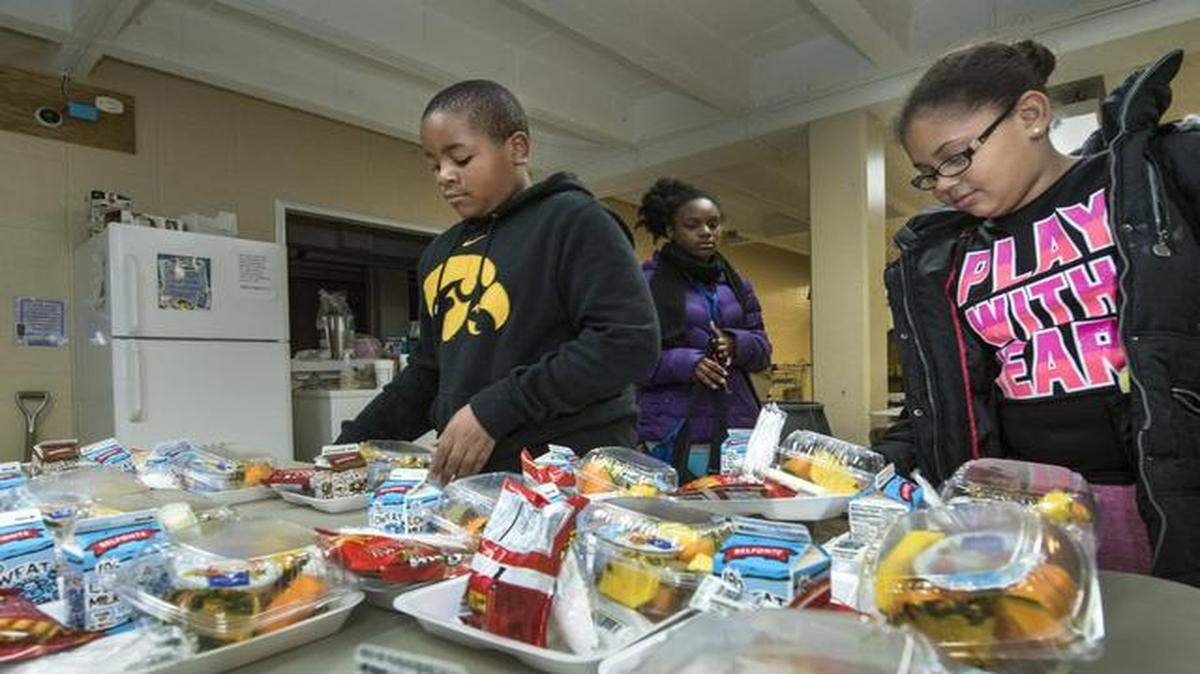
Kids in the league now get a meal after school five days a week. Fruit and yogurt, or a sandwich and chips. Maybe a cheese stick. Always milk.
“Sometimes this is their only dinner,” said Officer Antoney Perez, who worked with Harvesters to get the league’s facility included in the food bank’s Kids Cafe program, which provides small meals every afternoon during the school year.
“It feels pretty good to be able to provide them something to eat,” Perez said. “Kids have more energy, they’re more excited to come. We have more kids.”
They will show up at games to help with concessions so they can eat.
“Sometimes I’ll have 20 kids show up to help,” Deichler said. “They’re eating chili dogs at 8 in the morning — they’re starving.”
Other youth-centered programs, including those sponsored by churches and provided at low-income housing complexes, have seen their needs expand as well. Many have reached out to Harvesters in recent years to provide small meals in the early evening.
In 2010, Kids Cafe was serving 4,000 children a year. This year: 7,300.
“If you work with children long enough, you begin to see what their needs are,” said Valerie Nicholson-Watson, Harvesters’ president and CEO. “More programs are realizing that hungry children are showing up at their doors. And they realize when their programming includes food, more children will come.”
At the athletic league, some kids may come and just sit in the stands, with no desire to play basketball or box. When it’s time to eat, they head downstairs and then return to the stands.
Others will gobble down the small meal and head back to the court or ring, even stuffing extra food in their bag for later.
“I love the chips,” said Mark Johnson, 10, who worked his way through a bag of Sun Chips on a recent Thursday night. “And the milk, because it’s not overdue expired. … The food really helps me because when I go back, I play harder and keep the energy in me.”
$1 million goal
The numbers seemed staggering.
One study in the fall of 2010 showed one in four kids in Kansas City didn’t have enough food at home. Another put Missouri fifth in the nation for “food insecure” children. Kansas was 12th.
Those numbers sparked a desire to do something. And in that first year of the KC Challenge — a virtual food drive that is a partnership between The Star and Harvesters — readers donated more than $235,000 for the BackSnack program, which provides children with a pack of food to tide them over the weekend.
Now, in the fifth year, The Star hopes to push that total past $1 million.
“Families are just not able to make ends meet,” Nicholson-Watson said. “Food becomes one of those items in the equation when they have to decide on paying the mortgage or utility bill, the medical bills or medicine or buying food. It’s particularly hard on the children.”
The need is constant.
“But where the hope comes in is when we see the communities respond,” Nicholson-Watson said, “and (their) willingness to make a difference in the lives of these children.”
This year, Harvesters is delivering 19,500 BackSnacks each week to schools in the 26-county area. That’s a dramatic increase from 2004 to 2005, when just 65 kids received the food.
More than 400 schools send food packs home every week. Twelve schools are on a waiting list.
Pantries are seeing more families. Some elementary schools have waiting lists for BackSnacks each Friday. And advocates continually look for new ways to reach middle school and high school kids.
Too often, experts say, pride and embarrassment keep them from speaking up.
At PAL, though, organizers say they don’t see much of that. Although the kids may have different ethnicities or come from different cultures, they share a similar story of need.
“They’re all in the same boat, so there’s not a lot of posturing,” Deichler said. “None of them are saying, ‘You don’t got food, I do,’ because none of them do.
“And when they sit down to eat, there’s no division. One universal language is being hungry.”
‘We’ve got to fix this’
A few minutes before 5 one night last month, a basketball game was about to take shape inside the Police Athletic League gym. More kids congregated on the court, and a few middle school boys started hitting some of their practice shots.
Perez made his way across the gym floor, headed to the basement where rows of foam trays full of fruit, yogurt, cheese and sandwiches were set out.
“Hey,” the officer hollered to one of the boys, “you eat yet?” Then he lured another: “Come on now, let’s get something to eat.”
A guy who grew up just 12 blocks from the gym at 1801 White Ave., Perez knows what many of these kids are going through. He’s been there. Sports kept him on the path to become a police officer eight years ago. And today, kids seem to have even more worries than when he was young.
“You don’t know what’s going on until they open up,” Perez said. “And they have to know you.”
One kid was playing basketball recently when an officer looked down at his feet and asked about a bump that protruded from his shoe like a bubble. “My shoes are too small,” the boy said. Within a week, he was wearing a new pair of shoes the officer had bought.
Last year, when an officer went to the home of four PAL kids, it had no electricity or gas. Mom had a minimum-wage job, and dad worked landscaping in the summer but was out of work that fall. Four teenagers aren’t easy to feed.
The kids were trying to cook tater tots on an outside barbecue grill in November.
“That was dinner,” Deichler said. “They were literally fighting in any way they could to put anything on the table for the kids. They were proud. We had no clue. ... My officer came back and told me, ‘Man, we’ve got to fix this.’”
Christine Lentz, president of the PAL board, remembers the call she received about that family. And like she often does when officers stumble upon a need, she sent out emails for help.
“Within two hours, we got food,” Lentz said. “About $1,000 in food was delivered that day. Officers gave it out a little at a time to help this family.”
The board also adopted the family. They settled the gas bill, had the house — where electrical wires dangled from the ceiling — rewired. They got a new stove and new furnace.
By Christmas last year, the family was able to cook dinner in their home.
Officers and the board still help the young man who passed out on the football field. More than a week ago, his family received one of 16 meals PAL delivered for Thanksgiving. Officers keep up with him and make sure he’s doing well.
“I’m telling you for a fact, there are a lot of hungry kids in this town,” Deichler said. “Kids who on a regular basis are not being fed.”
That’s why, he said, “if nothing else goes right in the day, we make sure the food goes right because that’s the most important thing we do.”
To reach Laura Bauer, call 816-234-4944 or send email to lbauer@kcstar.com.
Feed KC kids
This holiday season, The Star is partnering with Harvesters on a virtual food drive to raise money for the area’s hungriest children.
Star readers have donated more than $800,000 to the drive over the past four years. The goal this year: Push the total to $1 million.
All money goes to Harvesters’ BackSnack program.
Details, A8
Virtual food drive
Reader donations to the KC Challenge go to Harvesters’ BackSnack program, which provides low-income children with two breakfasts, two other meals and snacks each Friday during the school year to tide them over until they go back to school Monday.
If you’d like to give, go to feedingkckids.harvestersvfd.org.
You can donate in a loved one’s name, with reader dedications published in The Star’s Christmas edition. The deadline for dedications is 5 p.m. Dec. 21.
Police Athletic League
For more information about the Police Athletic League, call 816-413-3621 or go to www.kcpal.org.
This story was originally published December 6, 2014 at 4:28 PM with the headline "At KC Police Athletic League, feeding kids is ‘most important thing we do’."