
In the wake of Ferguson, black teens and Kansas City police meet to discuss issues of trust
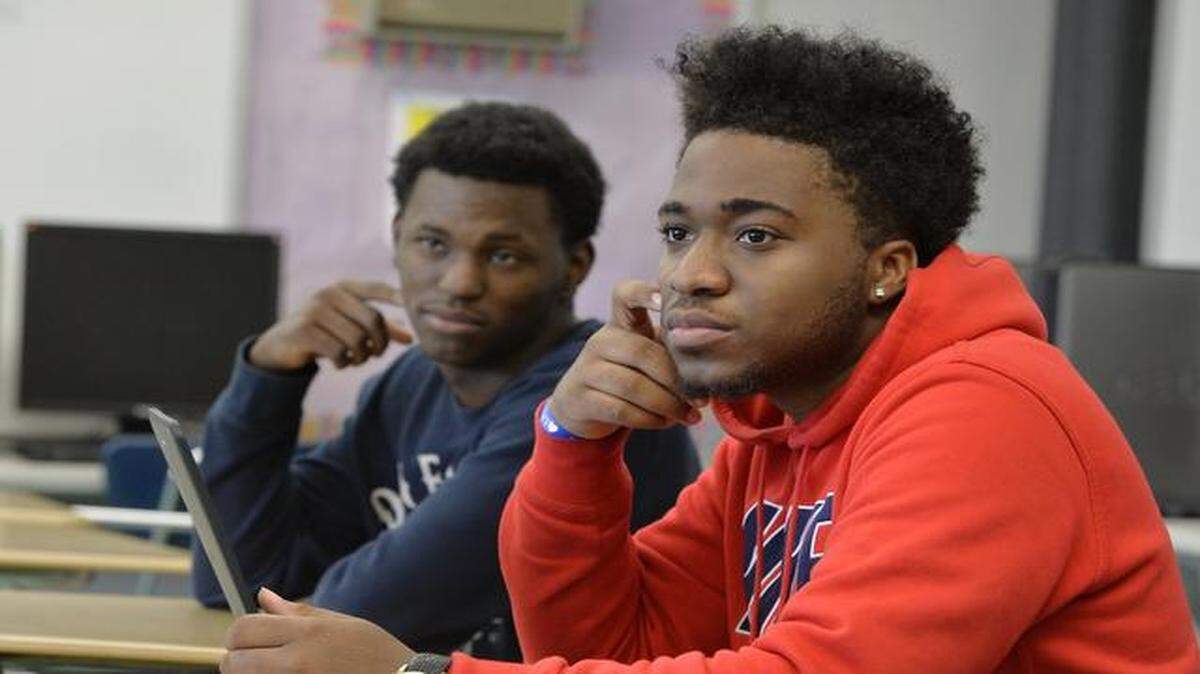
Here were three teenage students fresh from a school gathering with Kansas City police officers, talking about fear of law enforcement, swollen on the tension in Ferguson, Mo.
Their teacher at Center Alternative School chose them to reflect on the meeting because they were particularly articulate, future-minded teens.
He didn’t know that one of them — 17-year-old Tyrese Gully — would tell how he’d been pulled over while driving his mother’s Mercedes alone on eastbound Interstate 70, no reason given, and allowed to go on only after they called his mother to check his story.
Or that Corey Smith, 17, would tell of being stopped for no violation, just driving his sleeping sister home after dropping off his mother in his south Kansas City neighborhood following a long drive from Chicago at 3 a.m.
And even 15-year-old Donavion Gleese told of the trouble that came when he was looking for snacks in a Grandview convenience store and turned to the security officer shadowing him and said, “Why are you following me?”
Three teenagers, all three black, all three with nervous encounters with police.
“Thankfully,” said the teacher, James Bridgeford II, in each case the teens cooperated and presented themselves with the same coolness that the police officers recommended to all their schoolmates at the recent gathering at the school, 8434 Paseo.
“And nothing grave happened,” Bridgeford said.
The 29-year-old teacher knows about these kinds of incidents. It’s why he summoned the meeting to protect against anything happening to his students the way Michael Brown’s encounter with an officer in Ferguson, though the youth was unarmed, led to his shooting death.
Bridgeford knows because it turned out he had a story too, from when he was 16 in the Plaza, alone in his mother’s car. He was stopped and told over a police loudspeaker to drop the keys out the window, exit with his hands out, walk backward to the rear of the car and place his hands on the hood — with two officers’ guns trained on his back.
Kansas City Police Maj. Anthony Ell, 52, who is black, said after the meeting at the school that he understands the thinking that race can stoke police suspicion.
The stakes can run high, as seen with Ferguson, where demonstrations continue while the community nervously awaits a grand jury’s decision on whether the officer involved should face charges.
“Its a common belief … that young people will be stopped only because of race or the area they were in,” he said. “It’s not so much a belief, but also a fear.”
And officers must keep that forefront in their mind, he said. They must understand the reactions of the people they question.
He also told the students to imagine themselves as the police officer, trying to stay safe, not knowing who or what is waiting for them in the stopped car, knowing anything could happen.
“For the officer, it’s about safety,” Ell said. “It’s all about getting home.” To the students, he asked: “What would you do?”
Do what the officer says, Ell told the teens. Stay calm. Be courteous even if the officer is not. No quick movements. Never run.
Take note of the officer’s name. Do not argue at the scene. If you are wronged, file a complaint afterward with the Office of Community Complaints and follow it through.
The tension over the death in Ferguson and other police situations, much like the anger around the Rodney King arrest in Los Angeles a generation ago, courses through today’s youths with the extra fiery rush of social media, Ell said.
And there are racial profiling data, kept by the state attorneys general, that can fuel their frustration.
Statewide and in Kansas City and its suburbs, black residents are disproportionately stopped by police, records show. Once stopped, black people are more likely than whites to be subjected to a search.
But whites, when they are searched, are more likely to be found with contraband than blacks, the records also show.
But reality is complicated, said Ken Novak, the chair of the Department of Criminal Justice and Criminology at the University of Missouri-Kansas City.
The greater number of stops of black residents may be influenced by police being deployed in higher numbers in areas of increased crime, which occurs disproportionately in high minority areas, Novak said.
Stops in those areas are more often connected with an arrest, which calls automatically for a search. And those nondiscretionary searches are less likely to find contraband, he said.
Discriminatory practices may or may not be going on, and communities can’t rely only on crime data to find them, he said.
“If you only dust off the numbers after a tragedy, they’re going to support your preordained belief,” Novak said. “What we need is honest conversation on what we do know.”
That’s what Bridgeford wanted when he asked for the meeting, and the police were eager to oblige.
“This is about preparedness,” Bridgeford said.
He followed through with a complaint after his stop in the Plaza and received letters of apology from the officers involved.
Smith is troubled by his encounter with police. He said he never wears a hat while driving, trying to follow that and other ideas to fulfill his mother’s wish that he do nothing “to look suspicious.”
Gully expresses no hard feelings about being stopped on I-70 that day.
“I see where they’re coming from,” he said. “I’m open-minded.”
They’re protecting their future plans. Gully is planning to study architectural engineering at the Missouri University of Science and Technology. Smith, who will be graduating with a PC Pro certification in information technology, wants to be a music producer or computer technician. Gleese, still a freshman, is keeping his options wide open.
One of Ell’s missions when he and the other officers meet with young people is to help restore faith and confidence in police work. Distrust does not serve well the department’s desire to recruit more minority officers.
This time when Ell asked his audience, “Who’s thinking about a career as a police officer?” if any hands went up, they were halfway and drawn back while many of the youths craned their necks, some laughing, looking for any hands.
In the 1980s, when Ell was becoming a police officer, the usual reason anyone gave against joining law enforcement was the danger in the work, he said.
“But now it has more to do with the image of the police officer,” he said.
And he and the teacher and the students agree that the first thing they can do about that is to keep listening to each other.
To reach Joe Robertson, call 816-234-4789 or send email to jrobertson@kcstar.com.
This story was originally published November 8, 2014 at 6:04 PM with the headline "In the wake of Ferguson, black teens and Kansas City police meet to discuss issues of trust."