
Alternative charter high schools are disappearing in Missouri
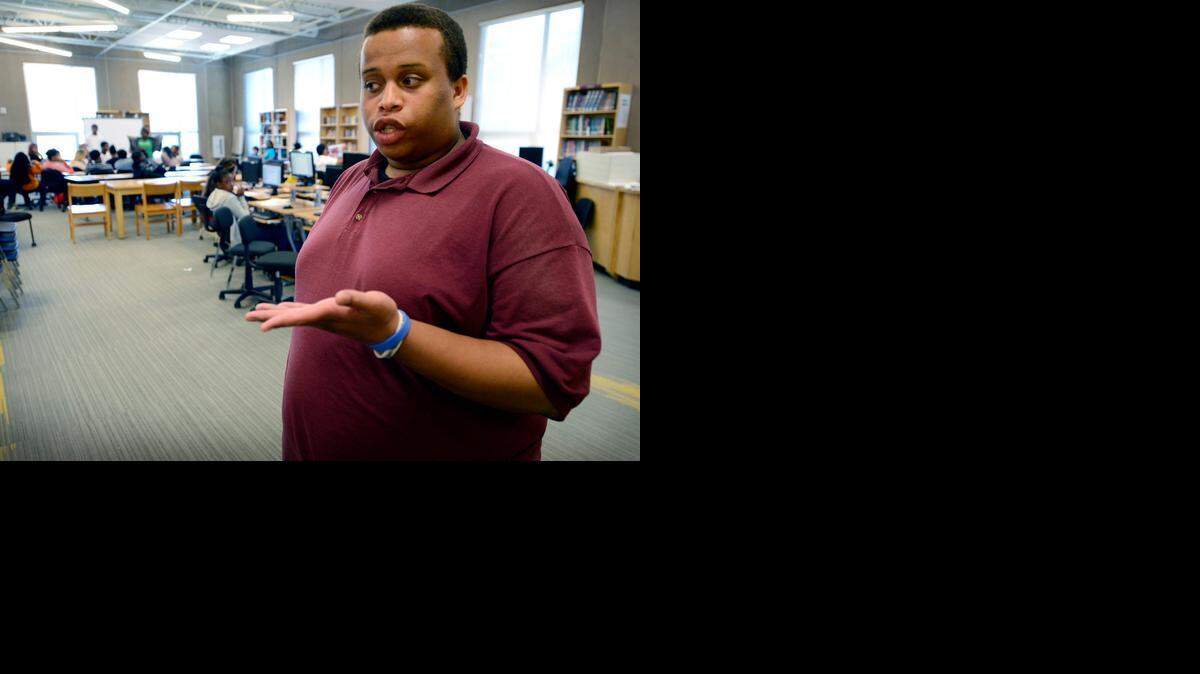
Teenager Derrick Williams has run all the way out on the shrinking ledge of Missouri’s independent, alternative high schools.
He knows as well as anyone that schools are disappearing.
He was told to leave Imagine Renaissance charter high school as a freshman — a general high school that has since closed.
He started over at Seton Center’s contract school — until it closed.
He carried on at Hope Academy’s dropout recovery charter school — and then it closed.
Now he stands, 19 years old, at Kansas City’s DeLaSalle Education Center, the only alternative charter high school still standing in Missouri.
And for all Williams says the school is doing for him and others, DeLaSalle is not going to score well compared to the balance of the state’s public high schools when state report cards are published next week.
DeLaSalle and its sponsor, the University of Missouri-Kansas City, want to open a conversation with policymakers and the community about changing the way alternative schools are judged.
A more realistic accountability system, they say, would redirect some of the focus from state test performance that has helped push many alternative schools to their demise.
Choices are vanishing for teens like Williams, who fall crosswise against the traditional high school experience.
Many of his schoolmates must work or seek jobs while still in school, he said. Many are homeless.
“They need help to get through school,” he said.
Once kicked out of his first high school, Williams saw his plans since childhood to study culinary arts and become a chef “all going down the drain,” he said.
“I was going to give up.”
And do what? His dad had made a living as a mail handler, he said. Maybe something like that. He’s glad he’s back on track, expecting to have the credits he needs to graduate in May.
Missouri’s public charter school system, now 15 years old, lists 45 schools in St. Louis and Kansas City.
Only nine of them serve high school students. And although all of those nine in varying degrees serve many students with high needs, DeLaSalle is the sole “alternative” charter high school — a school whose direct mission is to admit students who have struggled in other schools or dropped out.
They come at any time of the school year, at any grade level. Roughly half of DeLaSalle’s 280 students this year will be new to the school.
Other alternative charters have disappeared, the last to fall being Hope Academy in Kansas City and Shearwater High School in St. Louis.
“I would have expected to see more alternative high schools,” said Doug Thaman, the executive director of the Missouri Charter Public School Association. “But when organizations look at the challenges in regulations and statute, it becomes apparent they are not going to be able to meet the needs of students in a way they (the schools) can be successful.
“We’re not doing a service to these kids to keep opening and closing schools.”
Difficult, expensive
Last week was orientation week, and Kristi Washington, one of DeLaSalle’s Care Team members, was collecting life stories.
The writing exercise got the new students going on keyboards and let them, as much as they were comfortable, write about their families, their friends, their goals and, Washington said, “their emotional scars.”
They’d come from throughout the Kansas City Public Schools attendance area, from district schools, from other charter high schools — if they were going to school at all.
Some of the teens, in her view, “are used to quitting,” she said. “But I refuse to let them. I know that it’s in them.”
DeLaSalle has been able to raise millions of dollars over the years to support its mission. The private donations help keep its class sizes small and support special services like the school’s working print shop and the nursery for the children of teenage mothers.
But on the state’s scoring system, DeLaSalle in 2013 earned only 24.2 percent of the possible points. On the state’s high school end-of-course exams, 23.9 percent of students scored proficient or advanced in English language arts, and 12.1 percent scored proficient or better in math.
Many school districts have their own alternative programs, but their student performance is generally reflected back and diffused within the district. They aren’t standing alone.
“There are reasons you don’t see many alternative charter schools,” said DeLaSalle director Mark Williamson. “It’s difficult, and it’s expensive.”
Many of the school’s students, depending on when they arrive at the school and the conditions they came from, may not align well with the state’s algebra I test when it arrives, he said.
“But did they gain 11/2 grade levels in math and reading during the year?” Williamson said. “If 70 percent made progress in their treatment goals and behavioral services, that means something to me.”
Phyllis Chase, director of the Charter School Center at UMKC, and two researchers are preparing to take up DeLaSalle’s situation with the Missouri Department of Elementary and Secondary Education.
Chase knows she’s walking a fine edge.
“We don’t want lower expectations,” she said. “We must still have high standards and still take the end-of-course exams. … But when you take in students who have left other schools, who are under-credit and overage, (the accountability system) should acknowledge that and give credit.”
Charter schools take the same state tests as district public schools and are scored the same, but the state does not determine their accreditation. The university sponsors are expected ultimately to hold their charter schools accountable. But the state school board does issue and renew the charters.
Howard Jones, a former state education department administrator, and John Hagar, a former education analyst at the University of Missouri, have been building a case for DeLaSalle for UMKC.
They see possibilities, considering some of the drastic distractions in some students’ lives, in judging the growth of alternative students with flexibility as seen with special education students. Adjustments could be made and lines drawn, case by case, according to the depth of a student’s needs, Jones said.
“We need some accommodation,” he said. “I know bureaucracy is always scared … of being accused of treating somebody differently than someone else. But that’s the definition of fairness.”
The tests and the scoring are geared to measure schools across the state that mostly do not resemble DeLaSalle, Hagar said.
The closer comparisons would be to the Kansas City Public Schools’ general high schools like Central, Northeast and East, which have their own struggles having to take in transient students, including immigrant children, whenever and however they come.
Alternative school students could have individualized education plans that measure their growth on a curve beginning from their personal starting point, Hagar said.
“We need to think of ways to accommodate these kids and be trying to keep them in school and graduating,” he said. “Not hammer them with standards based on a completely different student population.”
To reach Joe Robertson, call 816-234-4789 or send email to jrobertson@kcstar.com.
This story was originally published August 21, 2014 at 5:38 PM with the headline "Alternative charter high schools are disappearing in Missouri."