
Kansas City hopes to replace deteriorating Chouteau Courts housing project
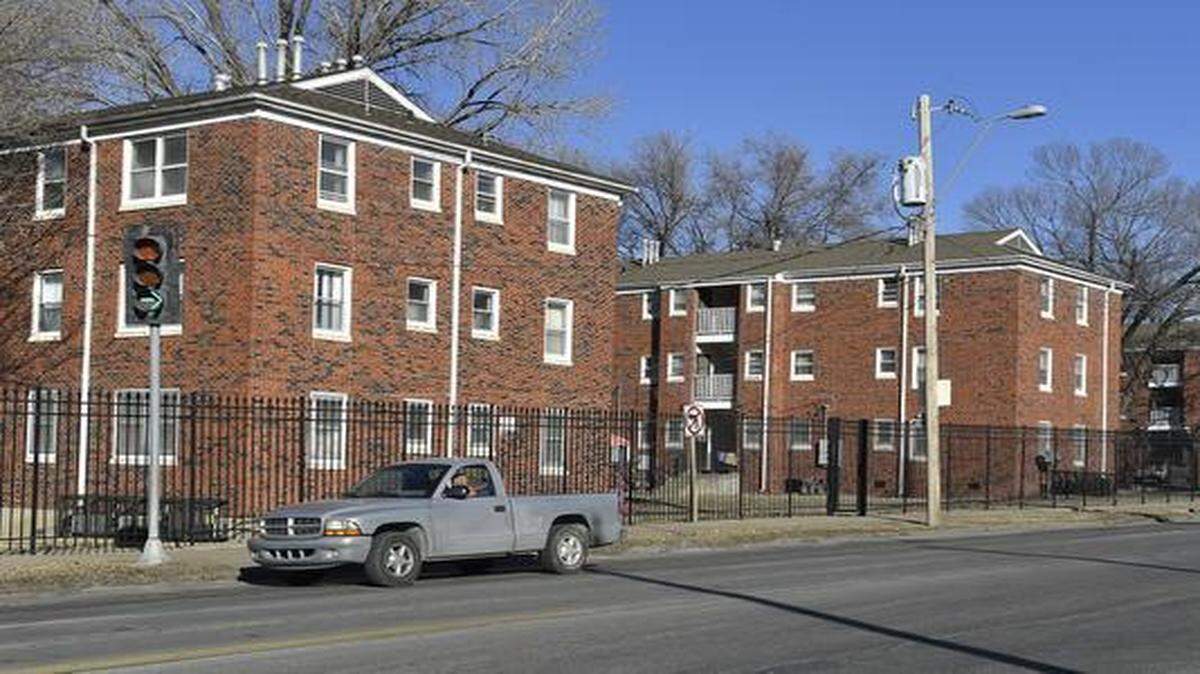
If Kansas City leaders have their way, the city’s most obsolete public housing project will be replaced in a few years by a much broader neighborhood transformation northeast of downtown.
Supporters say the plan not only would end the mistaken 1960s-era practice of concentrating hundreds of low-income families in the Chouteau Courts apartments, just northwest of Independence Avenue and the Paseo, but also would help nearby residents, schools, businesses and community organizations.
“It’s going to be a game changer for this corridor,” Kansas City Housing Authority board chairman Donovan Mouton said.
If successful, the initiative will demonstrate a whole new approach to providing housing for low-income families, said John Monroe, the Housing Authority’s director of planning and development.
“We can’t just rebuild public housing,” he said. “We have to rebuild the community in which it’s located.”
The plan calls for relocating about 500 residents of the Chouteau Courts apartment buildings to smaller mixed-income sites over the next five years. It also aims to improve the area’s educational, health, business development and social services. And it would provide better bus and bike access and other infrastructure investments.
The designated area, called the Paseo Gateway district, runs from Interstate 29/35 to Chestnut Trafficway and Prospect Avenue and from Cliff Drive to Ninth Street.
Residents say the changes can’t come soon enough to a complex that was built in 1959, has huge maintenance challenges and is bordered by highways and industrial sites.
“These buildings are so old,” said Sebra Scrogum, the tenants’ representative who has lived at Chouteau Courts for about six years. “We have lots of plumbing problems. The ground is shifting and causing foundation cracks.”
Scrogum said public housing still has a stigma, and residents long to live closer to parks and other neighborhood amenities.
“Everybody is really unified,” she said. “They’re all for the replacement of Chouteau.”
Advocates say that after years of planning and struggle, the Housing Authority finally has a good partnership with city government, a first-rate master developer and others to make the relocations a reality.
But accomplishing the full plan anytime soon hinges on millions of dollars in funding, and that’s a big if: Kansas City would have to win one of the most fiercely competitive grants that the U.S. Department of Housing and Urban Development hands out.
“This is a big deal,” Mayor Sly James said this month as the City Council voted to support the grant application and city matching funds. “A bunch of cities want it.”
The Housing Authority says it will meet a Feb. 9 deadline to apply for what’s called a Choice Neighborhoods Implementation Grant. Kansas City is expected to be one of more than 30 applicants competing for what may be three or four grants.
If the grant application is successful, it could mean about $30 million, with about two-thirds going for housing and the rest for education, economic development and other neighborhood improvements.
Finalists may be announced this summer; site visits would follow. Kansas City officials hope winners will be announced by November, with the grant funds available beginning in 2016.
City officials acknowledge winning could be a long shot. But Mouton said there’s reason for optimism. Kansas City was one of about 17 cities that won a Choice Neighborhoods planning grant in 2011, out of nearly 120 applicants. Those planning grants are seen as a preface to actual implementation grants.
In addition, Mouton and others said no regional city has yet won an actual Choice Neighborhoods implementation grant, so Kansas City is well-positioned to try to be the first. It is working with Brinshore Development of Chicago, which Monroe described as one of the country’s top public housing master developers.
Brinshore CEO David Brint said advantages in Kansas City’s favor are that the designated district has beautiful and historic housing stock as well as institutions such as the Kansas City University of Medicine and Biosciences that can help the area grow and thrive.
He said plans call for replacing Chouteau Courts’ 134 units with 350 to 400 mixed-income housing units, so the availability of good-quality housing in the area would increase.
Brint said many residents may be relocated to scattered sites in the designated district, but those wishing to move to the Northland also would have that option.
When Kansas City first started talking about replacing Chouteau Courts years ago, those in nearby neighborhoods feared having former public housing tenants moved next to them.
But Bobbi Baker-Hughes, who lives in the Northeast area’s Pendleton Heights neighborhood and heads the Northeast Chamber of Commerce, said the Housing Authority did good community outreach and that those fears have largely eased.
Many residents of Chouteau Courts have health and educational challenges, and only 14 percent are employed. The grant would provide extensive case management to help address those problems, said Diana Adorno-Boody, the Housing Authority’s director of resident services.
And if they don’t get the grant?
No matter what happens, Mouton said, Chouteau Courts must go. The plan would still move forward, although more incrementally, possibly with different types of grant funding.
Baker-Hughes said they’ve come too far to give up.
“The partners have now been identified. Many of us have been working together for some time and have become stronger,” she said. “That’s a plan that we can take to other funders.”
To reach Lynn Horsley, call 816-226-2058 or send email to lhorsley@kcstar.com.
This story was originally published January 27, 2015 at 6:33 PM with the headline "Kansas City hopes to replace deteriorating Chouteau Courts housing project."