
Democrat Paul Davis’ life immersed in policy and politics
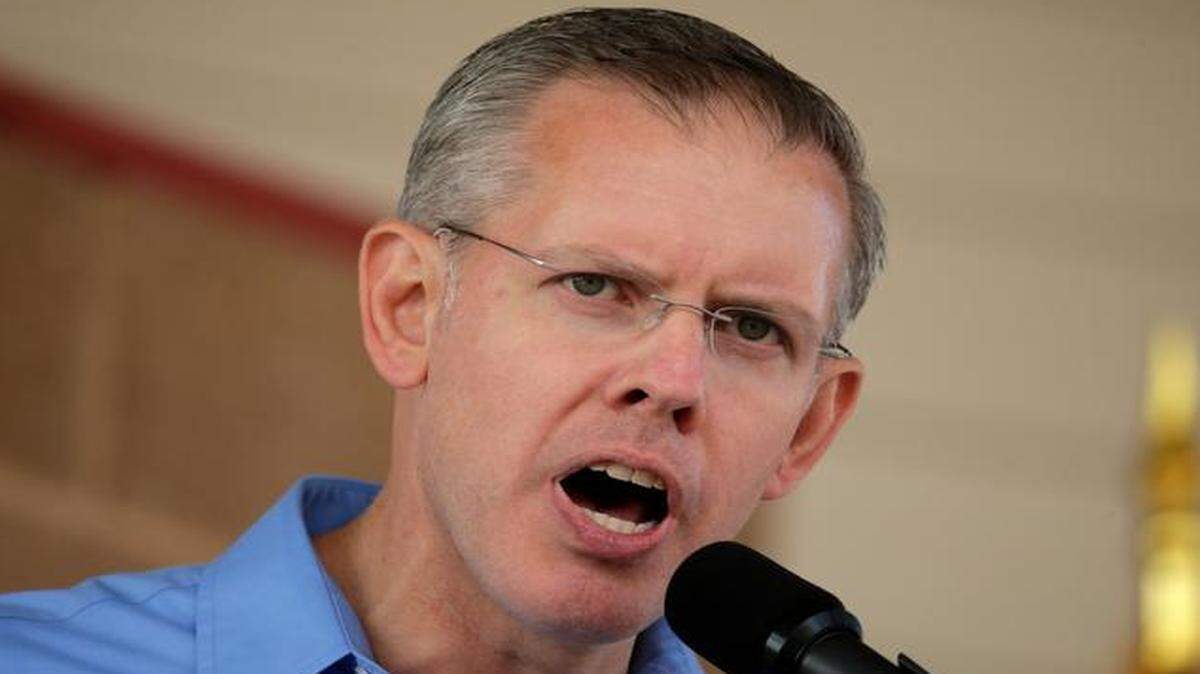
Kansas Democrats had just wrapped up their annual Washington Days shindig early last year when party chairwoman Joan Wagnon got the word.
After two days of meetings, receptions and dinners, an exhausted Wagnon was leaving the Topeka Ramada Inn with Paul Davis when the tall, slender lawmaker leaned over and shared a secret.
“You know, I think I’m going to run against Brownback. We’ve got to get rid of him,” Wagnon recently recalled Davis telling her that February evening.
She was skeptical. No one knew what kind of Democrat it would take to cut down the mighty Republican Gov. Sam Brownback.
After all, Brownback had so much money, was so well known and would have so much outside help from special interests.
“I didn’t know,” Wagnon said, “if he was the right guy to run or not.”
A year later, Wagnon isn’t having any second thoughts.
Davis could be closing in on the unlikeliest of upsets, aiming to topple a conservative incumbent governor in the reddest of red states where Republicans outnumber Democrats by about 340,000 voters.
So far, Davis has defied expectations. Most polls consistently show him leading Brownback as the Nov. 4 election approaches.
Davis has done it by running a campaign calculated to Brownback’s record rather than revealing much about himself or his record — so much that it clearly frustrates the governor at times.
The Democratic challenger casts himself as a “moderate,” “a common-sense leader” and an “independent thinker.” He castigates Brownback for income tax cuts projected to leave massive budget deficits and for failing to restore millions in lost federal stimulus money for schools.
Meanwhile, Davis has been guarded about what he might do about some major Brownback policies if he defeats the incumbent.
On taxes, Davis wants to freeze a portion of Brownback’s income tax cuts until state funding for school districts returns to pre-recession levels. He has stopped short of calling for their repeal. He wants a special commission to look at taxes.
On KanCare, the state’s privately managed care program for Medicaid consumers, Davis promises a “top-to-bottom” review.
He says KanCare is not working well and points to delayed payments to providers. He hasn’t said whether KanCare should be mothballed, but believes the developmentally disabled should be moved back to the old program.
On welfare, Davis won’t say whether he would reverse Brownback policies that cut thousands off of public-assistance rolls. He says he’s concerned about those changes and wants to review them.
While cautiousness is a deeply-rooted Davis trait, the Democrat leaves himself open to criticism that he’s running out the electoral clock on Brownback without offering a lot of detail about his own record.
As easy as it can be to read Brownback at times, Davis’ deliberate campaign approach can be more opaque.
A letter writer to The Star from Leavenworth argued he had trouble getting anything more than campaign rhetoric from Davis blaming Brownback for the state’s problems. He called Davis an “empty shirt.”
And a political scientist at Fort Hays State University, Chapman Rackaway, said of Davis: “We know very little about his background, about his philosophy.”
Rackaway added: “He’s very much a blank slate.”
Although recent polling shows Davis with generally strong approval ratings, a broad swath of the electorate — 35 percent — remains unsure. A new USA Today/Suffolk University poll out last week showed that almost as many voters viewed Davis favorably as they did unfavorably.
Wagnon said it should be no surprise that Davis is careful. “He is being very cautious trying to tell people where he’s going,” she said, “without giving the forces of darkness the ammunition they need to take his head off.”
Over the years, Davis has supported abortion rights, opposed a constitutional amendment banning same-sex marriage, opposed a coal-fired plant in western Kansas and voted against allowing the concealed carry of handguns.
He’s opposed removing job protections for teachers. He fought efforts to cut unemployment benefits for workers and supported allowing Wyandotte County to pay union-scale wages on public projects. He’s supported drug testing for welfare recipients and opposed new voter identification requirements.
He’s supported tax increases, notably a penny sales tax from 2010 that helped avert deep cuts to schools and social services and financed the state’s $8 billion highway program. He’s also voted for tax increases for schools.
Davis counters charges that he’s willing to support higher taxes with 17 pages of anti-tax votes since 2003. He says he voted for more than 150 tax cuts during his time in the Legislature.
Close friends and political allies don’t see Davis as an ideologue or firebrand.
“Paul’s philosophy is about problem-solving, not ideology,” said Raj Goyle, a former Democratic House member and a close friend.
While friends say Davis wants government out of people’s lives as much as possible, he believes strong government institutions like schools and universities can help create prosperity for everyone.
“He has a real affinity for blue-collar people,” said Senate Minority Leader Anthony Hensley, a Topeka Democrat who gave Davis an internship early in his political career. “He’s always looking out for the little guy.”
Politics in the genes
Davis’ campaign for governor may have started many years ago at the family dining room table in Lawrence.
There, the young Davis would kick around the issues of the day with his father, a public administration professor at the University of Kansas, and his mother, an elementary school teacher.
His dad, Ray, once worked as a staffer in the California Legislature and later trained generations of city administrators at the University of Kansas. His grandfather served in the Wyoming statehouse as legislator. Another grandfather served on a Wyoming school board.
“The political vein runs deep,” Ray Davis said.
Davis’ start in politics began at age 10, when he helped distribute yard signs for a neighbor running for the Douglas County Commission.
“He rode his bicycle all over Lawrence,” Davis’ father recalled. “I couldn’t quite figure that out. It was scut work. He thought it was a great time.”
The young Davis made a habit of milling around the county courthouse on election night to watch as the results came in, his parents said.
He conceded he didn’t grasp what the candidates did or what their issues were, but was still captivated by the process.
By the time he was 21, Davis was studying political science at the University of Kansas. He landed an internship with Democratic U.S. Rep. Jim Slattery, a longtime family friend. Within a month, Slattery decided to run for governor, and Davis went to work on the campaign as his scheduler.
Slattery taught Davis the Kansas political ropes. Elected from a largely rural district as a Democrat, Slattery gave Davis insight about how to appeal to Republicans and get their vote, something he will need to beat Brownback this year.
Davis, Slattery said, is interested in politics beyond the gamesmanship.
“I would not say that Paul is a natural politician,” Slattery said. “His interest in public service is really driven to get public policy right.”
Unflappable success
Throughout his tenure in the Kansas Legislature, Davis was regarded as an affable lawmaker liked even by conservatives who disdain his politics.
It explains why he was able to enter the Capitol at the age of 31 in 2003 and rise within five years to leading the House Democrats.
Davis is largely seen as even-keeled with an unassuming personality; no one can remember Davis getting angry publicly. It served him well in an environment where collegiality is valued on par with policy.
“You’ve got to be passionate and you need get angry about issues, but you cannot get angry with people because you constantly work with them,” said Josh Svaty, a friend and former House member who served with Davis.
Davis wasn’t seen as a showboat, which further helped him climb the rungs of Democratic leadership.
“He worked hard, but quietly,” said former state Rep. Bill Feuerborn of Garnett, who ran unsuccessfully against Davis for minority leader in 2008.
“He didn’t try to get headlines,” Feuerborn said. “He did a lot of work behind the scenes. He didn’t come in as a person talking about himself all the time.”
Davis’ steadiness has been tested twice during a campaign beset by controversies over an actor in one of his ads and Davis’ presence at a strip club in 1998.
He quickly shut down the ad when it was revealed the spot featured an actor accused of inappropriate sexual behavior. He issued a brief statement apologizing for the ad.
Davis then was faced with a report revealing he was at a Montgomery County strip club 16 years ago when he was 26 and single, during a drug raid. Authorities found him in a private room with a nearly naked woman. He issued a statement saying he was at the wrong place at the wrong time. He was not suspected of any wrongdoing.
Davis took the story in stride, Hensley said. “He’s never over-dramatic about things.”
Onto the finish line
Times have clearly changed since that winter night when Davis let Wagnon in on his plans to run for governor.
He’s far better known now than a year ago. He’s kept pace with Brownback in fundraising. Now he’s hoping to parlay a lead in the polls to an Election Day win.
“A lot of people told us (Brownback) can’t be beat,” Davis told a rousing crowd of Democratic supporters in Prairie Village recently.
“The state’s too Republican. He’s got too much money behind him. We’re not having any of those discussions any more.”
That may be because of the careful approach that Davis took throughout most of his political career, Wagnon said.
“Paul made up his mind early. He persevered. He just methodically put together a campaign,” Wagnon said. “He has grown into this job.”
To reach Brad Cooper, call 816-234-7724 or send email to bcooper@kcstar.com.
TOMORROW
The second of two profiles of candidates for Kansas governor: the incumbent, Gov. Sam Brownback.
This story was originally published October 6, 2014 at 9:06 PM with the headline "Democrat Paul Davis’ life immersed in policy and politics."