
Politicians feel the heat from the Ferguson crisis
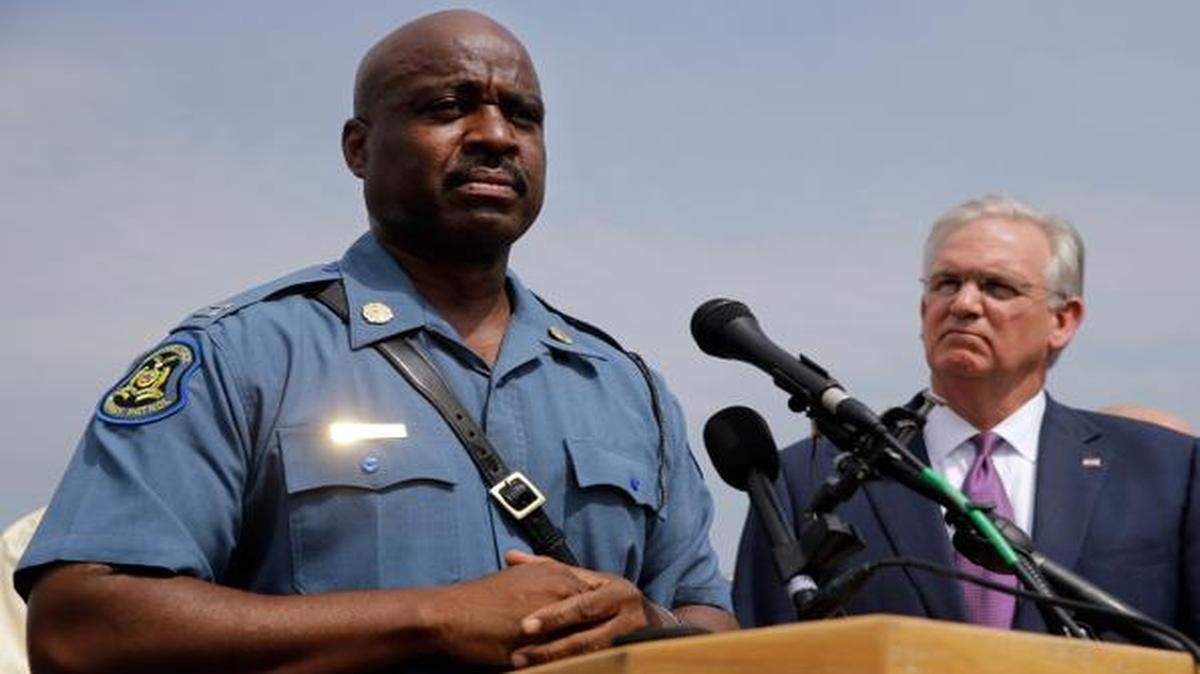
Missouri, and the nation, now begin to survey the destruction caused by more than a week of violent unrest in Ferguson, Mo.
The physical damage is clear enough. Injuries and arrests are being tallied. Race relations in the city and the state — strained and laid bare — may take years to mend.
But broad damage to the state’s political community has also been severe. By common consensus, Missouri’s response after the shooting of unarmed African-American 18-year-old Michael Brown was confused and tardy, a case of much too little much too late.
Gov. Jay Nixon, a Democrat, took by far the biggest hit. Clinton Adams, a lawyer and activist in Kansas City, called the governor’s performance woefully inadequate.
“He was slow to respond initially. And when he did get to the area, he wasn’t fully engaged,” Adams said, echoing a common refrain among analysts and politicians in both parties.
But other government figures — from mayors and council members to state lawmakers to members of Congress — faced scrutiny as well. No officeholder, it seems, escaped the Ferguson riots with their reputations fully intact.
“Everybody was taken off-guard by the event,” said George Connor, a political science professor at Missouri State University. “How this all happened so quickly was beyond the comprehension of almost everyone involved in the situation.”
The damage is particularly severe for politicians because an emergency response can define government, for good or for ill. Consider:
New Jersey Gov. Chris Christie, whose competence in the aftermath of Hurricane Sandy helped raise his profile outside his state.
New York Mayor Rudy Giuliani, who became an icon of resolve and resilience after the Sept. 11, 2001, terrorist attacks.
President George W. Bush in the rubble of the World Trade Centers after 9/11, and the backlash over his flubbed response to Hurricane Katrina four years later.
Even Nixon’s career was enhanced — and his name whispered in national circles — because of his quick reaction to the devastating Joplin tornado in 2011.
No more. Virtually every observer inside and outside the state said Nixon’s slow reaction has all but ended any national aspirations, and may hurt him in the final two years of his term in Missouri.
The governor’s office defends Nixon’s response.
Spokesman Scott Holste dismissed the idea that Nixon was sluggish or bumbling, saying that the governor “has been working around the clock” to balance the protection of protesters’ rights with the safety of the community.
Holste said Nixon called for an independent investigation by the Department of Justice on Aug. 11 — just two days after the shooting — and met with shooting victim Michael Brown’s mother on Aug. 15. The governor continues to meet with faith and community leaders, Holste said.
“The governor has been laser-focused on bringing peace to the people of Ferguson, so that justice can be ultimately achieved,” Holste said in a written statement. “He most decidedly has not been focused on perception or politics.”
But the verdict from social and mainstream media on Nixon’s efforts has been brutal.
Missouri State Sen. Maria Chappelle-Nadal, a black Democrat, tweeted profanity-laced criticisms about Nixon, calling him a coward for not going to Ferguson sooner — a comment that led some to criticize her.
Poor reviews
Time magazine dismissed Nixon as tone deaf. The Washington Post published a profile that described him as fighting for his political life. Politico declared that he had “missed his moment.”
It didn’t help that Nixon already had a testy relationship with Missouri’s black community. His role in ending a court-ordered school desegregation program as state attorney general, and a perceived lack of racial diversity among his staff and advisers, have long been sore spots among African-American politicians in the state.
And Nixon didn’t make the best impression on live television. His first remarks on the crisis to be broadcast live nationwide, at an Aug. 14 meeting with community leaders at a church, were informal and uncomfortably jokey. In the news conference that followed, Nixon’s rambling presentation didn’t do much to redeem him.
Not all the reviews were bad. Nixon’s appointment of Missouri Highway Patrol Capt. Ron Johnson to lead the state’s security response was seen as a positive action.
Johnson “has done as good of a job as anyone could do,” said Jim Bergfalk, a Kansas City-based consultant and a veteran of the 1968 riots during the Democratic National Convention in Chicago.
“But the governor injecting himself, with an on- and off-again curfew, on- and off-again National Guard … I think was a mistake.”
In a New York Times-CBS News poll published last week, 32 percent of those surveyed approved of Nixon’s response, while 34 percent disapproved. The remainder didn’t know.
Even as Nixon struggled to tamp down the crisis, other politicians stepped into the glare of the nation’s attention to Ferguson.
U.S. Sens. Claire McCaskill and Roy Blunt were quickly visible. U.S. Reps. Bill “Lacy” Clay and Emanuel Cleaver also showed up in Ferguson and on television, responding to the disturbances.
Yet their work did little to immediately reduce the anger in the community. It took a visit Wednesday from U.S. Attorney General Eric Holder, some said, to begin calming the city’s outrage.
Missouri Attorney General Chris Koster, a Democrat, also worked in Ferguson. Few Democrats were willing to publicly criticize his actions, partly because he has less power than Nixon.
Still, some Democrats said the perception of the state’s poor response in Ferguson might hurt Koster’s 2016 campaign for governor. As a result, talk continues in Missouri Democratic Party circles that McCaskill could be drafted to seek the job, particularly if Koster can be persuaded to step aside in 2016.
Some think McCaskill’s response in Ferguson could intensify the discussion. The former Jackson County prosecutor was a highly visible presence, talking with residents and leaders, visiting businesses and hugging protesters.
She gave impassioned interviews and fired out statements and tweets calling for police to “demilitarize.” McCaskill called the president, Holder, law enforcement officials and her congressional colleagues.
On Thursday, she announced plans to chair a hearing on police violence in Washington.
Although McCaskill’s image during the crisis was undeniably more positive, her efforts also could be interpreted as opportunistic — a common criticism of the Democrat. And her ambivalence over the role of the St. Louis County prosecutor in investigating the shooting has also drawn rebukes.
Asked for her assessment of how Nixon was doing, the senator declined to pile on — explicitly, anyway.
“This would be a terrible time to be critical of anyone who has that job,” McCaskill said in an interview. “What we all need to focus on right now is how much we want him to succeed.”
Limited power
To be fair, it isn’t clear how much politicians can do to control a fast-moving crisis like the riots that roiled Ferguson.
Former Missouri Gov. Bob Holden — like Nixon, a Democrat — declined to criticize the state’s response.
But he said all politicians can do a better job reaching out to affected communities before violence strikes.
“We all share some responsibility,” Holden said. “The real disconnect, and the African-American community has some responsibility here, is that disconnect between citizens and their elected officials, period.”
Some outsiders said Nixon’s response, and the state’s, was the best that might be expected in a complicated, unique situation.
Yet there is some evidence that politicians can defuse potentially violent confrontations, through a combination of appropriate rhetoric and community credibility.
In 1992, Kansas Citians held a rally following the acquittal of police officers in the Los Angeles beating of Rodney King. At one point, a young African-American speaker suggested protesting the verdict on the Country Club Plaza.
Then-Mayor Cleaver was quick to respond.
“We aren’t going to the Plaza,” he told the crowd. “We aren’t going anywhere talking about violence … The people dying in Los Angeles are not white folks. They are African-American. Let’s not be stupid.”
The city largely escaped the violence that plagued other urban areas, and many observers credited Cleaver for his calming influence at the rally.
Today, he credits good fortune for that response.
“Anything that you do successfully is probably by error,” Cleaver said on MSNBC this week.
“There is no book written on what you do or what you say. I think we put enormous pressure on anyone if we create the atmosphere that if this person comes to town everything is going to be OK.”
To reach Lindsay Wise, call 202-383-6007 or send to lwise@mcclatchydc.com.
To reach Dave Helling, call 816-234-4656 or send email to dhelling@kcstar.com.
This story was originally published August 22, 2014 at 9:38 PM.