
In one KCK neighborhood, the present and the future collide
To three generations, the neighborhood west of State Line Road at 45th Street was known as Spring Valley.
Now the tech world and geeks crowding in call it Kansas City Startup Village, where they’re encouraged to dream up apps and online businesses. Being just down the road from the Google Fiber offices, it was among the first residential hamlets anywhere to be wired for ultra-fast Internet.
The natives, though, are restless. They have recently begun to work with the young arrivals to reach an understanding of what neighborhoods are supposed to be.
From her front porch 14 steps above Cambridge Street in Kansas City, Kan., Jean Flaherty can point to homes owned by neighbors who grew up in them. But anymore, with all these techies coming and going, she said, “we don’t know who’s not supposed to be here.”
Too many strangers. Cars parked all along the narrow side roads. On occasion a tour bus rolls through.
So Flaherty and a longtime neighbor, Jane Vogl, circulated a petition a few weeks back when owners of two residential properties that house startup ventures sought to renew special-use permits.
Nearly 70 residents signed the petition, adding comments such as “Afraid of what our neighborhood will become” and “Love startups but this is residential.”
True, Spring Valley is residential — zoned for single-family housing.
But Startup Village is all business, much being conducted in houses. Hopeful entrepreneurs, mostly millennials and sometimes several under one roof, while away their workdays at laptops.
They came from as far away as Boston and Portland, Ore.
They started doing so in late 2012, when the enclave of quaint houses drew global media attention for being the first “fiberhood.” Google made fiber service available only to homes, not to commercial properties.
Startup Village co-leaders Adam Arredondo and Matthew Marcus say that their eyes have opened to the collision of Spring Valley and Startup Village and that they want to see both prosper.
Gripes about parking, increased traffic and alleged zoning violations are “all symptoms of something that’s good,” said Arredondo, who is working with city and economic development officials, along with the residents, to fix problems.
“You have this great neighborhood and this job-creating engine,” he said. “How do they coexist? That’s the underlying challenge.”
For now the junction of 45th and State Line is a crossroads of cultures past, present and future.
Sleepy antique shops, which defined the area’s commerce before Google Fiber, and more traditional in-home businesses stand alongside properties where funky-sounding startups (Leap.it? Eventr.io? Idle Smart?) hope to gain traction.
Gary Boyce since 1969 has worked with a different kind of fiber. His upholstery shop, Andrews & Abbey-Riley, employs eight people who spin big spools of thread through industrial sewing machines, stitching new fabric over old furniture.
“We do something here,” quipped Boyce, noting he wasn’t so sure what creators of Web startups do. “I’m not into Facebook, Twitter …
“There isn’t enough parking anyway,” he added. “This is not a place for whatever they’re doing.”
‘Hacker house’
Vogl, a Spring Valley homeowner for 22 years, said most of her neighbors support the startup community and its aspirations.
“But we need them to give thought to the need to be good neighbors,” Vogl said. “We were zoned residential. The residential zoning laws need to be enforced.”
The petition drive that she and Flaherty led opposed the renewal of special-use permits for two houses, both typical of the “co-working spaces” that define Startup Village.
A public notice outside one of those properties alerted neighbors to the owner’s request to continue providing “a hacker house” — living quarters for techies — operating as a business.
This past week the Kansas City, Kan., Planning Commission, facing a few disgruntled residents and two dozen Startup Village defenders, recommended that owner Ben Barreth’s permit be renewed.
Barreth, an area website designer and tech enthusiast, had charitable intentions. He tapped into his retirement savings to buy and renovate the vacant house on State Line. He dubbed it a “home for hackers” and offered budding entrepreneurs temporary rent-free housing.
The owner of the second house, a Colorado tech financier also providing space for free, evicted a business and withdrew his permit request. But KCK planning director Rob Richardson said neighborhood concerns over zoning probably will continue.
“When these startups grow, they can grow fast,” with as many as a dozen entrepreneurs working side by side on projects better suited for larger commercial settings with parking lots, Richardson said.
Besides the lure of what in 2012 was the fastest home Internet around, the aim of Startup Village was to cluster tech-savvy thinkers with modest resources into a single locale, swapping ideas all day long.
On that score it’s been a success, Richardson said. Many startups already have jumped to more suitable surroundings after securing capital for winning formulas.
“Up until now it’s been sort of a cool, loosey-goosey group of people sharing ideas among themselves,” Richardson said.
“But they need a formal organization that works with the rest of the neighborhood. We don’t want them to screw up the place for everyone else.”
Some of the newcomers have put gravel in the grass along the alley that bisects Spring Valley and, voila, a new place to park.
Others have been accused of tossing cigarette butts on neighboring lawns. Many are suspected of commuting to work in houses zoned for residential use.
The codes allow for as many as five nonrelated tenants to share a home. But that usually means five cars out front.
The parking problems reached a crescendo late last year, said Flaherty, a homeowner for 31 years.
That’s when a ballooning startup called EyeVerify, in commercial space on 45th Street, prepared to move to more appropriate digs in downtown Kansas City.
EyeVerify was adding employees and interviewing prospects while waiting for the new space to be renovated.
What an idea EyeVerify hit upon: an app that allows a user to hold up their smartphone and, using the phone’s camera, confirm the user’s identity based on vein patterns in the whites of their eye.
But for months before the startup moved out, the residential roads around Spring Valley, barely broad enough for two-way traffic, were lined with cars parked on the only side they could.
“Friends visiting me had to park on other streets,” Flaherty said.
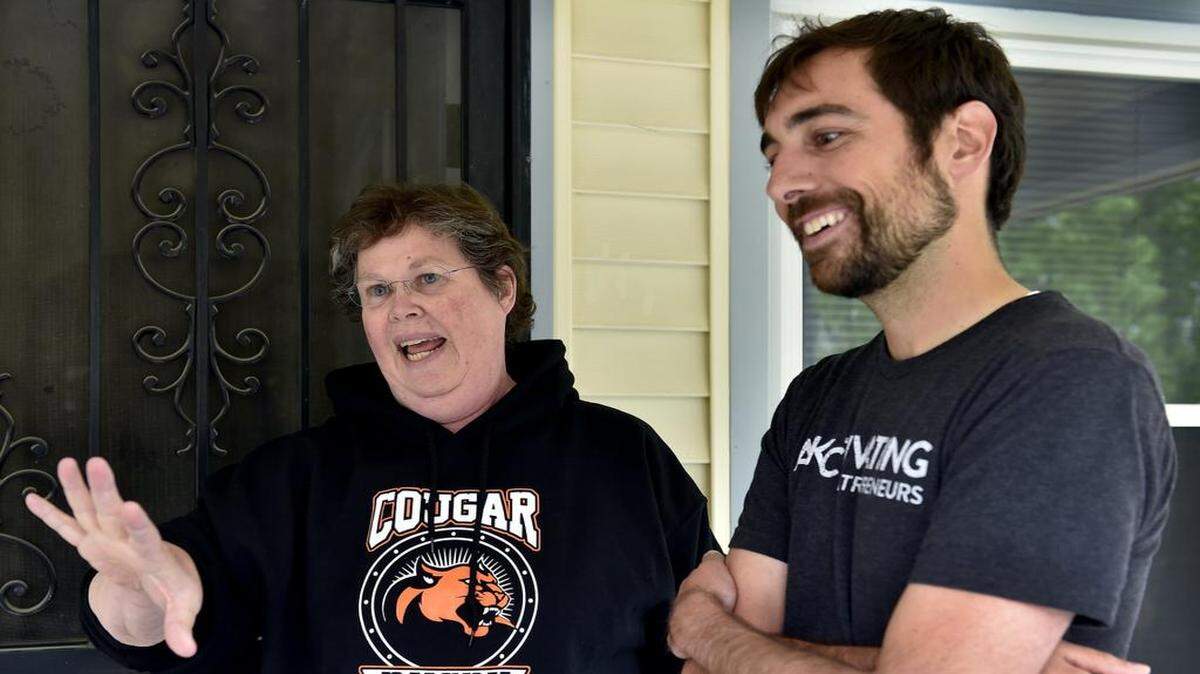
When Startup Village’s Arredondo came knocking the other day on a diplomatic mission, Flaherty smiled and voiced hope that the two SVs can work together to revive the residential flavor of Spring Valley.
“We’ve just been going through our terrible 2s,” said Flaherty, referencing the years in which the neighborhood has been adjusting to incoming techies.
She added: “I wouldn’t call it a clash. We’re just overcoming some rough patches. … Right, Adam?”
Arredondo replied with a sheepish laugh: “Yeah, I got that message.”
Open house
Maybe some arrivals to Startup Village were too absorbed in their app-making pursuits to think much about the quality of residential life.
Or maybe longtime dwellers of Spring Valley kept grievances to themselves before taking them to City Hall.
For his part, Arredondo has put real skin in the game to dress up the neighborhood.
With private money, he helped convert a cinder-block structure once a salon into a snappy-looking space for business developers to work together.
The new Village Square is operated by the Center of Entrepreneurial Ecosystem Development, which Arredondo co-founded.
The building also could serve as a meeting place for neighborhood groups, city planners and the startup community to iron out issues, Arredondo said.
“I guarantee we’re going to have a far more unified vision moving forward,” he said. “It’s our duty as good neighbors.”
About 200 people, including petition leaders Flaherty and Vogl, attended Village Square’s open house on Wednesday.
Among neighborhood geeks in the crowd was Brandon Schatz of Sportsphotos.com, which contracts with photographers to take and store pictures of amateur athletic events.
“My perception was we were kicking butt making neighborhood improvements,” Schatz said. “It didn’t even occur to me the residents would be upset.”
He lives with others in the Home for Hackers, which was a home for raccoons until Startup Village and volunteers such as Barreth came onto the scene.
The in-home startup is a business unlike a beauty parlor in a residential basement or a tax preparer who welcomes clients into her dining room.
Often it’s a Mark Zuckerberg wannabe tapping out computer code on a couch, hatching ideas with fellow techies and hustling to raise capital.
Planning director Richardson said the challenge for cities everywhere is learning how to integrate this new kind of trade into the lifestyle fabric of older neighborhoods for the benefit of both.
“For urban areas there are two hard things to come by — great neighborhoods and job growth,” he said.
“There’s an opportunity here. I think we all can figure out how to make it work.”
To reach Rick Montgomery, call 816-234-4410 or send email to rmontgomery@kcstar.com.
This story was originally published April 18, 2015 at 7:00 AM with the headline "In one KCK neighborhood, the present and the future collide."