
Local farms offer new varieties of mushrooms, a growing market
As a kid, Matt Trammell hated mushrooms. If it was a button, portobello or cremini, he wouldn’t touch it.
“The texture is kind of …” he trails off before finding the right word: “Slimy.”
So it’s a surprise to many people, including Trammell, that he and his wife, Nora, now operate a mushroom farm at their home in Warrensburg, Mo.
Trammell Treasures Mushroom Farm produces specialty mushrooms such as oysters, shiitakes and lion’s mane and sells them at the City Market and the Overland Park Farmers Market and to local restaurants such as Renee Kelly’s Harvest, Webster House and Westside Local.
Sales of specialty mushrooms account for about 6 percent of total mushroom sales in the United States, which are at an all-time high. According to the National Agricultural Statistics Service, total mushroom sales topped $1.1 billion in the last growing season, between July 2013 and June 2014. Specialty mushroom sales totaled $66 million in that period, another all-time high.
Still, white buttons and brown portobellos are the market’s “big dogs,” says Steve May, director of Hen House produce and procurement for Balls Food Stores in Kansas City, Kan.
Last month, Hen House started buying oyster mushrooms from the Trammells and dropped a supplier in Pennsylvania, where more than half of the country’s specialty mushrooms are sprouted. May says Hen House is “all-in on supporting the local guy,” which is why the markets buy from about 150 local farms.
To sell mushrooms at Hen House and other markets, the Trammells had to get general liability insurance from a specialty vendor that insures mushroom farms. Matt Trammell also volunteered to help educate Hen House consumers. He spent a recent Saturday afternoon demonstrating recipes and answering questions about oyster mushrooms, which have a velvety texture and delicate flavor that varies by their color.
May says consumer education is vital to expanding the market for specialty mushrooms.
“Everyone knows what to do with a white button or cremini — you sauté them in butter,” May says. Not as many Americans know that you can do the same with oyster mushrooms, despite their popularity in Asian and European cuisines.
Still, sales of Trammell Treasures oyster mushrooms were strong in their first week. Customers purchased 38 of the 40 clamshells the Trammells supplied to the Deer Creek Hen House in Overland Park. The 5.3-ounce clamshells cost $6.99, or $5.99 with a Hen House card. As the fledgling farm increases production, its mushrooms will become available at additional Hen House locations.
The Hen House market was a tipping point for the Trammells, whose mushroom venture was spawned completely by accident.
In March 2013, when the Trammells returned home from a trip, they discovered that their Overland Park apartment had been flooded by a leaky washing machine. Water seeped into the carpet and drywall, which sprouted spongy mushrooms.
The fungal infestation made Matt Trammell curious about mushrooms. He started researching them and found a book called “Mycelium Running: How Mushrooms Can Help Save the World.” In it, he read that aggressive species such as oysters could be used to combat oil spills and filter E. coli bacteria from feedlot runoff.
Matt Trammell was no longer disgusted by mushrooms — he was fascinated. After shifts at his day job, processing applications in a loan office, he started cultivating edible mushrooms on his patio and in a greenhouse in his bedroom.
Nora Trammell, a mental health technician, was OK with her husband’s new hobby. “Matt has always been the kind of person who dives head-first into a new adventure,” she says. “I give him some space, let him do his thing. It usually works out for the best.”
Despite Matt Trammell’s admitted lack of farming know-how and patience, his mushrooms took off. Soon he was selling several varieties of oysters — pink, gold, brown, gray — at the Overland Park Farmers Market and looking for a rental property where he could turn his hobby into a working farm.
In November 2013, the Trammells moved their family of four to a two-bedroom house outside Warrensburg, about an hour east of Kansas City. The small white house sits on 20 mostly wooded acres. There’s a tin-roofed workshop, a watertight grain bin and a barn that looks like it’s one wind gust away from collapsing. “I don’t trust it,” Matt Trammell says, “so I don’t use it for anything.”
The scenic country setting provides room to roam for the children: Sara, 6, and David, 4, who like riding bikes on the gravel driveway. And the house has an ideal mushroom-growing space: a damp, unfinished basement with low ceilings and windows that let plenty of sunlight spill inside.
The mudroom leading to the basement steps is lined with plastic ice bags stuffed with straw. Clusters of colorful oyster mushrooms sprout out of holes poked in the bags. The stems of the mushrooms curve up to the sunlight and flare out into velvety caps with feathery gills on the underside.
The basement is filled to capacity with mushroom bags — on shelves and on the cool concrete floor. One corner is cordoned off with plastic tarps that trap moisture emitted from a pair of buzzing humidifiers.
The plastic-wrapped room is where Matt Trammell grows his favorite mushroom. Hericium erinaceus, also known as lion’s mane, bearded tooth and pom pom, looks nothing like an oyster mushroom. The white fungus has a round, pillowy shape and is coated in what looks like fuzzy icicles.
“It’s my favorite mushroom to eat,” Trammell says. “The texture is like lobster or crab meat.”
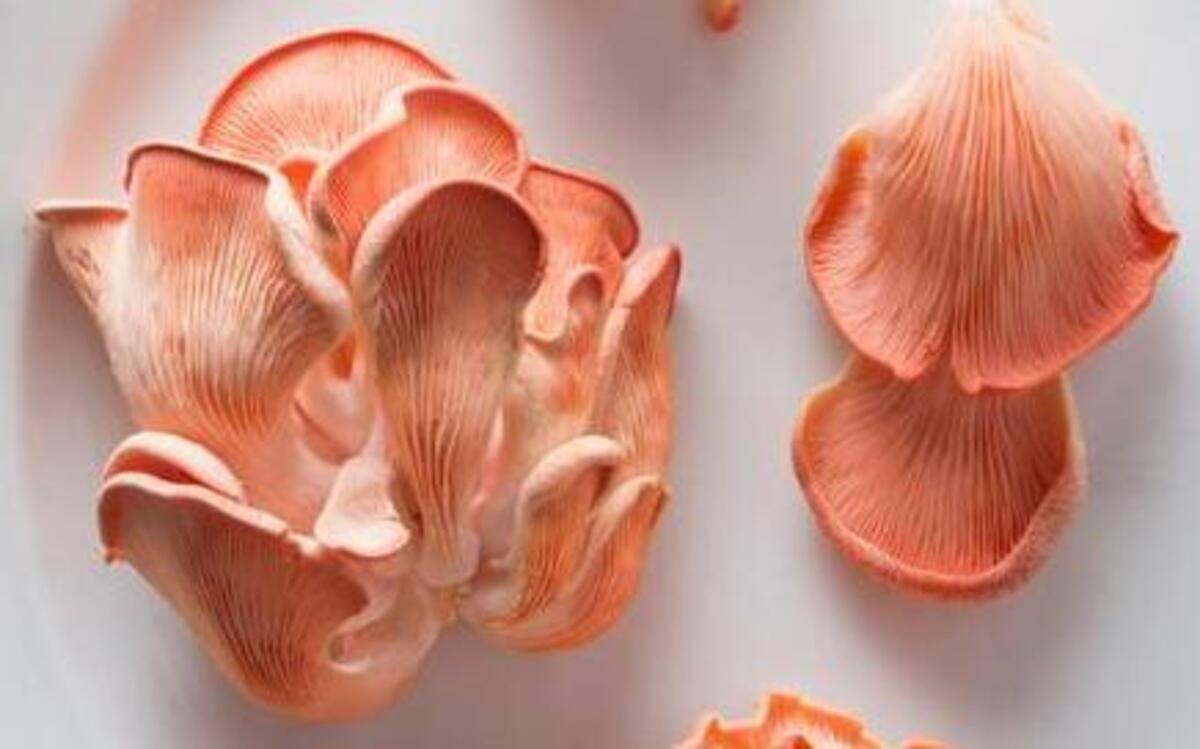
Customers can’t get enough of pink oysters, a frilly sort of fungus that grows in dense pink and coral clusters. Matt Trammell calls them roses because it sounds prettier than pink.
Renee Kelly, chef and owner at Renee Kelly’s Harvest in Shawnee, has been captivated by the Trammells’ rose oyster mushrooms since she spotted them last year at the Overland Park Farmers Market.
“They are possibly the most beautiful mushrooms I’ve ever seen,” says Kelly, who buys them for her restaurant.
“It’s fun to use them in a vegan pasta because they actually taste like shrimp,” the chef says. “It’s kind of trippy, especially for vegans.”
Oyster mushrooms have a mild flavor and rich texture that appeal to those who can’t stomach what Kelly calls the “wet sponge” texture of button mushrooms. The aggressive fungi are also relatively easy to grow compared with other wood-loving species such as shiitake.
“Oysters are crazy,” says Mark Lumpe, who grows them at Wakarusa Valley Farm outside of Lawrence. “They grow in everything. You can throw them in a field and they’ll start growing.”
Lumpe has been cultivating mushrooms since 2003. Like the Trammells and many other mushroom farmers, he started by sprouting oysters from straw. Now he grows 13 certified organic varieties, including shiitake, lion’s mane and black poplar, on growing medium that he makes from sawdust, corncobs and sunflower seed shells.
The farmer sells his Wakarusa Valley Farm mushrooms at the Lawrence Farmers Market, as well as the Merc Co-op, 901 Iowa St. in Lawrence, and Badseed Farmers Market, 1909 McGee St.
Earlier this month, Lumpe started selling his mushrooms on Sundays at the City Market. Selling specialty mushrooms isn’t easy, he says. Most customers recognize shiitakes but can’t identify other varieties such as oysters. And there are lots of people out there who avoid mushrooms.
“Some people just can’t stand them,” Lumpe says.
Lumpe and the Trammells are trying to widen their customer base by sharing samples and information with potential customers.
“We have to make the market by showing people how good these mushrooms are,” Matt Trammell says.
Local mushroom farmers don’t have a lot of competition, in part because growing mushrooms is a specialized process.
The Trammells start the sprouting process by sterilizing straw, their preferred growing medium, with calcified lime. Over 24 hours, the lime raises the acidity levels in the straw, which kills off non-beneficial bacteria.
Once the straw is sterile (proven by a test that involves pH levels), they add mushroom spawn, or seed, which they make themselves or purchase from mushroom farms around the country. The Trammells then pour the mulch-like mixture into plastic bags.
Sometimes Sara and David help their parents fill the bags, but “it usually ends up turning into a straw-throwing party,” Nora Trammell says.
The Trammells poke holes in the bags, letting in oxygen, and stash them in the cool basement so the spawn can grow. Like plants, mushrooms need oxygen, light and water. The water is delivered via humidifier or a light mist from a spray bottle.
Temperature is important, too: Matt Trammell says 65 degrees is ideal, which means mushrooms grow best in fall and spring. Pink oyster mushrooms like it hot — above 72 degrees is perfect — and gray oysters sprout when it’s cooler, around 55 degrees.
Mold and gnats can kill mushrooms, so they’ve become Matt Trammell’s enemies. He fends off gnats with a plant-based insecticide spray called pyrethrin and prevents mold by carefully monitoring humidity levels.
Oyster mushrooms take two to five weeks to bloom. The Trammells harvest them two to three times every week. On Saturdays, the family splits up to sell their stock.
Sara Trammell earns a 10 percent commission on every pint she sells.
“She’ll say ‘Good morning’ to people, teach them about all the different mushrooms, tell them how our family cooks with them, and give nutrition info,” Nora Trammell says. “She’s definitely not shy at all.”
Matt Trammell, who home-schools his children and works from home filing medical records, says he once observed Sara and David playing “farmers market” with toy blocks. At that moment, Matt Trammell realized that mushrooms weren’t just a hobby anymore. They were a family business.
Thanks to their deal with Hen House and a new winter community-supported agriculture effort (see accompanying story), the Trammells are expanding farming operations with two 200-square-foot greenhouses.
They also want to teach others how to farm fungus with oak logs filled with shiitake spawn. The logs are ideal for a casual home grower because they require little maintenance and sprout mushrooms for several years.
The family is focused on mushrooms, but the long-term goal is to farm full time and find a permanent homestead closer to Kansas City where they can experiment with aquaponics, grow vegetables, raise rabbits and chickens and start mushroom composting.
For Matt Trammell, who now savors specialty mushrooms at any meal, the fungus could be the key to a sustainable lifestyle for his family.
“The dream,” Matt Trammell says, “is that mushrooms will support everything we want to do.”
To reach enterprise reporter Sarah Gish, call 816-234-4823 or send email to sgish@kcstar.com. Follow her on Twitter: @sarah_gish.
All about exotic mushrooms
▪ Choose mushrooms with firm, spongy caps. Avoid mushrooms with wrinkles or shriveled caps.
▪ Don’t soak mushrooms or wash them under running water. Instead, use a damp paper towel to wipe off dirt.
▪ Store the mushrooms in a brown paper bag or cardboard box in the refrigerator for up to one week. Or do what chef Renee Kelly does and stash them in a plastic tub lined with paper towels or clean linen. Just make sure the lid of the tub isn’t shut all the way. “Mushrooms need to breathe,” Kelly says.
▪ Before using the mushrooms in a recipe, cut off any woody stems. You can freeze the stems and use them later to add mushroom flavor to homemade chicken or vegetable broth.
▪ Oyster mushrooms can be eaten raw, but “they need to be cooked to bring out their flavor,” says Mark Lumpe of Wakarusa Valley Farm. Sautéed mushrooms add interest to scrambled eggs, fritattas, soups, salads, green beans, pasta dishes, pizzas and enchiladas.
▪ Their texture makes mushrooms a filling substitute for meat. Sautéed gray or brown oyster mushrooms make a flavorful base for vegetarian gravy that can be spooned over warm biscuits. And Kelly says pink oyster mushrooms are perfect for pasta dishes.
Buying local
Trammell Treasures Mushroom Farm
Trammell Treasures Mushroom Farm, located near Warrensburg, sells mushrooms on Saturdays at the City Market and the Overland Park Farmers Market. They are also available at the Deer Creek Hen House market, 6900 W. 135th St., Overland Park. A 5.3-ounce clamshell of oyster mushrooms costs $6.99.
Trammell Treasures also offers a winter mushroom CSA. Here’s how it works: Customers pay $225 up front, which gets them a quart of mushrooms each week until May 8. Two quarts per week costs $423. Each quart contains a variety of exotic mushrooms such as oyster, king oyster, shiitake and lion’s mane. Pickup locations are at the City Market and Overland Park Farmers Market. For more info, go to TrammellTreasures.com.
Wakarusa Valley Farm
Wakarusa Valley Farm, 7 miles southwest of Lawrence, has been cultivating mushrooms since 2003. Farmer Mark Lumpe grows 13 varieties, including shiitake, hericium (or lion’s mane) and five kinds of oyster mushrooms. All of Wakarusa Valley Farm’s mushrooms are certified organic, and they’re sprouted from growing medium that Lumpe makes from sawdust, corncobs and sunflower seed shells.
Wakarusa Valley Farm mushrooms are available at the Lawrence Farmers Market and the Merc Co-op, 901 Iowa St., in Lawrence. You can also find them on Sundays at the City Market, on Fridays at Badseed Farmers Market, 1909 McGee St., and on the menus at several local restaurants, including Novel, Eden Alley and Westside Local.
Oak Ridge Farm
For 25 years, Alan Terry has been sprouting shiitake mushrooms from oak logs on his wooded property outside Baldwin, Kan. Terry’s Oak Ridge Farm produces about 1,500 pounds of shiitake mushrooms every year. The shiitakes end up at Lawrence restaurants such as Pachamama’s, 715, Wheatfields Bakery and Cafe, Merchants Pub & Plate and Limestone Pizza + Kitchen + Bar.
You can also buy Oak Ridge Farm shiitakes and shiitake logs at the Merc Co-Op in Lawrence. Terry makes the logs by drilling holes in hunks of oak, then filling the holes with mycelium, the vegetative part of the fungus. After the holes are plugged with wax, the mycelium slowly takes over the log, which starts sprouting shiitakes. Terry says the logs, which cost about $20 each, typically produce mushrooms for four to five years.
Oak Ridge Farm’s shiitake logs will also be available at the Lawrence Farmers Markets Christmas Fair (9 a.m. to 5 p.m. Dec. 13 at Holiday Inn, 200 McDonald Drive in Lawrence).
Fresh Cream of Mushroom Soup
For a fresh take on comforting cream of mushroom soup, skip the canned stuff and make your own. This recipe takes only 20 minutes.
Makes 2 quarts
8 ounces fresh mushrooms, cleaned and chopped
2/3 cup all-purpose flour
6 tablespoons butter
2 quarts chicken, beef or vegetable stock
1 cup half and half, cream or milk
Lightly sauté mushrooms in butter. Add flour and stir constantly for about 5 minutes. Slowly add stock, stirring until all is incorporated, then simmer for 10 minutes. Add cream, stir and serve.
Per 1-cup serving: 182 calories (65 percent from fat), 12 grams total fat (8 grams saturated), 34 milligrams cholesterol, 11 grams carbohydrates, 3 grams protein, 1,249 milligrams sodium, 1 gram dietary fiber.
Source: Trammell Treasures Mushroom Farm
Spinach, Mushroom, Red Onion and Goat Cheese Pizza
This vegetarian pie pairs tangy goat cheese with earthy mushrooms and sweet caramelized onions.
Makes 4 servings
1 tablespoon olive oil, plus more for drizzling
1 small red onion, sliced
1 1/2 cups mushrooms, sliced
1 large purchased pizza dough, rolled out
6 ounces fresh mozzarella, thinly sliced
3 cups baby spinach
4 ounces goat cheese
1 tablespoon balsamic vinegar
Kosher salt
Black pepper
Preheat oven to 425 degrees. Heat 1 tablespoon of olive oil in a pan, and gently sauté the onions and mushrooms until al dente. Sprinkle with a small amount of salt to help draw liquid from the mushrooms.
Drizzle or brush olive oil on top of dough. Top with mozzarella, spinach and mushroom/onion mixture. Crumble goat cheese on top, then lightly drizzle with more olive oil and balsamic vinegar. If desired, sprinkle a small amount of kosher salt and fresh cracked black pepper on top.
Bake on the middle oven rack for 15 minutes, or until crust is cooked through.
Per serving: 647 calories (41 percent from fat), 29 grams total fat (15 grams saturated), 68 milligrams cholesterol, 66 grams carbohydrates, 29 grams protein, 1,150 milligrams sodium, 2 grams dietary fiber.
Source: Trammell Treasures Mushroom Farm
Sautéed Oyster Mushrooms
Browning oyster mushrooms in oil draws out their delicate flavor, while adding a touch of cider vinegar lends a hint of brightness. Use these sautéed mushrooms in pasta dishes, scrambled eggs or as a topping for chicken or steak.
Makes 8 servings
1 pound small oyster mushrooms, stems trimmed
1 tablespoon vegetable oil
1/2 teaspoon salt, plus more to taste
2 teaspoons cider vinegar
Cut any large oyster mushrooms into 1-inch pieces.
Heat oil in a large nonstick skillet over medium-high heat until hot. Sauté mushrooms with salt until golden, about 8 minutes. Add vinegar and sauté until evaporated, about 1 minute. Season with salt, then transfer to a plate to cool.
Mushrooms can be made 4 hours ahead and kept at room temperature.
Per serving: 36 calories (44 percent from fat), 2 grams total fat (trace saturated fat), no cholesterol, 3 grams carbohydrates, 2 grams protein, 150 milligrams sodium, 1 gram dietary fiber.
Source: Epicurious
This story was originally published November 11, 2014 at 6:00 AM with the headline "Local farms offer new varieties of mushrooms, a growing market."