
Dairy goat farm thrives in this idyllic Terabithia
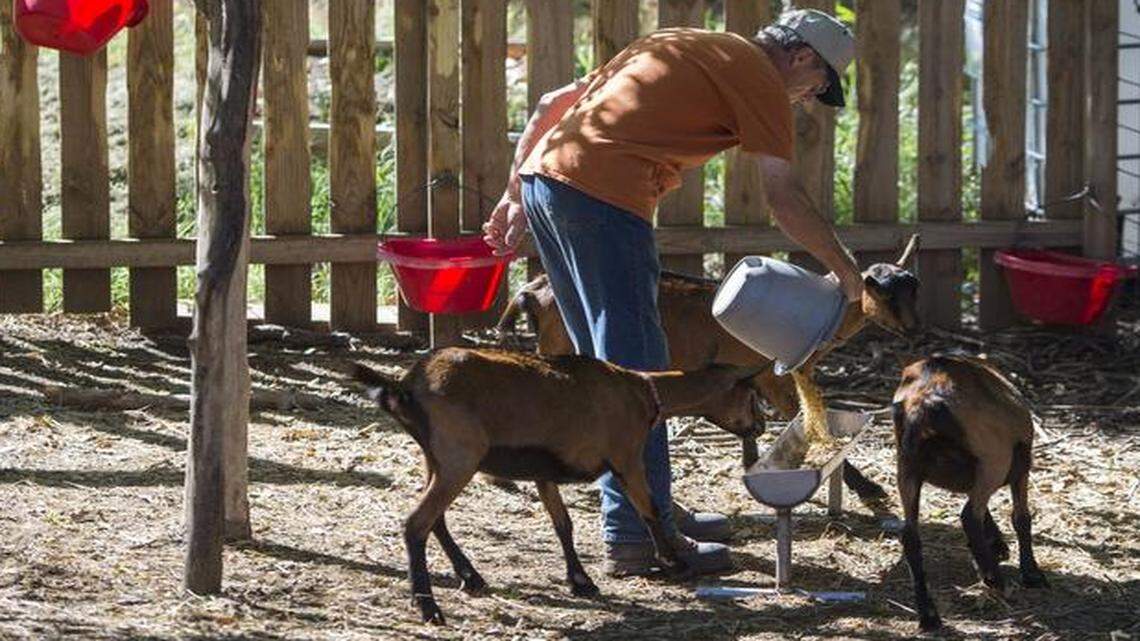
Terabithia Dairy Goat Farm has everything a small goat cheese-producing operation needs, including a well-tended herd and a couple of big, hairy dogs to warn predators.
The mood on the 12-acre property in Miami County, Kansas, is agreeable and slow-paced. A turquoise vintage Ford truck emblazoned with Terabithia’s logo and decorated with well-worn work boots and antique milk canisters is a 3-D billboard at the farm’s entrance.
Terabithia is both ground zero for a serious food artisan, which co-owner Becky Thorpe is, and the epicenter of a cottage-based creamery where the farmstead cheese products are made only from milk generated by the goats. “Because we sell our products only on the farm, directly to the customer, there isn’t a regulation process,” Thorpe says.
A self-taught goat cheesemaker who has perfected her skills over the decades, Thorpe makes garlic-dill, chive, cranberry and even chocolate goat cheese. She also makes batches of fudge, and her husband, Vince Thorpe, smokes goat cheese, which lends an unusual and intriguing flavor.
Pasteurized goat’s milk is available for purchase at Terabithia — make sure to bring a container — along with the wedges of cheese that Becky carefully wraps in special wax-coated paper. “The paper is instrumental in keeping the cheese fresher longer, allowing air flow while maintaining proper humidity,” she says.
Becky, who owns the farm with Vince, a medical technician, has learned her cheesemaking craft through trial and error and a healthy dose of experimentation. “I love being in the kitchen, tweaking recipes and coming up with new flavors or a better way to do something,” she says.
Terabithia Goat Cheese is part of the burgeoning, farm-based cheese industry. The cheese is unusual: absent is the sharp, tangy flavor that characterizes many goat cheeses. Instead, Terabithia’s flavor profile is milder, in large part because of the milk yielded by the Thorpes’ Oberhasli goats. The texture is chewier than a traditional creamy goat cheese.
“The milk is sweet, which is a trait of the Oberhasli,” Becky says. “That appealed to us when we were planning our farm.”
Customers such as Brenda and Steve Wrischnik are Terabithia fanatics. The couple live up the road from the Thorpes and own Hoot Owl Hill, a business that offers glamorous camping — or glamping — experiences on their idyllic property.
Brenda serves the goat cheese to overnight guests, emphasizing how local the Terabithia delicacy is and why a grassroots product is so important.
“First, Terabithia’s cheese is delicious,” Brenda says. “Second, I like to look out my kitchen window in the direction of the farm and close my eyes and envision the whole process Vince and Becky go through. It’s quite wonderful, being able to buy cheese this fresh.”
Charm abounds at the farm, which borrowed its name from the popular children’s book and movie “The Bridge to Terabithia.” “The book was our daughter Mara’s favorite,” Becky says. “The name just fit the ambiance we wanted to create.”
A wooden footbridge with a handmade sign proclaiming “Troll Bridge” leads from the Thorpes’ modest house and patio to the farm’s four-legged inhabitants. It’s a muggy September mid-afternoon, and a tiny black cat lounges in the middle of the bridge, temporarily blocking progress.
“This bridge serves a purpose,” Becky says, stopping to let the cat finish its stretch, pointing at small puddles. “After a heavy rain, it’s a nice thing to protect you from standing water.”
Painted signs direct visitors to Terabithia’s goats: Kids and bucks to the right; nursery and does to the left. A cicada chorus crescendos and flies buzz about as Becky prepares to perform the afternoon goat-milking ritual. Black rubber boots pulled over jeans, stainless steel buckets dangling from each hand, the modern day goat herder meanders to the barn, passing three pens that hum with activity.
At one end of the farm, three pungent billy goats with muscle-bound physiques strut around a spacious enclosure. The swaggering bucks alternately climb a stump, surveying the surroundings with a king-of-the-hill demeanor. A momentary tussle ensues as two goats butt heads, their fierce-looking horns locking in a mock battle. The smaller goat walks away defeated, losing some unknown territorial spat.
Next to the males’ pen are a dozen or so lively spring kids, gangly and noisily bleating, tumbling over one another to greet a visitor whose face is pressed up to the gate’s wooden slats. One kid firmly plants front hooves on the back of another, its long neck craning to get a better view of the stranger.
The last pen, adjacent to the barn, holds the females, some jostling for position at the front, some poking their heads through fence gaps. Other does, preferring to graze, occasionally lift their heads to observe the commotion.
Becky, with Vince’s help, grants each goat a name, sometimes relying on word association. There’s Kimber, the horned nanny goat; Eva, Chantilly, Sparkle, Shirley Temple and Petunia; and the rambunctious twins, Double and Trouble. Terabithia bucks have manly monikers like Buckeye, Malarkey, Frankie and Bojangles. Two kids born on Easter Sunday are called Sunny and Brooke.
“They respond to their names,” Becky demonstrates, calling out Olivia, who trots to the fence, a tinkling bell affixed to her collar.
A lone horned doe hugs a large tree in the middle of the pen, tentatively peeking from behind the trunk before disappearing. “That’s Kimber,” Becky nods in the direction of the shy goat that scurries to hide behind another tree. “She’s a reformed bullier.”
Becky continues toward the barn, the buckets that will soon catch warm, sweet milk from the goats’ swollen udders gently swinging with her gait. A tabby cat darts in front of Terabithia’s matriarch and with a swift leap perches on a ledge inside the barn, ready to keep watch over its farm companions.
Vince appears in the doorway, pushing a wheelbarrow piled with hay harvested from the farm’s two lush brome fields and containers filled with a soybean, oat and corn mixture ready to be portioned for the does.
“Dinnertime,” he says. “Let’s get started.”
As if on cue, the goats, all wearing colorful collars, move as a graceful, synchronized pack into the barn. It’s 4:30 — time for happy hour at Terabithia.
Gorgeous goats
By society’s standards of beauty, goats fail miserably.
Defined by features such as broad, angular faces and odd, pale eyes set on the sides of their heads, full-grown goats are big-boned. Billy goats sport scraggly beards and emit a peculiar odor.
Unlike most creatures with eyes, goats have horizontal rectangular pupils. Because of their eyes’ physical positioning, goats can nearly see behind themselves. “You can’t sneak up on a goat,” Becky says with a laugh, settling onto a wooden bench in the barn.
For the next 90 minutes she communes with her beloved goats, collecting milk to be pasteurized and sold to customers and transformed into goat cheese and fudge.
But Terabithia’s Oberhasli dairy goats might woo a beauty contest judge. The purebred animals, a hardy breed that originated in Switzerland and were imported to the United States in the early 1900s, are gorgeous — sleek, caramel-colored coats with black facial stripes from the eyes to the muzzle — and personable.
“They’re highly intelligent, curious, social and extremely resourceful,” Becky says. “While they have a positive temperament, they are persistent.”
“And this milk” — Becky motions to the liquid in the bucket at her knees as she pets the goat — “makes the most divine ice cream. I cook with the milk and cheese all the time. People even buy it to make their own goat’s milk soap at home.”
Becky’s long, graceful fingers grasp the first goat’s teats. Her orange Terabithia-logoed T-shirt contrasts with the brown-and-black goats clamoring for food on the opposite side of the milking station. Three goats already in position stand on raised metal platforms, their heads buried in feed bowls, bits of grain flying through the air as dinner is devoured.
“The food is made in Baldwin from a Kansas State University recipe, with 18 percent protein, which is important for milking,” Becky says. “Goats we actively milk eat about two pounds of grain a day.”
Rhythmically pulling on the goat’s teats, Becky tells the story of how she and Vince, avowed city folk, came to own a pastoral farm outside Paola.
“We always dreamed of living in the country, and in 1989 we moved here from Michigan, after serving in the Air Force,” she says. “I had this idea to raise goats, so I did lots of research about raising them and making products from their milk.”
Elizabeth, a Grade Nubian goat, relocated with the Thorpes to Kansas. “She was our first goat,” Becky says. “What a sweetheart — she was so kind. One of our cats rode around on Elizabeth’s back. The two were inseparable.”
Things went well with Elizabeth, and Becky and Vince decided to move forward with the ambitious plan of building a herd. The Thorpes’ three children, Catherine, Mara and Rusty, were raised on goat’s milk, which is popular with people who experience difficulty digesting cow’s milk.
Education is part of Terabithia’s mission, including dispelling the myth that goat’s milk and cheese have an overpowering taste. “It’s true, the flavor can be rather strong,” Becky says. “But here we separate the bucks from the does so their scent doesn’t get into the milk. Our milk is mild and naturally sweet.”
The Terabithia goats familiar with the milking routine effortlessly exchange places as Becky continues milkmaid duties. “Vince and I found this land, which is coincidentally in the same area where his great-grandfather owned land in 1854,” she says. “It seemed like the place we had imagined for Terabithia.”
“Buckeye” Bill Thorpe, who began his career selling snake oil with an Indian chief named Horn Bull, was a well-respected auctioneer in 19th century Kansas when abolitionist John Brown’s activities spawned violence. He fled the area around 1856. “Bill moved to Ohio and came back to Kansas in 1858. He loved this place, and so do we.”
The Terabithia does rotate in and out of the feeding area, some exhibiting pushy behavior, others hanging their heads over a wooden ledge, waiting their turn. Becky cleans each goat’s udder with baby wipes from a nearby box before milking. “It’s essential to clean them first,” she says, milking the fourth goat in this afternoon’s lineup.
Becky and Vince share the myriad duties: He builds structures and makes repairs and helps Becky care for the herd’s health and well-being by administering booster and tetanus shots and worming the goats. She heads up the kitchen and is the point person at Terabithia. “And we both dote,” Becky admits. “These goats are family members.”
In fact, some of the goats — such as Fortitude and Daydream Believer — have been at Terabithia since they were born 13 years ago.
Terabithia goats are milked twice daily. “I take the afternoon milking shift and Vince does 5 a.m.,” Becky says. “Out of our herd of about 40 goats, we milk 12 or so each day.”
Becky is Terabithia’s executive chef, making the goat cheese four to five times a week, filling phone orders and conducting classes and tours.
“We have a small production here, and as such, it’s difficult to go from a micro farm to market, so we sell our products here at the farm and people find us by word of mouth and our Facebook page,” she says.
But this afternoon Vince plays sous chef, doling out food, pouring fresh goat’s milk into bowls set on the ground outside the barn, tsk-tsking the chickens pecking the ground. Sweetie, a white Great Pyrenees and Terabithia’s resident coyote chaser, laps up the milk. Felines circle the dog, waiting for their serving of milk.
Wrapping up the afternoon milking session, Becky stands up and shakes specks of grain from her hair. She smiles as Vince fills feeders with hay, watching as her girls jockey for position.
“Dessert is served,” Vince announced, removing his work gloves and joining Becky in a moment of appreciative silence.
The couple stand side-by-side, listening to the contented sounds of their herd as it winds down for the day. The goats feel less like farm animals and more like a community of neighbors acquainted with one another, bad habits and all.
Getting the word out
The Terabithia herd is registered with the American Dairy Goat Association, and Becky and Vince are avid readers of industry publications such as Dairy Goat Journal.
“When you raise goats, there’s a lot to keep up on,” Vince says. “Not just veterinary issues, but maintaining buildings, mixing feed, constant research.”
Terabithia is a regular stop on the semi-annual self-guided Miami County Farm Tour, offering visitors a glimpse into the daily life of a small diary farm. Becky offers cheesemaking demonstrations and interactive games to involve youngsters.
“The year Sparkle was born Vince put a rhinestone collar on her and kids coming through on the tour played ‘I spy Sparkle,’” she says. “It’s important to involve children — ours benefited so much from working with the animals, having them as 4-H projects.”
As Becky exits the barns with goat’s milk sloshing in the buckets, Vince tells her a customer is returning with containers to purchase some. “He’s never tried goat’s milk,” Vince says. “We get lots of people familiar with goat cheese, but not drinking the actual milk.”
Entering the goat cheesemaking kitchen on the home’s lower level, Becky begins the pasteurization process, preparing milk to sell and turn into Terabithia’s farmstead cheese.
“The rewards are many here at Terabithia,” she says quietly. “We have everything we need.”
Kimberly Winter Stern is a freelance writer from Overland Park. She is a frequent contributor to The Star’s Food section and the Chow Town blog.
If you’re going to Terabithia
For more information on Terabithia Dairy Goat Farm and its products, call 913-294-5436.
This year’s Fall Farm Tour in Miami County is slated for Oct. 18-19, and Terabithia will once again join other Miami County producers, such as Prothe Pecans.
“It’s exciting to showcase the area’s vibrant local farmers and artisans,” Terabithia co-owner Becky Thorpe says. “We’re proud to be part of the event — it helps raise awareness for locally grown food.”
For information about the farm tours, visit paolachamber.org.
Spinach and Goat Cheese Salad With Cider Vinaigrette
This easy spinach salad stars another Miami County farm product — Prothe’s Pecans, which are grown and harvested not far from Terabithia Dairy Goat Farm.
Makes 4 to 6 servings
Salad:
1 (6-ounce) package baby spinach
8 ounces Terabithia Dairy Goat Farm Garlic-Dill Goat Cheese
1 apple, peeled, cored and cubed
4 ounces Prothe’s Kansas Pecan Pieces
Vinaigrette:
2/3 cup apple cider
1/3 cup vegetable oil
Pinch salt
1 teaspoon prepared mustard
Place all salad ingredients in bowl. Place all dressing ingredients in jar and shake to combine. Pour over salad and toss to serve.
Per serving, based on 4: 400 calories (81 percent from fat), 38 grams total fat (4 grams saturated), no cholesterol, 17 grams carbohydrates, 4 grams protein, 84 milligrams sodium, 4 grams dietary fiber.
Bacon-Butternut Skillet Pasta With Goat Cheese
Makes 4 to 6 servings
1/2 pound bacon cut in 1-inch pieces
1 medium butternut squash, peeled and cubed (about 2 cups)
8 ounces penne pasta
1/2 cup sour cream
8 ounces Terabithia Dairy Goat Farm Smoked Goat Cheese, cubed
1/2 teaspoon smoked paprika
1/2 teaspoon onion powder
1/4 to 1/3 cup dry white wine
Salt and pepper to taste
In a large skillet over medium heat, brown bacon pieces until crisp. Remove cooked bacon to drain on a paper towel. Discard all but 3 tablespoons bacon fat. Place cubed squash in skillet with bacon fat. Sauté until tender and caramelized, about 5 to 10 minutes. Remove from pan and reserve.
Meanwhile prepare pasta to al dente, according to package directions. Drain pasta, reserving 1 cup of the pasta water.
Deglaze the skillet the squash was cooked in with white wine. Add bacon, penne, sour cream, smoked paprika and onion powder. Gradually stir in reserved pasta water to create a creamy consistency. Add goat cheese to heat through. Salt and pepper to taste, then serve.
Per serving, based on 4: 1,051 calories (46 percent from fat), 55 grams total fat (28 grams saturated), 121 milligrams cholesterol, 94 grams carbohydrates, 47 grams protein, 1,135 milligrams sodium, 9 grams dietary fiber.
Country-Style Goat Milk Ice Cream
Makes 1 gallon
2 1/2 quarts (10 cups) goat’s milk, divided
1/4 cup all-purpose flour
1 cup sugar
1/2 teaspoon salt
4 egg yolks
1 tablespoon vanilla extract
1 (3.4-ounce) instant pudding (vanilla, French vanilla or cheesecake flavor)
Optional toppings: Purchased or homemade pumpkin butter, cinnamon
In a medium saucepan over medium-low heat, scald 1 quart goat’s milk. In a small mixing bowl, stir together flour, sugar and salt. Add enough scalded milk to flour mixture to make a thin paste. Stir paste back into the hot milk; continue cooking over low heat, stirring occasionally, until mixture thickens slightly (coats a metal spoon), about 15 minutes.
Beat egg yolks until well-combined. Add a small portion of the hot milk mixture to the egg yolks. Remove hot pan from burner and add milk-egg mixture to the remaining hot milk mixture. Stir continually for 2 minutes. Pour mixture through a strainer into ice cream freezer can and chill completely in the refrigerator.
Add dry pudding mix to 2 cups goat milk. Mix and refrigerate. Add chilled pudding, vanilla and remaining 4 cups goat milk to the cooled egg-milk mixture in the freezer can. Freeze in ice cream maker according to manufacturers’ directions.
To serve: Top ice cream with pumpkin butter and sprinkle with cinnamon sugar, if desired.
Per 1-cup serving: 184 calories (38 percent from fat), 8 grams total fat (5 grams saturated), 71 milligrams cholesterol, 22 grams carbohydrates, 6 grams protein, 162 milligrams sodium, trace dietary fiber.
This story was originally published September 30, 2014 at 7:00 AM with the headline "Dairy goat farm thrives in this idyllic Terabithia."