
Sous vide: Cooking in a vacuum achieves consistent perfection
If you dine out frequently or find yourself drooling over TV shows like “Top Chef,” you have probably heard of sous vide (soo-VEED), a French term that means cooking “under pressure or vacuum.”
But you may not know why it has become an indispensable staple of many of the finest restaurants in the world.
Consistency and precision are hallmarks of all good cooking. The ability to nail that perfect fried egg or a blushing medium rare steak time after time is one of the hardest skills to master.
Technology has played a role in taking some of the guesswork out of cooking, with advancements such as nonstick skillets, digital thermometers and other implements. But few innovations have given cooks the ability to achieve precise accuracy in cooking meats, fish, fowl and vegetables like sous vide.
Sous vide cooking requires an immersion circulator, a device straight from the science lab. Think of it as the slow cooker’s much wiser, more efficient cousin. With the cost of such devices coming down into the $200 to $400 range in recent years, an increasing number of home cooks have started dabbling with the technology.
Food is sealed in plastic bags to remove air and then cooked in a water bath heated to the desired temperature. The method has become popular because it allows full control over ingredients of all kinds, especially meat, fish and poultry.
There is no suffering through the ups and downs of cooking uneven cuts to differing degrees of doneness or leaving something in the pan a minute too long. The gentle and precise temperature-controlled environment of a water bath means that something can be cooked through evenly and held for a period of time at the exact desired temperature, without over- or under-cooking.
Another bonus: You don’t lose the essence of flavor that renders out with many traditional cooking methods. Because nothing is leaving the airtight bag, you do not lose flavor to poaching water or braising liquid. And a carrot or beet cooked sous vide retains all of the vibrant nutrients it came out of the ground with.
One drawback to cooking items this way is that you miss the Maillard reaction, that is, some of the things we seek in delicious food, like grill marks on a steak or browned pork chop.
Most cooks get around this by cooking an ingredient to a desired temperature, then removing it from the bag and quickly searing it in a hot pan, creating crisp chicken skin or a steak with that perfect seared crust.
The equipment
The basic sous vide setup requires a heating implement placed in a container of water large enough to hold sealed pouches of food.
The most accurate tool for this is an immersion circulator, which has a heating element and a pump so that it agitates the water to surround what is being cooked and holds it at that temperature within a tenth of a degree. It is the ultimate “set it and forget it” kitchen instrument that allows you to work on other things while it does its job.
The newer Sansaire, Nomiku and Anova brand circulators, available at gourmet cookware stores and online, are around $200, with other models like the Polyscience Professional and Sous vide Supreme (which is a box water oven, not a circulator) moving up to the $400 range.
Large stockpots or food-safe plastic tubs in the 10- to 20-gallon range work well as vessels in which to submerge the circulator.
Affordable vacuum sealers, such as the FoodSaver, are available for $60 to $200. (An additional $10 or so buys a supply of bags.) These devices work by compressing all air out of the pouch before sealing food inside with a heat strip. The drawback to home models is liquids will often leak out, hindering the sealing process. For this reason, the recipes developed here use solid fats rather than liquids.
Many of the same rules that dominate conventional cooking apply to sous vide, starting with cleanliness and safety. Following standard food safety rules to avoid cross contamination is important when using vacuum-sealed items.
Some items, like fish or steak, are generally cooked under 140 degrees and should not be held for longer than 3 hours to avoid any chance of harmful bacteria. Following the manufacturers’ instructions regarding low temperature cooking is recommended.
The advantage to the sous vide method is that when cooking something as simple as a chicken breast or pork chop, you can cook and hold it without the need to cook it to well done. A chicken breast cooked sous vide at 155 degrees for 45 minutes to an hour is fully cooked through and retains a beautifully moist interior.
Sous vide also allows you to prepare many ingredients ahead of time, but if you are not consuming the dish immediately, it is best to chill all ingredients in an ice bath before refrigerating. Then when ready to use for a meal, reheat in a water bath and cook to desired doneness.
Times and temperatures
Every animal is a complex mix of lean and tougher meats, so look at the cut you are cooking and adjust time and temperature to it, much as you would if grilling or braising.
Lean muscles with less intramuscular fat, such as beef steaks, chicken white meat, and pork loins and chops cook quicker and at lower temperatures, generally in the 140 to 155 range for under 3 hours.
The tougher, fattier cuts such as beef short ribs, brisket and chuck roasts, pork or lamb shoulders and bellies and dark meat chicken cook for longer periods to break down those tissues to desired consistency, from 6 to 24 hours or more.
Softer green vegetables and more fibrous root vegetables cook differently. Both heat at a relatively high temperature of 185 to 190 degrees, with green vegetables cooking rather quickly and for short times to preserve their texture and color.
Root vegetables take longer, and as with tougher meat, have fibrous structures and pectin that take high heat and time to break down. Depending on size, those take around an hour or more to cook to a tender finish.
Tyler Fox is a personal chef and freelance restaurant critic who lives in Kansas City. To reach him, send email to tfoxfood@gmail.com.
Breaking down sous vide
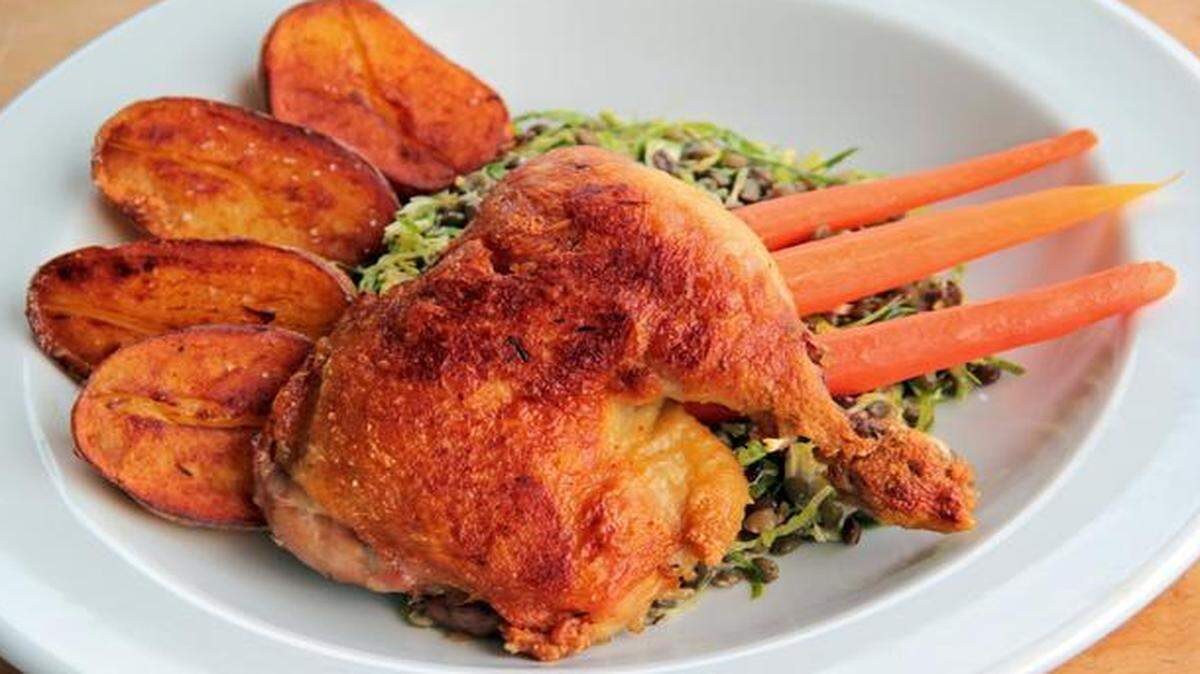
Sous vide Confit Chicken Leg With Crispy Potatoes and Lentil Salad
Confit is a classic technique of curing and then cooking an item in its own fat slowly for hours. Duck confit is the most famous example, but the inexpensive and readily available chicken leg quarter makes a fine substitute that is ideal and easy for beginning your sous vide cooking experience. The potatoes and carrots can be cooked with the turnips and beets a day ahead, then reheated individually and finished for each dish. The mustard vinaigrette does double duty dressing the lentils and the beet salad if made together.
Makes 4 servings
For confit:
5 tablespoons kosher salt
2 bay leaves, crumbled
4 sprigs fresh thyme
8 whole black peppercorns
4 garlic cloves, smashed
4 chicken leg quarters
6 tablespoons chicken fat (or duck fat, lard, butter)
8 new potatoes, whole, cooked sous vide at 185 degrees for 45 minutes to 1 hour
8 carrots, peeled, cooked sous vide at 185 degrees for 20 to 30 minutes
For lentil salad:
1/4 cup sherry or red wine vinegar
1 lemon, juiced
1 tablespoon Dijon mustard
2 cloves garlic, finely minced
Freshly ground black pepper
1 1/2 cups olive oil
2 cups Puy or green lentils, cooked according to package directions
1/2 pound Brussels sprouts, sliced very thinly
To make the confit: Combine salt, bay leaf, thyme, black pepper and garlic in a mixing bowl. Place chicken leg quarters in a glass baking dish or large Ziploc-style bag, sprinkle salt cure mixture over each leg evenly. Let sit overnight in the refrigerator.
Remove legs from cure, rinse off and dry thoroughly. Place 2 legs each into 2 vacuum bags with 3 tablespoons fat each and seal. Cook in water bath with immersion circulator set to 165 degrees for 3 to 4 hours.
If not serving immediately, shock sealed bag of chicken in an ice bath for 20 minutes, then refrigerate. If using immediately, drain fat and juices from the bag and pat chicken dry.
In skillet on medium high, add chicken, skin side down, and cook until crisp and golden brown, 3 to 4 minutes. Turn and brown slightly on other side, about 1 minute.
Remove chicken, then slice new potatoes in half and add them, cut side down, and cook until golden brown, 1 to 2 minutes.
To make lentil salad: Whisk together vinegar, lemon, mustard, garlic and black pepper in a mixing bowl. Whisking quickly, or with electric mixer, slowly add olive oil in a stream to form an emulsion. (Put dressing in jar or squeeze bottle and refrigerate until ready to serve.)
To serve, combine cooked lentils with shaved Brussels sprouts and 3 tablespoons vinaigrette (save the remainder for another use). Mound a portion of lentil salad in center of plate with carrot as garnish. Serve chicken leg over salad and accompany with crispy potato halves.
Per serving: 951 calories (30 percent from fat), 33 grams total fat (8 grams saturated), 66 milligrams cholesterol, 119 grams carbohydrates, 50 grams protein, 1,052 milligrams sodium, 35 grams dietary fiber.
Beer-Brined Sous vide Pork Belly With Pickled Apple, Braised Turnip Greens and Mashed Turnip
Pork belly is the fetching cut of pig you would normally know as bacon, but before it is cured or smoked. This beer-brined pork belly gives the belly a slight cure, infusing flavor and seasoning into it before it cooks sous vide for hours. Once cut and seared, it elevates the humble cut to an unctuous bit of pork grandeur. Pickled apples and the two turnip dishes offer sweet, slightly tart and earthy flavors to balance the richness of the beer-brined belly.
Makes 4 servings
For beer brine:
2 cups water
1 bottle of beer (such as Boulevard KC Pils or Wheat)
1/4 cup salt
4 tablespoons brown sugar
1 bay leaf
4 sprigs fresh thyme
1 tablespoon smoked paprika
2 pounds pork belly, cut into two pieces
For the pickled apples:
1/2 cup water
1/4 cup apple cider vinegar
3 tablespoons sugar
1 teaspoon kosher salt
1 Granny Smith apple, sliced thinly
For the turnip mash:
6 turnips, peeled and halved, sealed with 6 tablespoons butter and cooked sous vide at 185 degrees for 1 hour, (reserve turnip greens, clean and roughly chop)
3/4 cup milk
To finish the dish:
2 tablespoons oil
2 cloves garlic, minced
Reserved turnip greens
Salt and pepper to taste
To make the beer brine: In a mixing bowl, combine water, beer, salt, brown sugar, bay leaf, thyme and paprika; stir all ingredients to dissolve salt and sugar, then pour over the pork belly pieces in a large Ziploc-style bag. Brine overnight.
Drain pork belly and dry thoroughly; place pieces into large vacuum style bag or large Ziploc-style bag, then seal. Cook sous vide in water bath set for 160 degrees for 12 hours.
Chill in ice bath for 20 minutes and refrigerate. When cold, cut pork belly lengthwise into strips 1/2 inch thick; removing the layer of skin on top is optional. Keep in the refrigerator until ready to serve.
To make pickled apples: An hour before serving, stir water, vinegar, sugar and salt together in a mixing bowl until dissolved, then pour over apples and allow to sit.
To make turnip mash: Empty turnip bag and its juices into a medium saucepan with milk on low heat. Mash as you would mash potatoes with a mixer or by hand.
To finish cooking pork belly: Add oil to large skillet over medium-high heat and carefully lay in strips of pork belly, searing on both sides to caramelize the exterior, about 2 to 4 minutes total. Remove pork and add garlic and turnip greens to pan, stirring and cooking until wilted, about 5 minutes total. Season with salt and pepper to taste. Serve pork and greens with pickled apples and turnip mash.
Per serving: 665 calories (62 percent from fat), 46 grams total fat (21 grams saturated), 172 milligrams cholesterol, 30 grams carbohydrates, 34 grams protein, 965 milligrams sodium, 4 grams dietary fiber.
Kale Salad With Sous vide Beets, Hazelnuts and 64-degree Celsius Egg
This is a slightly more modern spin on the classic beet-topped salad with poached egg. The 63-degree C egg is popular in many restaurants (and appears on the menu by its Celsius temperature), but I prefer the creamier, less slithery, texture of a 64-degree C egg (or 147 degrees Fahrenheit).
Many different greens would work for this, but kale is very healthy and has a nice sturdy crunch to it that works well with the softer textures of the other elements. You can play with adding other ingredients like good cheese, other nuts or vegetables to your liking.
Makes 4 servings
2 large or 4 small beets, cooked sous vide at 185 for 1 to 1 1/2 hours (reserve beet greens, wash and thinly slice)
4 eggs, cooked sous vide at 147 degrees F or 64 degrees C for 1 hour
2 bunches kale, spinach or mixed greens, stems removed and sliced thinly crosswise
4 tablespoons mustard vinaigrette (see Lentil Salad recipe on D5) or your favorite salad dressing
1/4 cup hazelnuts, toasted and coarsely chopped
Remove beets from bag, draining any juices. Slice each half into four wedges and reserve.
Gently crack the eggs as though peeling a soft boiled egg. The whites will still be quite soft and slightly runny, so gently lay peeled eggs in individual bowls.
Assemble kale or greens in large mixing bowl and add 4 tablespoons mustard vinaigrette, tossing to mix thoroughly. Add to bowls. Top with slices of beet around the edges with the 64-degree egg in the center. Garnish with hazelnuts.
Per serving: 274 calories (67 percent from fat), 21 grams total fat (3 grams saturated), 212 milligrams cholesterol, 13 grams carbohydrates, 10 grams protein, 155 milligrams sodium, 4 grams dietary fiber.
This story was originally published March 10, 2015 at 7:00 AM.