
HBO miniseries ‘Olive Kitteridge’ finds just enough humor in human trauma
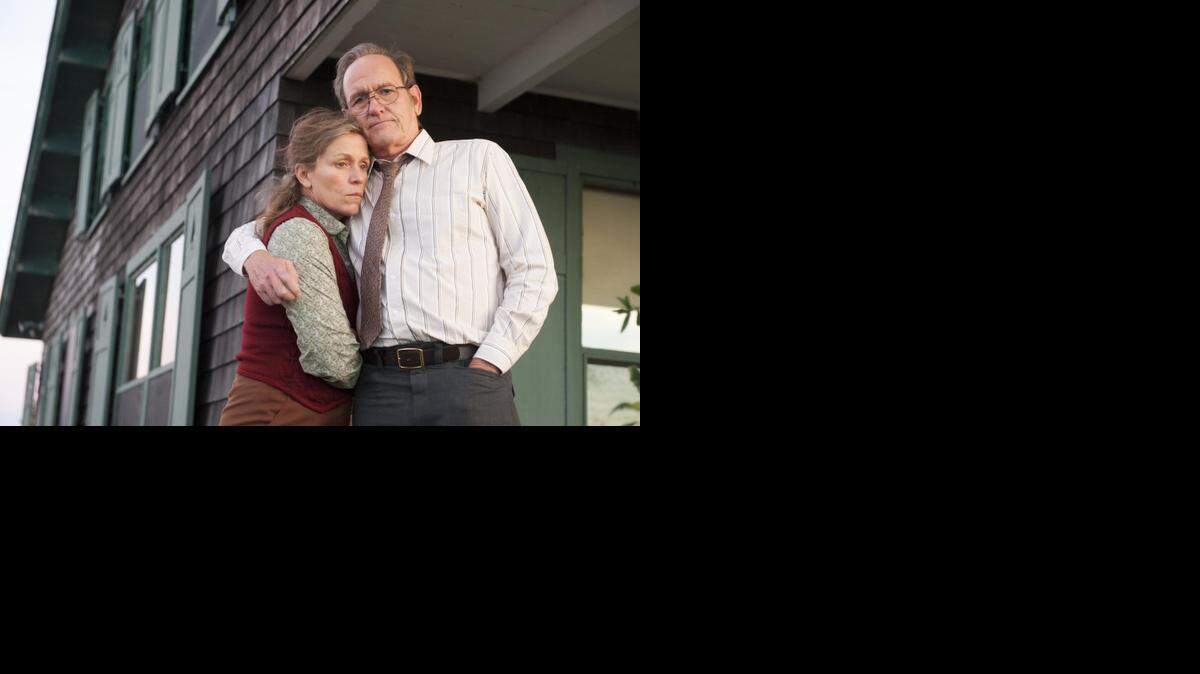
If you think your mom is moody, embarrassing in public, passive-aggressive and overly critical, “Olive Kitteridge” will make you want to give her a hug.
Based on the Pulitzer Prize-winning novel-of-stories by Elizabeth Strout, “Olive Kitteridge” bounces around the life of an aging everywoman who keeps her emotions under wraps by never holding back her acerbic opinions.
We meet Olive when she’s still a seventh-grade math teacher in coastal Maine. She lives in a town where people say “gosh,” take pride in the quality of their firewood, put ketchup on baked beans and turn gloomy when the slush lingers on the streets.
Frances McDormand delivers another one of her consistent, airbrush-free performances in HBO’s four-part miniseries, an adaptation of Strout’s book that focuses more tightly on its title character and ends up drawing to a simpler, more raw-edged conclusion.
Richard Jenkins is equal parts endearing and maddening as Olive’s husband. A pharmacist, Henry Kitteridge is so earnestly benevolent that he won’t fill prescriptions he doesn’t approve of, such as an extra Valium request from a troubled single mom (Rosemarie DeWitt).
Mental illness — specifically, depression — is a fact of life Olive dismisses with aplomb, even when her son, Christopher, asks her at the dinner table if she’s depressed.
“Your mother is not depressed,” Henry insists.
“Yes I am,” Olive insists. “Happy to have it. Goes with being smart.”
Mealtimes in the Kitteridge household bring thick stews, steamer clams and inevitable conflict, often spurred by the topic of Mr. O’Casey, the English teacher whose high standards for Christopher’s schoolwork match Olive’s own.
“Your son doesn’t understand subtext!” she snaps during one dinnertime squabble, then starts scrubbing the dishes furiously with Joy detergent.
“Well, I don’t know that I understand subtext,” Henry muses. No kidding.
Olive and Henry are constantly confronting death: discussing it, witnessing it, even preventing it. Olive complains about her father’s suicide as though she’s discussing the weather.
As “Olive Kitteridge” moves forward, mostly chronologically, it becomes clear that Olive thinks herself too complicated for those around her. People enter her life to make waves, then wash away again, with Henry her only constant.
And those tertiary roles are occupied by a bevy of strong young actors — Jesse Plemons of “Breaking Bad,” Zoe Kazan of “Ruby Sparks,” John Gallagher Jr. of “The Newsroom” — who are nonetheless thoroughly outclassed by their older castmates.
The late arrival of Bill Murray as a Limbaugh-listening, Porsche-driving widower keeps the four-hour story from turning into a hopeless wallow as Olive’s caustic relationships begin to wither for good.
Out for fresh doughnuts, our heroine finds herself having an intimate chat about suicide with a former student during a windstorm.
“It’s never clean,” she scolds him after seeing the shotgun in the backseat. “You should know that.”
Despite her take-no-prisoners philosophy on living, Olive ends up putting up with a lot: Her husband’s galling crush on a young widow, her daughter-in-law’s biting condescension, her son’s therapy-induced self-righteousness.
McDormand captures more of her character’s anxiety and less of her lumbering awkwardness. Olive is always busy cleaning, gardening, working — and eating as though she’s starving.
She tears into her steak and baked potato while everyone else is toasting at the rehearsal dinner before Christopher’s wedding, then passes around a tin of nuts during the ceremony.
Staying relentlessly busy, even as her back bends with age, keeps Olive moving after tragedy strikes. “Go, go, go,” she whispers to herself.
There’s no doubt “Olive Kitteridge” in any form would be a depressing exercise in entertainment. But McDormand’s version, directed by Lisa Cholodenko of the Oscar-nominated film “The Kids Are All Right,” finds just the right amount of levity.
Strout’s book, told in a series of 13 related stories, wasn’t something readers tore through in a night or two, so it’s good that the miniseries is chopped up into four hourlong bits — Olive’s world can be so suffocating to observe, it’s hard to imagine inhabiting it.
Olive can be one mean old lady, but you’ll love watching her go through airport security in a bad mood.
To reach Sara Smith, call 816-234-4375 or send email to ssmith@kcstar.com. Follow her on Twitter: @SarawatchesKC.
WHERE TO WATCH
“Olive Kitteridge” premieres at 8 p.m. Sunday on HBO.
This story was originally published November 1, 2014 at 7:00 AM with the headline "HBO miniseries ‘Olive Kitteridge’ finds just enough humor in human trauma."