
The Lyric’s ‘Silent Night’ appeals to more than just fans of opera
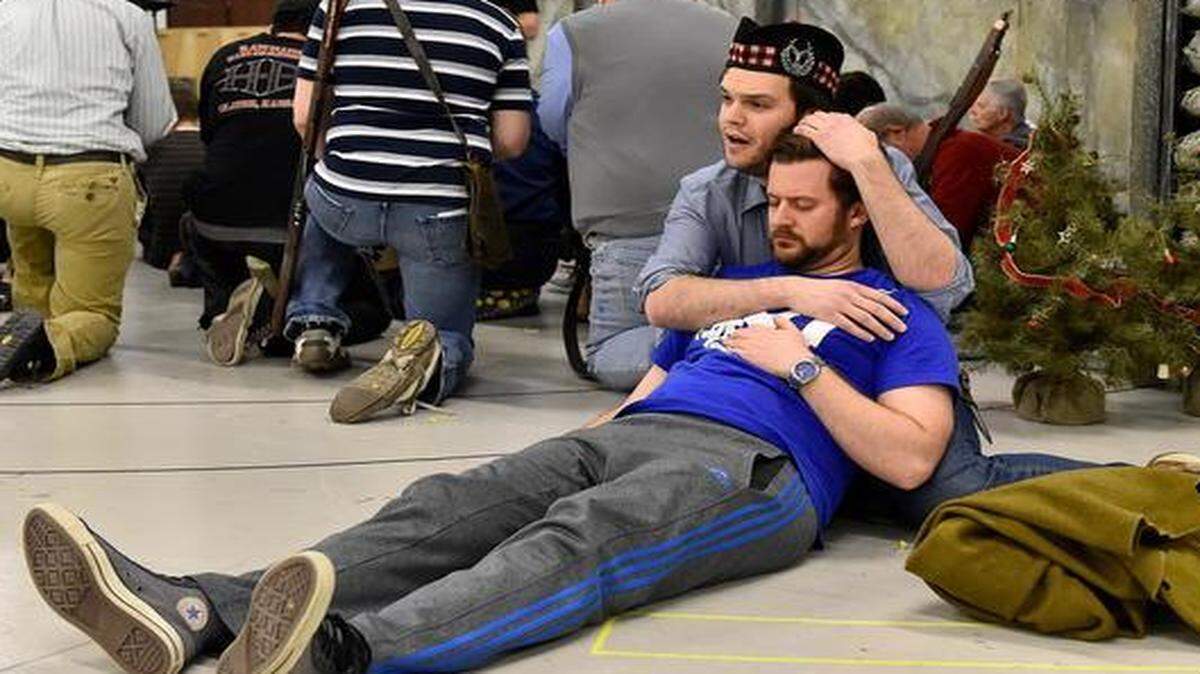
Craig Irvin has performed the role of a German officer in the World War I-set opera “Silent Night” more than a dozen times, but that repetition hasn’t hardened his heart.
“There are still moments on stage where I’m almost moved to tears,” Irvin said.
“Silent Night,” by composer Kevin Puts and librettist Mark Campbell, is based on the film “Joyeux Noël,” which tells the story of the 1914 Christmas truce when German, French and Scottish troops broke protocol and reached out across no man’s land to exchange carols, gifts and brotherly love.
The Lyric Opera of Kansas City will perform the Pulitzer Prize-winning opera four times, beginning Saturday at the Muriel Kauffman Theatre.
This will be the fifth production in which Irvin has portrayed the tormented Horstmayer. He says his favorite orchestral part comes when a French lieutenant sings as he writes down the names of dead soldiers, then puts down his pencil to sing about how much he misses his pregnant wife. The chorus bleeds into the end of the aria. It starts in English, and the French join in, and then the Germans. The chorus ends at sunrise.
“When I first heard that, my jaw literally dropped,” he said. “You can hear the sunrise with the birds singing and fluttering off into the distance. From that moment of touching beauty, I’m completely lost.”
Deborah Sandler, general director and CEO of the Lyric Opera, was similarly affected when she first saw the show.
Given the fact that Kansas City is home to the nation’s only World War I museum and that last year marked the centennial of the start of the war, she thought the opera would be an ideal choice for her company and the community.
“The issue of war and its toll is with us today,” she said. “There is so much conflict in the world. There’s so much isolation. This opera addresses it in such a powerful, beautiful way.”
The dramatic story, with its tender pathos and heartbreaking tragedy, noble heroes and soulless villains, certainly has an operatic quality. According to Sandler, Puts’ score is appropriately emotional and, unlike much modern classical music, very tonal. Audiences should be very comfortable with the sound of the opera, which is lush and romantic, she said.
“It’s unfortunate that sometimes when you talk about contemporary opera, people immediately imagine that the music is not melodic, that it is scary and off-putting,” she said. “That could not be farther from the case in this work. I think Kevin Puts is clearly one of the foremost composers today.”
Irvin agrees that the opera should have broad appeal, not just for its music but also for what he describes as its cinematic quality.
“If you love movies, you’ll love ‘Silent Night,’” he said.
There is a choreographed battle with hand-to-hand combat and guns shooting, and realistic sound effects of machine gun fire and bomb bursts.
In a performance in Fort Worth, Texas, the company invited military personnel to watch the final rehearsal for free, and the cast ran into them later at a bar.
“We were sitting there drinking and having fun, and a couple of guys in military uniform came up to us and said they had just come to the show, and it was the first opera they had ever seen, and they loved it,” he said. “They actually came back to both performances in Fort Worth.”
The production also uses video projection creatively.
“My character, Horstmayer, is Jewish and there’s a funny line when a Scottish soldier comes up to me and says, ‘Well, this may turn out to be the most memorable Christmas of your life.’ And my response is, ‘In my life, it’s the only Christmas,’” he said.
“At the end of the opera, one of the last things you see is the Germans being sent off to the Russian front. As they walk off the stage, you see a projection of a train, and it’s the train that takes them to the front, but it also alludes to the trains that are coming for Horstmayer and his family in about 30 years.”
Sandler wants to make “Silent Night” as accessible to the community as possible because she thinks audiences will be profoundly moved by the opera. To that end, she will moderate a free panel discussion the day before the opera at 6:30 p.m. at the Muriel Kauffman Theatre. The panel will include cast members, the composer and librettist and a World War I scholar. And “Joyeux Noël” will be screened for free at 3 p.m. Sunday at the National World War I Museum.
“I’ve never really done an opera before where I knew the audience was going to cry,” Irvin said. “I don’t want any empty seats in the house because every empty seat is a person who could’ve seen the show. ‘Silent Night’ is all of the things that I think a great opera should be.”
7:30 p.m. Saturday, 25 and 27 and 2 p.m. March 1. Muriel Kauffman Theatre, Kauffman Center for the Performing Arts. $30-$175. 816-471-7344 or kcopera.org.
Patrick Neas is program director for RadioBach.com. You can reach him at pneas@jccc.edu.
Musica Sacra
Timothy McDonald will lead Musica Sacra in music by William Byrd, William Boyce and Wolfgang Amadeus Mozart Saturday night at St. Francis Xavier Church.
Byrd was one of the greatest composers of the Elizabethan era, and Musica Sacra will perform several of his soaring motets. Boyce is a composer whose works should be much better known, and his Jubilate Deo and Lenten anthems should be a great introduction to his distinctive British sound. Musica Sacra has a way with Mozart, so one can expect his Missa Brevis, KV. 49 to sound pretty glorious in the resonant St. Francis Xavier acoustics.
7 p.m. Saturday. St. Francis Xavier Church, 1001 E. 52nd St. $12-$18. 816-235-6222 or rockhurst.edu/mstickets.
Heritage Philharmonic: Music of Russia
James Murray will conduct the Heritage Philharmonic in “Music of Russia” Saturday night at Blue Springs High School. Murray has chosen music that is very evocative of 19th century Russia, and they’re works that don’t show up on concert programs all that often.
The Symphony No. 2 by Alexander Borodin is a richly melodic work that should appeal to those who love the composer’s Polovtsian Dances. Anatol Liadov’s “Eight Russian Folk Songs” are colorful orchestrations of songs ranging from the comic to sublimely spiritual. Cellist Susie Yang will be the soloist for Peter Ilyich Tchaikovsky’s “Variations on a Rococo Theme.” Written in a Mozartean style, the variations combine 18th century, classical elegance with lush Russian romanticism.
7:30 p.m. Saturday. Blue Springs High School, 2000 N.W. Ashton Drive, Blue Springs. Free. heritagephilharmonic.org
This story was originally published February 14, 2015 at 6:00 PM with the headline "The Lyric’s ‘Silent Night’ appeals to more than just fans of opera."