
‘Black Pearl Sings’ was a story playwright Frank Higgins couldn’t ignore
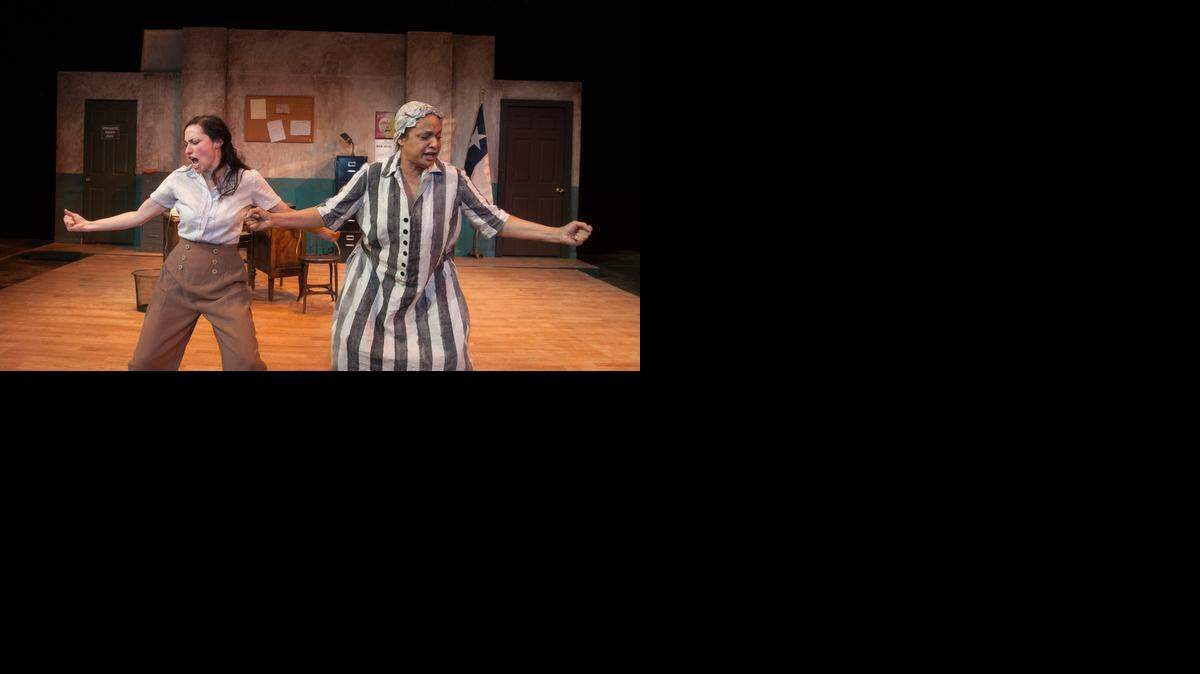
Two women. One black, the other white. One educated, the other not. One pushing to make her name in a male-dominated world, the other committed to finding a missing daughter.
These are the characters — indeed, the only characters — in Frank Higgins’ “Black Pearl Sings,” a play about the power of music and language that became one of the most-produced plays in regional theater during the last five or six years.
Higgins, a Kansas City-based playwright, modeled his Depression-era story to an extent on the history of folklorist John Lomax, who traveled the American South in the 1930s with a massive recording device in the trunk of his car, collecting folk songs from farmers, laborers and convicts.
His most famous “discovery” was Huddie Ledbetter — “Lead Belly” — an African-American guitarist and songwriter serving time in the Angola Prison Farm in Louisiana. Ledbetter later became an important figure in American music, often performing with Woody Guthrie, Pete Seeger and other folksingers of the era.
But as Higgins rolled the dramatic possibilities around in his creative imagination, he decided to reverse the gender of the characters — which allowed him to depict women who, each in her own way, could be seen as a proto-feminist.
Higgins is a guy you’re tempted to call a “journeyman” playwright. He’s been at it for decades, quietly working on his craft, gradually creating a body of work that has yielded productions in New York, California and points in between. But “Black Pearl Sings” has achieved success beyond anything else Higgins has written.
Higgins said recently that his two-actor play about a song collector and a convict in 1935 has had about 40 productions in regional theaters, including some of the most respected companies in the country — Northlight Theatre in Skokie, Ill.; the Penumbra Theatre in St. Paul, Minn.; Ford’s Theatre in Washington D.C.; Portland Center Stage in Oregon and the Geva Theatre Center in Rochester, N.Y.
“I haven’t counted them,” Higgins said. “I’ve seen at least 15. It just opened (in February) in North Carolina. What’s becoming common is that I just can’t get there. If I go to see some of those shows, I’m going on my own nickel.”
But now “Black Pearl Sings” will be performed for Kansas City audiences. A new production from Spinning Tree Theatre begins performances Friday at Just Off Broadway Theatre in Penn Valley Park. Veteran actor Walter Coppage makes his professional directing debut with the show, which features Vanessa Severo and Nedra Dixon.
The play depicts Susannah Mullally (Severo), a folk-song collector from the Library of Congress, and her relationship with the title character, Alberta “Pearl” Johnson (Dixon), a female convict in the Texas prison farm system, who possesses rare folk songs she learned growing up among the Gullah people in the Sea Islands off Georgia and South Carolina.
Susannah sees Pearl’s storehouse of rare music as a path to establishing her academic credentials, while Pearl views Susannah’s interest as leverage she could use to gain her freedom.
Higgins, who teaches playwriting at the University of Missouri-Kansas City, said that Lomax was far from being the only folk-song collector in the 1930s and that a number of women produced important field recordings — not the least of which was Zora Neale Hurston, a writer who devoted her literary career to documenting and reflecting African-American culture.
As a result, Higgins said, he began imagining the story with female characters. For one thing, a play depicting Ledbetter would require an actor who could convincingly play the 12-string guitar, an exceedingly rare commodity. But there was another reason he began constructing the story from a feminine perspective — he was caring for his mother as she succumbed to Alzheimer’s disease.
“After I finished the first draft, I found myself becoming aware of this link: the song collector is trying to save and preserve … songs before they disappear from public memory forever,” Higgins said. “In dealing with my mother, I was trying to save and preserve her as much as possible before she disappeared — and I guess by extension, part of me.”
Higgins said he often tells his students: Write the play you can’t not write. And “Black Pearl Sings” was that kind of play. But Higgins said his thoughts about the creative process came later.
“If you think about things too much beforehand, it can interfere with freeing your mind up and writing from your subconscious,” he said.
Higgins’ mother died in 2006 — the same year the play received its first public performance as part of the “Plays in Progress” reading series at Rockhurst University. The official premiere came a year later in Houston. Higgins said that in preparing the Spinning Tree production, he’s made minor changes to the script in collaboration with Coppage. And working on it in his hometown has been a rare pleasure.
“It’s nice to be able to work on a play and sleep in my own bed,” he said.
Coppage said he’s glad Higgins chose to write about women.
“It’s not that story of John Lomax and Lead Belly but it’s a similar kind of situation,” Coppage said. “In some ways I’m kind of glad he didn’t write that story because we have plenty of plays about two guys.
“The other reason I think it should be about women is that for a lot of women, especially characters like Susannah, they were trying to advance in academic departments and this is one of the few areas where they could go out and be their own boss and do the research.”
To do that in the ’30s required a thick skin and intense ambition. Pearl developed her own hard-as-nails mindset behind bars.
Coppage said the play — although far from a musical — contains about 20 songs, some of which are heard only in snippets. Most of them are performed a cappella by Dixon, who has pursued a multipronged career as an actress, director, choreographer and jazz singer.
An autoharp played by Severo, who also sings in the show, is the only accompaniment. Musical director Angie Benson worked with the actresses on the arrangements.
Barry Lee, a program host and the manager of KKFI-FM, said he and Higgins go back to their days when they were both poetry-writing students at Raytown High School and later UMKC.
Lee said he has read the play but has yet to see it; he is eagerly looking forward to it. At times, he said, Higgins would solicit his opinion about the use of certain songs in the show.
“The dialogue is very witty, and he knows where to put the right lines in the right places to get the right reaction,” Lee said. “I got the sense that it was going to be something powerful onstage.”
Lee said the play obviously calls for strong actors.
“For an actress, this play is a daunting prospect,” he said. “You have to have a singer who can act. It requires a lot of stamina from the actresses in order to pull this play off.
“It makes them reach and stretches them as an actress. And they don’t get a break. They’re on stage the whole time.”
Coppage thinks he has the ideal cast. Dixon, who was memorable for her comic performances in multiple roles in the Coterie’s two productions of “The Wiz,” already was attached to the production by the time Coppage came on board. Other actresses were asked to audition for Susannah by reading with Dixon. Severo, he said, was the ideal choice.
“Vanessa just walked in and drilled it,” Coppage said. “(Nedra) was kind enough to come in and read, and she and Vanessa had chemistry right off the bat. My job was done at that point. I was like, ‘Just light it.’”
One reason “Black Pearl Sings” has been so successful in regional nonprofit theaters is pretty basic: It’s affordable to produce. It has only two actors and uses public-domain music. Beyond that, it deals with race and women’s issues — topics that always attract the attention of artistic directors. Put it all together, and you have what amounts to a commercial formula.
But Higgins said that only became clear after he had finished the script. His only goal was to write something good.
“The thing I try to communicate to my class at UMKC is that you need to get yourself to the point where if you have a heart attack and you’re dying, you can say, ‘I wrote the play I couldn’t not write,’” he said. “The couple of times I had a commercial idea, those were really hard to write because they were coming from my head and not my heart.”
Opens Friday
“Black Pearl Sings” begins performances Friday and runs through March 22 at the Just Off Broadway Theatre, 3051 Central St. in Penn Valley Park. Call 816-569-5277 or go to SpinningTreeTheatre.com.
This story was originally published March 5, 2015 at 6:01 AM with the headline "‘Black Pearl Sings’ was a story playwright Frank Higgins couldn’t ignore."