
The Classical Beat: KC Symphony teams again with audiophile label to record Holst’s ‘Planets’
Reference Recordings is not one of the larger classical recording labels, but to cognoscenti it’s one of the finest.
Founded in 1976 by John “Tam” Henderson and Keith O. Johnson, the label is devoted to quality, not quantity.
There are only 100 recordings in its catalog, but they are recordings of only the finest orchestras and musicians in the highest-quality audiophile sound.
Many of them have been nominated for and earned Grammy Awards. Johnson has received seven nominations for Grammy engineering awards.
In 2010, the Kansas City Symphony began recording for Reference, and right out of the gate its recording of Benjamin Britten’s “Young Person’s Guide to the Orchestra” won a Grammy for best surround-sound album. Since then there have been three other Kansas City Symphony releases, with more in the pipeline.
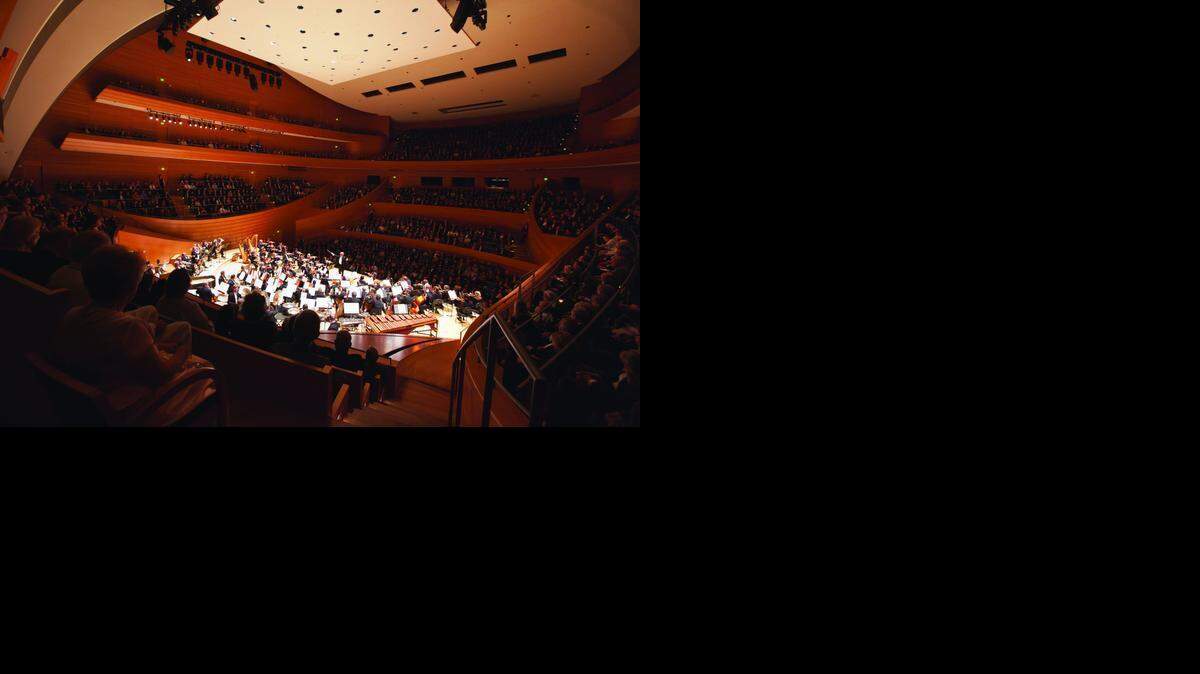
Coming up next, Reference will record the Kansas City Symphony’s performance of Gustav Holst’s “The Planets.” You can attend a recording preview concert of “The Planets” on Thursday at Helzberg Hall. Also on the program is Holst’s “The Perfect Fool” ballet suite, which will fill out the new CD.
“Ultimately a recording should simulate the same flow and the same freedom and the same spontaneity that you would hear in a live concert,” said Frank Byrne, executive director of the Kansas City Symphony. “So by doing the performance, we have the opportunity to exhibit the work that’s gone into the rehearsals leading up to the recording and to give the audio engineers a chance to test balances and look at all issues of mic placement and anything else that we might need to address or tweak before we go into the sessions themselves.”
Johnson will record “The Planets” in Helzberg Hall, which he considers “a great hall.” The first album that Reference made with the Kansas City Symphony was recorded in Community of Christ Auditorium, which Johnson considers problematic but likens to the Royal Albert Hall in London.
“When we recorded Britten’s ‘Young Person’s Guide to the Orchestra’ in the Community of Christ Auditorium, it kind of matched Albert, where the Britten was either originally performed or performed a fair amount because it fit. Albert’s an arena, and you expect to hear things bouncing all over the place. The reverb has intelligence. You can actually hear the words coming back at you.
“Helzberg Hall is very, very opposite. It has a congealed, overall balanced sense of space. The space is actually projected to the audience, which gives great excitement. That kind of space works especially well for strings and for large ensembles within the orchestra.”
Johnson is a legend in the recording industry. As a boy he was a recording hobbyist. While still in high school he made one of the first portable yet serious tape recorders. He earned a scholarship to Stanford University from Ampex, an electronics company known for its recording equipment. After graduation he started making recordings for Armed Forces Radio in Los Angeles.
“There were some great orchestras and conductors in Los Angeles,” he said. “The L.A. Philharmonic shared musicians with Carmen Dragon’s Hollywood Bowl Orchestra. The famous soundtrack composer Franz Waxman also had things going. So I got to learn how orchestras work. I started making my own microphones and experimenting. Decca London heard of me, and I was invited to come to sessions and listen in. Once in a while I’d hang up some microphones, and we’d compare different microphones on a live session.
“I took some of the more interesting recordings that we could release and put them on an album called ‘Professor Johnson’s Astounding Sound Show,’ and that took off. That was the start of Reference Recordings. It became a hit and put the label on the map.”
For more than 30 years Johnson has been recording the world’s greatest orchestras in some of the world’s greatest halls. So how does the Kansas City Symphony measure up?
“Basically I consider them to be a formidable orchestra,” he said. “They’re serious, they’re real, they have presence, and they have visibility. They’re a team, and they’ve got vision about where they’re going and the skills to perform. The Kansas City Symphony also has a great venue in Helzberg. You put all that together, and you have something that we thought was definitely worth considering.”
Byrne returns the admiration for Reference. He considers the audiophile label to be the perfect match for the Kansas City Symphony.
“The distinguishing feature of Reference Recordings is their commitment to making audible every note that is in the score,” he said. “We are both excited and at the same time daunted by the challenge to deliver the kind of performance that Reference will represent in their truly spectacular sound.
“For a company like Reference, the microphones are a sort of microscope to the music. Every little detail of the performance will be exposed, so it’s incredibly challenging to make sure that something that might pass unnoticed in a live performance is captured in as perfect detail as can possibly be achieved for a recording that people can review and listen to multiple times. It’s a permanent document.”
Johnson says he is very pleased with his label’s partnership with the Kansas City Symphony. And he’s also very happy with the repertoire that the symphony has been recording. In addition to the Britten, there have been discs of music by Edward Elgar, Arthur Sullivan and Paul Hindemith. In the can but not yet released are Camille Saint-Saens’ Organ Symphony, with Jan Kraybill playing the Helzberg Hall organ, and a disc of music by Adam Schoenberg.
“The choice of compositions has been very, very fine,” he said. “You really have to know what you’re doing to venture out into a lot of this music, because reviewers might say, ‘Well, I like some older recording better,’ and that’s the end of that. With the Kansas City Symphony, that’s not been happening. Instead, the critics are saying, ‘Well, here’s something new.’ They like what they hear or feel or sense.
“After all, the sound of the recording is not just what I do. It’s the playing. If the brass are tight and powerful, they’re going to make it happen. If the strings are a bunch of kitty cats squealing together, it’s not going to work. You have to have a great orchestra to start with to get a great sound. My skill is to support it.”
7 p.m. Thursday. Helzberg Hall, Kauffman Center for the Performing Arts. $9. 816-471-0400 or www.kcsymphony.org.
Patrick Neas is program director for RadioBach.com. To reach him, send email to pneas@jccc.edu.
Friends of Chamber Music — Alon Goldstein with the Ariel Quartet
World War I has been a prominent theme this season with Kansas City’s classical music organizations.
The Friends of Chamber Music will present a concert Friday that explores music from the time of the Great War.
Pianist Alon Goldstein and the Ariel String Quartet will perform the Divertimento for String Quartet by Erwin Schulhoff, Three Pieces for String Quartet by Igor Stravinsky and the Piano Quintet in A Minor by Edward Elgar.
Schulhoff, born in Prague of Jewish-German ancestry, served in the Austro-Hungarian army in World War I, fighting on the Russian front. He was taken prisoner and was released from an Italian prisoner-of-war camp at the end of the war.
His divertimento was a student work, written in 1914, when Schulhoff was 20 years old. It’s a cocky work and a harbinger of Schulhoff’s later avant-garde music. Schulhoff was one of the most promising composers of the early 20th century and was arrested by the Nazis for his political and artistic tendencies. He died in the Wulzburg concentration camp.
Stravinsky’s Three Pieces for String Quartet, written in 1914, shows the Russian composer distancing himself even more from romanticism.
Elgar’s Piano Quartet, written in 1918, will balance Schulhoff and Stravinsky’s pungent modernism nicely. Elgar, born in 1857, was firmly ensconced in the sound world of the 19th century, and his Piano Quartet is a perfect example of the kind of rich and melodic writing for which the composer is known.
8 p.m. Friday. Folly Theater, 300 W. 12th St. $10-$25. 816-561-9999 or www.chambermusic.org.
This story was originally published January 25, 2015 at 6:00 AM with the headline "The Classical Beat: KC Symphony teams again with audiophile label to record Holst’s ‘Planets’."