
The Classical Beat: Richard Danielpour is a composer from two worlds but one mission
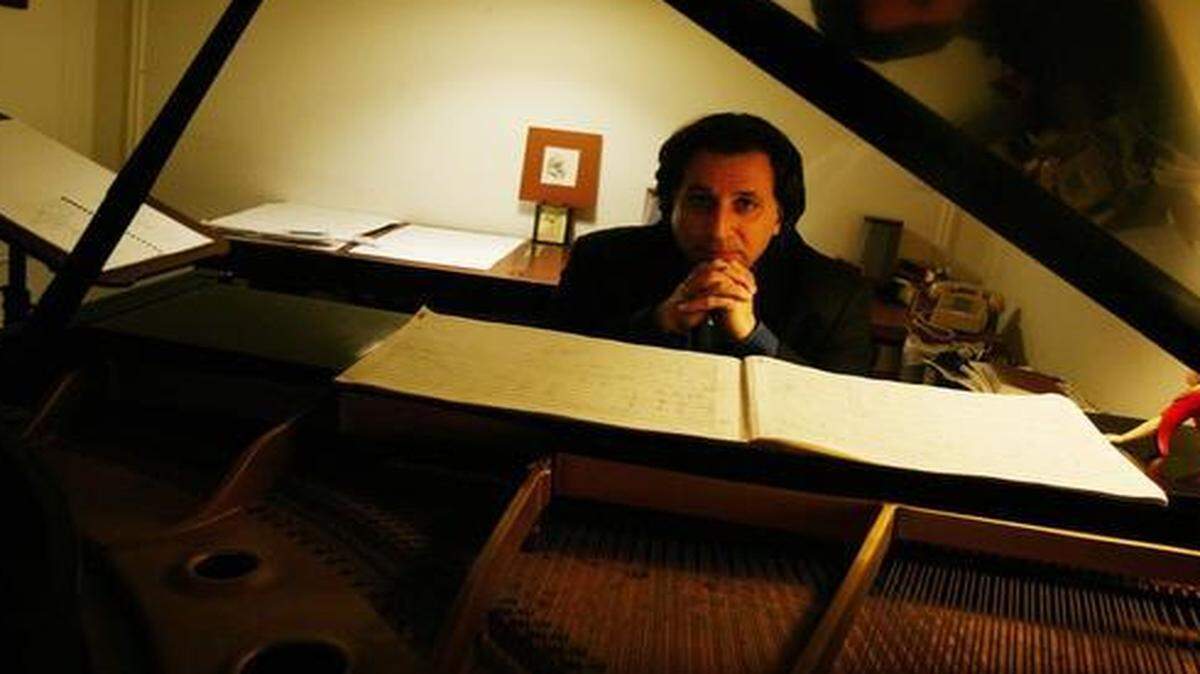
Richard Danielpour describes himself as “an American composer with a Persian memory.”
In his recent works he has been inspired by his Iranian heritage and the heroism of those who are suffering under the mullah regime currently ruling Iran.
But throughout his career, Danielpour has been a champion of the oppressed. For example, his clarinet concerto “From the Mountaintop” pays homage to Martin Luther King Jr. and all those who took part in America’s momentous civil rights struggle.
The Kansas City Symphony conducted by Michael Stern, which co-commissioned Danielpour’s concerto, and clarinetist Anthony McGill will give the Kansas City premiere of the work this Friday, Saturday and March 8 at Helzberg Hall. Also on the program is Ludwig van Beethoven’s “Leonore” Overture No. 3 and Robert Schumann’s Symphony No. 3, known as the “Rhenish.”
Danielpour was born in the United States to Iranian immigrant parents, but at the age of 7 his family returned to Iran so his father could attend to some business interests. While in Iran, the young Danielpour became very ill with kidney inflammation, and after only a year, the family had to return to the U.S. for medical treatment.
But his family maintained its ties to Iran. Danielpour’s mother was a sculptor and did a number of commissioned works for the shah of Iran and the rest of the Pahlavi family. When the shah was overthrown, the Danielpour family was profoundly affected.
“I had a couple of family members imprisoned, and an uncle of mine was tortured and then executed by firing squad,” Danielpour said. “Another family member escaped dressed as a mullah. Just really harrowing stories. Of course because of all of this I kept my Persian heritage at quite a distance. I was born in the U.S., and I wanted to grow up and evolve as an American artist. I didn’t want to have anything to do with my genetic DNA.”
In 2009, with what he calls Iran’s “rigged election,” his attitude changed. After seeing the execution of a young protester, Neda Agha-Soltan, on CNN, he had an awakened interest in his Iranian heritage.
“There were also a number of Iranian expatriates who were musicians who would all come to me and talk about what was going on,” he said. “I started to get interested in ancient Persian poetry and stories like the ‘Shahnameh.’ I began to remember very cogently what I heard and what I saw. I made my peace with all the unpleasantness of the past, and as a result it’s been a great, great resource and something for me to reflect back on.”
Clarinet evangelism
Since 2009, Danielpour has written many works on Iranian themes, incorporating the rhythms of Persian poetry and the sounds of traditional Persian music and addressing the evils of what he calls “Iran’s fascist Islamic government.”
While his clarinet concerto “From the Mountaintop” deals with the American civil rights movement, it shares with his Persian works a concern for victims of injustice. Of the concerti he’s written, it’s among his favorites.
“I care about this one very, very much,” he said. “The clarinet soloist is the equivalent of a minister, and the orchestra represents the congregation. I knew the one person I wanted to premiere this was Anthony McGill. When you see him, he has the same sort of energy that you would encounter in a Southern Baptist church, which is exactly what I wanted.”
The inspiration for the concerto came from Martin Luther King’s last speech which he gave the night before he was killed. Danielpour says that he listened to King’s words over and over again when the idea for the concerto came to him. He considers King’s final speech to be one of his finest.
“It was raining, thundering outside, and he was feeling quite ill,” Danielpour said. “He had a bad sore throat, but he gave the speech of his life. At the very end he said it really doesn’t matter what happens to me now because I’ve been to the mountaintop. I want you to know that I may not get there with you, but we as a people will get to the promised land. My eyes have seen the glory of the coming of the Lord. Then he sat down and collapsed in his chair.”
It is believed that Persian and Indian classical music can subtly alter consciousness, even when the music is without words and purely instrumental. Danielpour shares that belief and hopes his wordless sermon also will work on the hearts and souls of the audience.
“Sometimes instrumental music has a way of bypassing the cognitive part of the brain and going right for the primitive brain, which is preverbal and post-verbal at the same time,” he said. “In many cases what happens is that the person who goes to the concert expecting to receive something always receives the deeper part of themselves or a deeper awareness of themselves. Music is designed for us to get in touch with ourselves.”
A dramatic opening
To set up Danielpour’s concerto, Stern has chosen a work by Beethoven to open the concert, the “Leonore” Overture No. 3.
Beethoven struggled to compose an overture for his opera “Fidelio,” eventually writing four overtures before settling on the shortest of the four as the actual overture. But the “Leonore” Overture No. 3 really took on a life of its own, becoming what Stern calls “a mini tone poem” relating the story of the opera. It’s Beethoven at his dramatic best, Stern said. A descending scale takes listeners into foreign territory, harmonically speaking.
“It’s a perfect evocation of despair, of people being lost,” Stern said. “Then Florestan calls out and you have the heroism of Leonore fighting for her husband’s release and getting him freed. It’s one of the most triumphant endings Beethoven ever wrote.”
With its ringing call for liberty and justice, “Fidelio” is a potent political work of art. But Stern believes that the real relevance of the opera is on the personal level and that its most important message is love.
“Martin Luther King declared war on injustice, but he never wanted to raise a finger,” Stern said. “It was all about equality and fairness and love. In fact, for all of the political agenda in ‘Fidelio,’ ultimately the opera is about Florestan and Leonore.”
The second half of the concert is devoted to Schumann’s Symphony No. 3, the “Rhenish.” The symphony, which depicts the Rhineland region of Germany, was inspired by a trip down the Rhine that Schumann took with his wife, Clara, at a time in the 19th century when rivers were vital.
“They were the hub of all life, they’re where you got your water, commerce went up and down in boats, towns and cities popped up around water and rivers,” Stern said. “This kind of feeling of motion and journey, that’s in the first movement. It just splashes with color right off the bat — boom. Here we go. All aboard.”
At its first performance in Dusseldorf in 1851, the audience loved the work, applauding between movements and shouting hurrah at the end. It truly is a glorious river cruise. My favorite movement is the fourth, which depicts the glorious, gothic Cologne cathedral.
“The fourth movement brings in the heavy brass, and you have this weighty chorale which absolutely evokes the cathedral,” Stern said “And the last movement is pure joy. This is a piece where you just think, he got it so right.”
8 p.m. Friday and Saturday and 2 p.m. Sunday. Helzberg Hall, Kauffman Center for the Performing Arts. $23-$73. 816-471-0400 or www.kcsymphony.org.
Friends of Chamber Music: Andras Schiff
When it comes to piano music of the classical era, Andras Schiff has few rivals.
The Hungarian-born pianist has received countless awards, honorary degrees and critical accolades for his deeply felt and honest interpretations.
The Friends of Chamber Music will present Schiff in Concert One of his series “The Late Great Sonatas of Haydn, Beethoven, Mozart and Schubert” Friday night at the Folly Theater. He will return next year for the Friends’ 40th anniversary season with Concert Two.
On Friday’s program are sonatas by the biggies: Franz Joseph Haydn, Beethoven, Wolfgang Amadeus Mozart and Franz Schubert. Any opportunity to hear to hear a pianist of Schiff’s stature is not to be missed
8 p.m. Friday. Folly Theater, 300 W. 12th St. $15-$35. 816-561-9999 or www.chambermusic.org.
Harriman-Jewell Series Discovery Concert: Zhang Zuo
The 20-year-old pianist Zhang Zuo is already blazing a remarkable career.
She has won prizes in many prestigious international piano competitions, including first prize in the 2006 China Shenzhen International Piano Concerto Competition, and has performed as a soloist with some of the greatest orchestras in the world. She’s obviously a pianist to watch.
The Harriman-Jewell Series will give you a chance to hear this remarkable young woman on one of its free Discovery concerts Saturday at the Folly Theater. Zuo will perform music by Johann Sebastian Bach, Franz Schubert and Franz Liszt.
A highlight of the program will be Schumann’s dazzling “Faschingsschwank aus Wien.”
7 p.m. Saturday. Folly Theater, 300 W. 12th St. Free. Visit www.hjseries.org to print your tickets. Limit four per household.
Patrick Neas is program director for RadioBach.com. To reach him, send email to pneas@jccc.edu.
This story was originally published March 1, 2015 at 2:00 AM with the headline "The Classical Beat: Richard Danielpour is a composer from two worlds but one mission."