
‘Exodus: Gods and Kings’: Let my movie go — 2 stars
Ridley Scott’s “Exodus: Gods and Kings” runs for almost 21/2 hours, and that still isn’t enough time for it to figure out why it’s here or what it wants to say.
It’s based, of course, on the Old Testament story of the exodus of the captive Hebrews from Egypt, but the filmmakers are obviously ambivalent over matters of faith. Heck, they explain away the story’s supernatural elements as a result of a bump to Moses’ noggin.
This is the second monster-budget biblical epic of the year (it follows Darren Aronofsky’s over-produced and over-thought “Noah”). If Hollywood doesn’t believe, why does it bother?
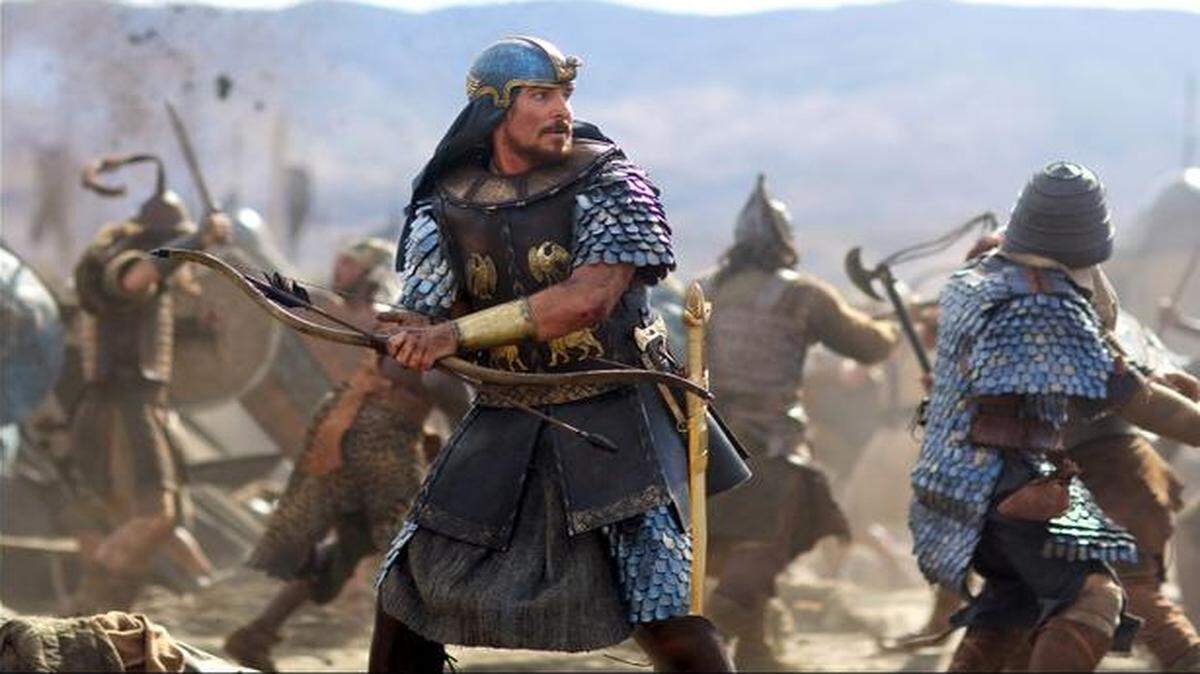
In a word: spectacle. Scott and his visual effects geeks go all out to create the thriving Egyptian capital of Memphis, the parting and unparting of the Red Sea, a slam-bang battle with an invading army.
But on a spiritual and dramatic level “Exodus” is a creaky affair.
Most of us are familiar with Cecil B. DeMille’s 1956 “The Ten Commandments,” an alternately silly and awe-inspiring affair. DeMille may have had the dramatic instincts of a snake oil salesman, but he was a fierce believer in his own showmanship, and if you can ignore the absurd emoting, his epic remains ridiculously entertaining.
Scott, on the other hand, delivers a film that is, well, grumpy. For all the f/x wizardly, there’s not much joy or discovery to be had. “Exodus” feels like a paint-by-numbers job assembled by an indifferent committee.
Dispensing with the babe-among-the-bullrushes origin story, the revisionist screenplay (by Adam Cooper, Bill Collage, Jeffrey Caine and Steven Zaillian) begins with the grown Moses (Christian Bale) and Prince Ramses (Joel Edgerton), who were raised as brothers and are now waging war on an enemy nation. (It’s a trick Scott learned with “Gladiator” — start your film with a big battle.)
It is evident to everyone — including the Pharaoh Seti (John Turturro) — that Ramses is a privileged lout and that Moses would make a better leader, but bloodlines are all important. Soon enough, Ramses exiles Moses, and our hero eventually settles into life in the hinterlands.
But then he gets caught in a landslide, is knocked unconscious and awakens to a burning bush and the Almighty who, in a puzzling Scriptural re-interpretation, takes the form of a crabby young boy who makes cryptic pronouncements and seems mightily unimpressed with his servant Moses.
Believing he has been ordered by God, Moses returns to Egypt to foment rebellion, with the help of some ghastly plagues.
Bale, an actor who seems game for just about any challenge, plays Moses as psychologically tormented. This Moses simply doesn’t want to be here. Yawn.
Edgerton’s Ramses pales in comparison to the buff, arrogant and very sexy interpretation by Yul Brynner in DeMille’s film.
Both actors are British, reflecting Hollywood’s longstanding tradition that ancient peoples all spoke in English accents. And the north African setting is populated mostly by people who seem like candidates for the Aryan Brotherhood. (There’s a school of thought that the ancient Egyptians might have been black, but not in this retelling. Even most of the Semites don’t look particularly Semitic.)
The movie is jammed with pointless cameos by familiar faces like Sigourney Weaver and Ben Kingsley. Aaron Paul, late of cable’s “Breaking Bad,” looks lost as Moses’ colleague Joshua — he gets maybe three lines of dialogue.
The high point of the film has nothing to do with the performances — it’s the plagues (a bloody Nile, frogs, locusts, boils) unleashed upon the Egyptians. About the only time “Exodus” comes to life is when it’s dishing outlandish punishments.
Of course, when DeMille needed to show thousands of Hebrews, he had to hire thousands of extras. That was impressive. Scott whips up most of his effects from electronic bytes. Moral: When you can show anything, nothing is that special.)
Now if you’ll excuse me, I’m going to watch Monty Python’s “Life of Brian” as a palate cleanser.
You can read more of Robert W. Butler’s reviews at butlerscinemascene.com.
‘EXODUS: GODS AND KINGS’
☆☆
Rated PG-13
Time: 2:22
WHAT’S REAL, WHAT’S CGI?
▪ The plagues: Most are computer-generated, but the frogs are very real. Six handlers, with the help of a trained dog, wrangled 400 live frogs on set. Golshifteh Farahani, playing Queen Nefertari, had to pretend to be asleep over several takes, knowing that a bag of frogs was being emptied over her head.
▪ The water: Scenes at the Nile and the Red Sea were filmed in tanks at England’s Pinewood Studios, with some extra digital assistance.
▪ Egypt: The movie was filmed in the deserts of southern Spain (the location for “Lawrence of Arabia” and “Raiders of the Lost Ark”), the volcanic mountains and empty beaches of the Canary Islands, and sets at Pinewood Studios. In the capitol scenes, a statue of Ramses rises 200 feet, 30 of which the production built; the rest was computer-generated.
| Sharon Hoffmann, The Star
Source: 20th Century Fox
3-D OR NOT 3-D?
The 3-D version is perfectly adequate but largely superfluous. It’s unobtrusive — definitely not dramatic enough to warrant the higher ticket price.
This story was originally published December 11, 2014 at 7:00 AM.