
Kansas City FilmFest goes back to ‘Back to the Future’ with screenwriter Bob Gale
Last year an organization named Secret Cinema converted a part of modern London into Hill Valley, the fictional town from 1955 where the movie “Back to the Future” was set.
Audience members were assigned identities that allowed them to interact within a re-creation of the film’s notable locales, including Doc Brown’s laboratory, Lou’s Café, the high school’s Enchantment Under the Sea dance and, of course, the courthouse’s clock tower.
The event drew more than 60,000 people over 20 nights.
“Every filmmaker dreams of having a movie that people still enjoy 30 years later,” says Bob Gale, writer of the “Back to the Future” trilogy. “We didn’t know that was going to be the case. We didn’t know anybody was going to show up at the theater in July 1985 when it opened.”
The enthusiastic dedication to this comedy-adventure is even more prevalent in 2015. After all, that’s the same Space Age year that Marty McFly (played by Michael J. Fox) time-traveled to in “Back to the Future Part II.” Thus numerous events are slated throughout 2015 to celebrate the date (specifically Oct. 21) when Marty arrived, including a Secret Cinema gathering in Los Angeles.
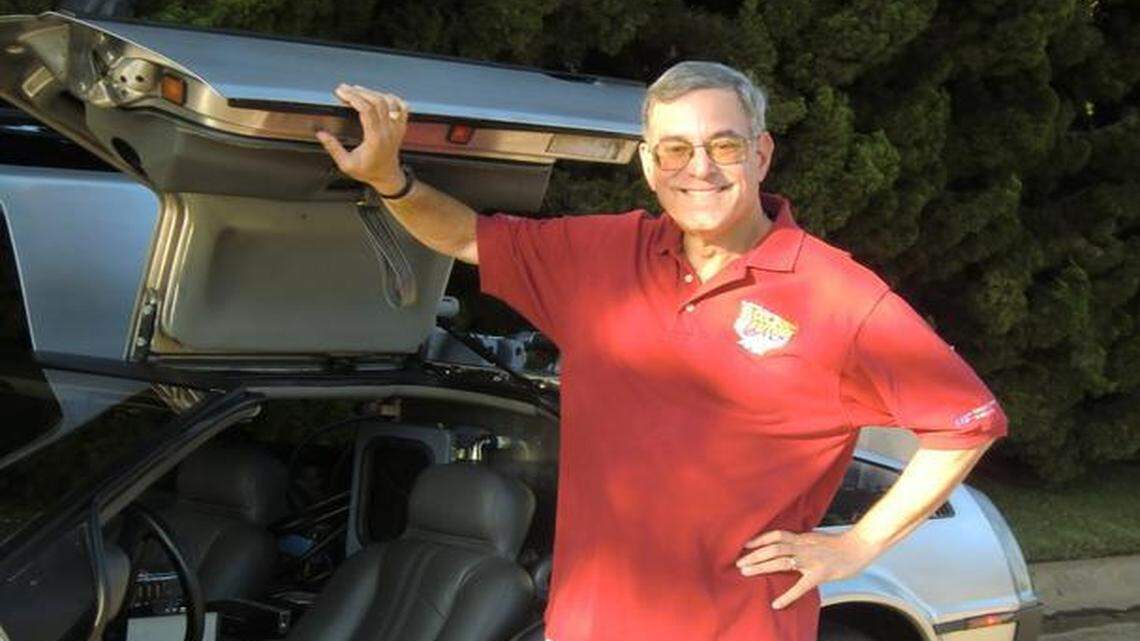
Locally, Gale appears Saturday as part of the Kansas City FilmFest. He’ll present “Back to the Future,” followed by a Q&A.
Gale admits it has been entertaining to watch speculations he provided decades ago match up with the realities of 2015.
“We knew when we made the movie that we weren’t going to have flying cars,” Gale, 63, says.
He remembers viewing a TV show as a youth in 1960 about the “wonderful world of 1985” that predicted flying vehicles. So he added that element to his original screenplay as an homage.
“We didn’t set out to predict the future,” he says. “We set out to have a good time in the future. A lot of the stuff is jokes.
“On the other hand, we got a lot of things right. Some we expected, like the idea of urban redevelopment in Hill Valley results in a big green space or the civic building of the courthouse becomes a shopping mall. That was based on urban trends.
“We got flat-screen TVs right. Home video conferencing right. We got drones in there. 3-D movies are back. What’s really cool is people are out there actually trying to invent hoverboards.”
Caseen Gaines, author of the upcoming book “We Don’t Need Roads: The Making of the Back to the Future Trilogy,” says Gale’s screenplay for the first film is taught in screenwriting courses across the nation — and with good reason.
“It’s a perfect case study for the ‘set it up, pay it off’ kind of narrative,” he says.
Even if you’re watching the movie for the first time, Gaines says, you get a sense that you should watch everything carefully.
“Nearly every second in the film is filled with a clue or Easter egg that enhances the viewing experience,” he says. “The performances are brilliant, but the real star of the ‘Back to the Future’ trilogy for me has always been the screenplay.”
Gale grew up in a suburb of St. Louis. Although he made short films while in high school, he decided to pursue engineering on the advice of a guidance counselor.
“I picked Tulane just because I wanted to go to Mardi Gras,” he says.
Then a fellow freshman in his dorm told Gale, If making movies is your hobby, they’ve got film schools in California. Make it your job, then it won’t feel like you’re going to work.
This led Gale to the USC School of Cinematic Arts. While there, he partnered with future Oscar-winning filmmaker Robert Zemeckis (“Forrest Gump”). Upon graduation, the two novice writers got their big break on the 1974-1975 supernatural series “Kolchak: The Night Stalker.” Their episode “Chopper” involved a headless motorcyclist who hunts down members of his old biker gang.
“There were always shows at the bottom of the ratings, and the good writers don’t want to write for those because they won’t get picked up for another season,” Gale says. “Bob (Zemeckis) and I figured out that the shows we should be peddling to were those at the bottom of the ratings because none of the writers would be interested. That strategy worked, and we were able to get the story outline to a producer.”
It turned out “Kolchak’s” story consultant was David Chase, future creator of “The Sopranos.”
Gale and Zemeckis then set their aim on the big screen. They teamed for seven features, beginning with the Beatlemania comedy “I Wanna Hold Your Hand,” Steven Spielberg’s “1941” and the cult comedy “Used Cars.”
None proved to be hits. So they endured four years of rejections before “Back to the Future” finally got greenlit. It ended up the top-grossing picture of 1985. It also earned Gale and Zemeckis an Oscar nomination for best original screenplay.
“We knew going in that the chance of us winning was really low,” he recalls about attending the ceremony. “If your movie gets nominated for best screenplay but it’s not a best picture nominee, it’s going to get ignored. ‘Witness’ won that year. It was fun to be there. The best part of it was I got to bring my parents.”
After that, Gale continued to write for television, contributing episodes of “Amazing Stories” and “Tales From the Crypt,” the latter of which he also directed. He also began writing video games such as “Tattoo Assassins.” More recently, he has penned superhero comic books such as DC’s “Batman” and Marvel’s “Daredevil” and “The Amazing Spider-Man.”
But the Southern California resident hasn’t been involved with a feature film since writing and directing the 2002 adventure “Interstate 60: Episodes of the Road.”
“I like to do original stuff. It gets harder and harder to convince studios to take a chance on something that’s original and a little bit offbeat,” he says.
As for career milestones, it’s apparent “Back to the Future” is hardly a thing of the past.
“There are certain shots where I cringe a little bit because the special effect isn’t quite right, or I see the continuity mismatch. But there’s nothing in it where I react with embarrassment,” Gale says of sitting through the film these days. “I don’t know if there’s a better time-travel movie.”
Wednesday through Sunday
The Kansas City FilmFest begins Wednesday and runs through Sunday at Cinemark on the Plaza. “Back to the Future” screenwriter Bob Gale will be a special guest during a screening of the film at 7 p.m. Saturday. Festival passes are $45-$80. For more information, go to KCFilmFest.org.
This story was originally published April 12, 2015 at 7:00 PM with the headline "Kansas City FilmFest goes back to ‘Back to the Future’ with screenwriter Bob Gale."