
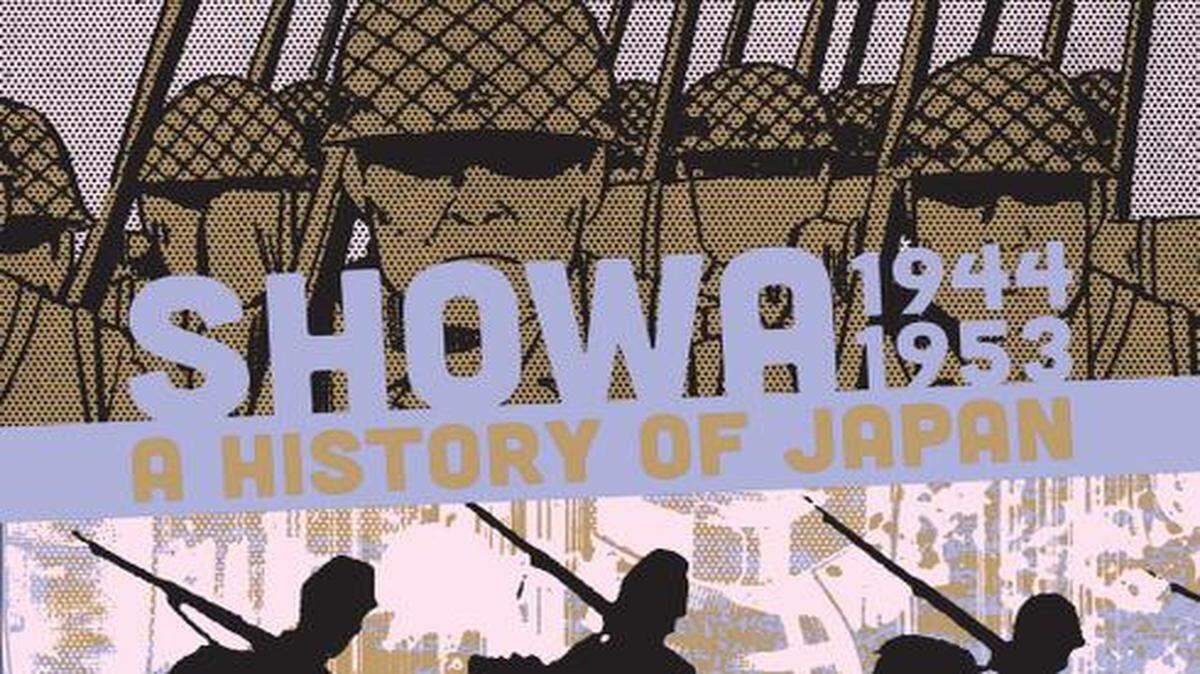
Latest installment of ‘Showa,’ the brilliant graphic novel, depicts World War II Japan
In Japan, history is still divided according to the reign of the emperors. This year, for instance, is Heisei 26 — the 26th year of the reign of Emperor Akihito, who will be posthumously renamed Heisei.
Shigeru Mizuki, the manga artist beloved in Japan for his tales of yokai, the spirits and monsters of Japanese myth, was born in 1922, or Taisho 11. Now 92, he lived through the entirety of the longest, most perturbed period in Japanese history — the reign of Emperor Showa, or Hirohito, which lasted from 1926 to 1989.
In 1988, Mizuki began to publish “Showa,” his monumental history of the period.
After the success of “Onward Towards Our Noble Deaths,” Mizuki’s Eisner-Award-winning, semi-autobiographical account of one Japanese army company’s suicide charge in World War II, on what is now Papua New Guinea, graphic novel publisher Drawn & Quarterly turned its attention to “Showa,” dividing the work into four volumes.
The third covers 1944 to 1953 and now appears in English for the first time.
Like Art Spiegelman’s “Maus,” the first (and so far only) graphic novel to win the Pulitzer Prize, “Showa” combines history and memoir. The narrative is sweeping, ferrying us through the second Sino-Japanese War, World War II, the Korean War and the Cold War.
Yet it’s also surprisingly intimate: Mizuki intersperses scenes from history (the careering fighter planes and craggy politicians so finely drawn that they bring to mind etchings) with snapshots of his own life, in a cartoonish style that belies their weight.
When we first meet Mizuki, in Volume 1, he is an apple-cheeked boy in rural Japan obsessed with eating, a passion he retains throughout his life. (At one point later he punctures a tin of pineapple with his bare fingers.)
Now in Volume 3, an infantry grunt in World War II, Mizuki suffers through so many cliff-hangers and improbable twists that it is difficult not to pity him even as you devour the pages.
By sheer luck, Mizuki outlives other members of his army company not once but three times.
Bullied by the officers and ostracized by many of his fellow soldiers for not dying a “noble death,” Mizuki becomes a kind of ghost himself, drifting around Papua New Guinea.
Jumping from the Potsdam Conference to the masses of hungry and impoverished Japanese huddling in the streets, “Showa” captures the crushing aftermath of Japan’s disastrous nationalistic fervor.
With Japan, China, and Korea now butting heads over the history of the war — Shinzo Abe, Japan’s prime minister, has drawn ire for proposing revisions to Japan’s schoolbooks — this volume of “Showa” arrives at an interesting moment.
On the one hand it is a subjective account of one man’s life. On the other, it is unstinting in its portrayal of Japan’s war crimes, and the product of much research.
“Showa” is literature, illustrated or not, at its finest: a story that sweeps you off your feet only to find, when you return to Earth, that nothing looks quite the same.
Scheffler has written for the New Yorker and the Los Angeles Review of Books.
Showa 1944-1953: A History of Japan, Shigeru Mizuki, translated by Zack Davisson (536 pages; Drawn & Quarterly; $24.95)
This story was originally published November 22, 2014 at 8:29 PM with the headline "Latest installment of ‘Showa,’ the brilliant graphic novel, depicts World War II Japan."