
In new collections, four Kansas City poets reflect on matters of faith
William Blake asks, “Tyger! Tyger! burning bright, in the forests of the night, what immortal hand or eye could frame thy fearful symmetry?” This question from the 18th century continues to challenge contemporary writers.
The spiritual quest to understand that “fearful symmetry” inspires poets to renew psalms, testaments and moral reflection in recent publications by Robert Stewart, Scott Cairns, Catherine Anderson and Jericho Brown.
Robert Stewart, editor of the Kansas City literary magazine New Letters, is also a poet and essayist. His new collection of short essays outlines issues of integrity for writers. The title essay, “The Narrow Gate: Writing, Art & Values,” directly connects literature to spiritual thought.
The narrow gate refers to Matthew 7:14, “Small is the gate and narrow the road that leads to life.” In this essay, Stewart describes artworks and situations that pose moral choices.
One real-life example is Franz Jagertstatter, a German Catholic who spoke against the Nazis. The poet’s “narrow gate” is perhaps beautiful, but true value lies beyond ornament. Stewart challenges writers and artists to concern themselves with larger questions essential to faith-based action.
The short essays, first printed as introductory notes for New Letters, consider topics like “Faith,” “Service,” “Glory,” “Heroes” and “Power.” For Stewart, reflection is essential to goodness, as he writes, “In each story or poem I read in manuscript, I can’t help but seek to confront some moral dilemma.”
At a time when bloggers dash off top-10 lists to skim quickly, Stewart celebrates slow reading. He explains the endurance of good writing in “a continuum beyond present time.” He suggests John Keats, from Blake’s era, as an enduring, spiritually engaged writer.
Stewart’s polished style is a pleasure to read, as is his commitment to substance. The American Society of Magazine Editors recognized Stewart with a national award for editing. This volume illustrates his excellence as both writer and editor.
Scott Cairns, professor at the University of Missouri in Columbia, is one of the leading American poets of faith. The title of his new book, “Idiot Psalms,” shows his ability to combine biblical study with humility. Fourteen invented psalms, spread throughout the book, have a grieving narrator, the “Idiot,” who regrets his imperfections.
He recognizes the “fraught obscuring fog / of my insufficiently capacious ken.” The first of this sequence shows a “servant” who seeks spiritual connection with his God. After self-examination, he turns to faith.
Most of these invented psalms follow the same pattern. The 12th one ends with a prayerful petition, “grant in this obscurity a little light.”
In this era of flash media frenzies, Cairns, like Stewart, takes readers back to a time of reflection. Little popular culture appears, but instead more sedate, thoughtful settings where the true action is interior struggles.
Cairns creates his own poetics to pursue the difficult goal of writing about the Bible without being preachy. He uses Greek, both modern and New Testament vernacular, phrases to amplify his religious motifs. Indeed, the poet sets some poems in Greece, which creates an immediacy for the entire collection.
The confessional writings of St. Augustine are a model for the poet, even if indirectly. Cairns renews Augustine’s genre to present contemporary spiritual struggles.
“Lenten Complaint” is an apologia for gluttony, set in Omaha, “… surrounded by the beefy, land-locked generations.” The “rancid” smell of the meat-packing plant town underscores how this writer’s insights have meaning beyond his personal quest. The familiar urbanscape frames timeless questions of faith.
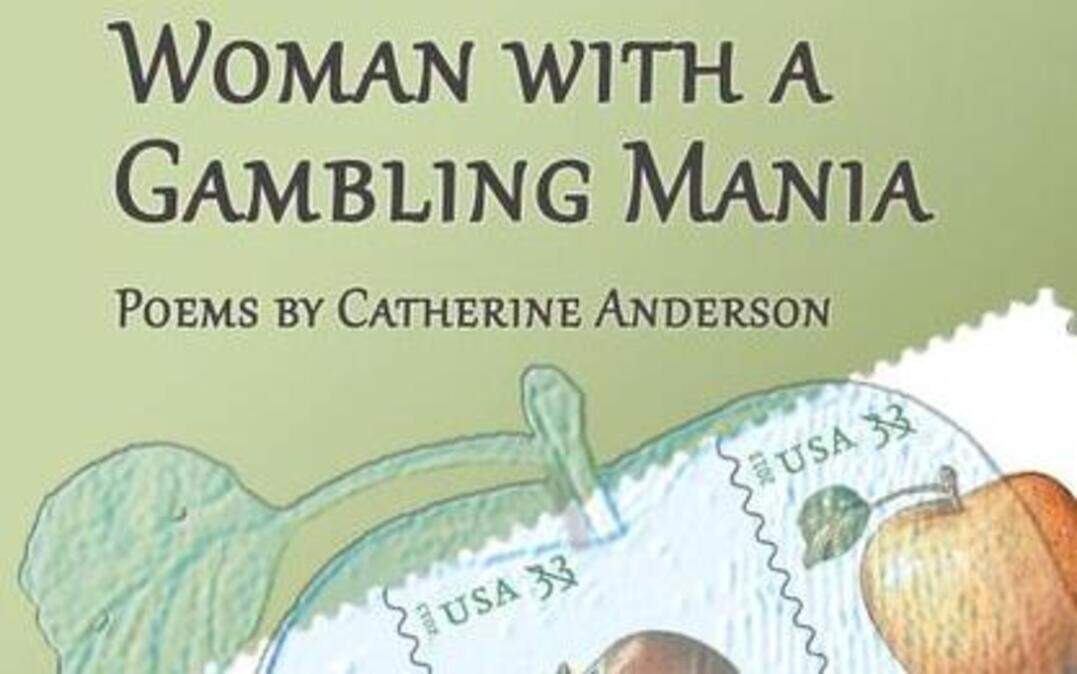
Catherine Anderson, a Kansas City poet, delves deeper into the very nature of language as a tool of spirit in “Woman With a Gambling Mania: Poems.” “Sometimes a story is entered through the middle,” she writes, “coiled to the end, then repeated over and over until / we find the golden core of its origin.” At this point of “golden” purity, she centers each poem.
Anderson’s faith is one of secular witness, using both art and history to approach divinity. In the poem “Men in the Absence of Women,” she recounts stories about fathers and sons.
Anderson’s title poem is based on a painting by Theodore Gericault, a French artist. The painter’s rendering of a woman’s portrait examines “the hairline crease between madness and divinity.” This mix of suffering and transcendence creates tension in all the poems.
Anderson often dialogues with visual artworks. James Ensor and Andrew Wyeth inspire the poet, as do anonymous photographers. Always, she uses strong images. The poem “Gericault’s Madwoman” juxtaposes dark palette colors with “flailing arms” and other gestures of the insane.
In “The Portrait,” the narrator is herself an art object as she poses for a painting. She is a nude model, turned into a still life like “an apple core on a plate.” In another, “Sketch in Pencil,” the narrator becomes an artist.
Anderson creates paintings through her palette of words, and foremost is her love of storytelling. Interesting people step out of her poems, alive with all their contradictions. The lovely, original language is word art of the highest order.
Jericho Brown immerses himself in biblical stories in his collection of poems “The New Testament.” He narrates life experiences, apparently autobiographical, as an African-American from Louisiana raised with the gospel. This is one lens he uses to spotlight romantic passion, social justice and mortality. He also explicates life experience as an African-American man in a homeland that sometimes is enemy territory.
In the poem “Homeland,” he references the arrest of Henry Gates, an African-American professor, on his own porch. Brown comments, “No one in this nation feels safe, and I’m still a reason why.”
Brown opens the book in biblical times, with the poem “Colosseum,” where a Roman gladiator celebrates love as “being any reminder that we survived.”
Romantic love colors much of this collection, with the added depth of biblical references.
In several poems, Brown directly retells biblical stories, as in a poem spoken from Cain’s point of view. In Brown’s version, Cain is a “quick-tempered vegan.” He mocks himself as a “Turnip lover.” He turns, then, to celebrate his patience, “I plant seeds and wait.” He understands his own fierce drive, quite equal to that of “small men” like Abel.
Brown intermixes directly biblical pieces with snapshots of contemporary life, with “The Ten Commandments” near “Football Season.” He reworks Langston Hughes’ poem “The Negro Speaks of Rivers” in a tour de force, “Langston’s Blues,” where he asks, “Is it blood that binds Brothers? Or the Mississippi?”
Brown’s second book of poetry is funny, playful, graphic and ironic. He is creating his own poetics, not afraid, like all these writers, to challenge nor to revel in faith.
Denise Low, Kansas’ poet laureate from 2007 to 2009, is author of 25 books of poetry and prose.
The Narrow Gate: Writing, Art & Values, by Robert Stewart (82 pages; Serving House; $12)
Idiot Psalms: New Poems, by Scott Cairns (86 pages; Paraclete; $17)
Woman With a Gambling Mania: Poems, by Catherine Anderson (68 pages; Mayapple; $14.95)
The New Testament, by Jericho Brown (91 pages; Copper Canyon; $17)
This story was originally published October 17, 2014 at 7:00 AM with the headline "In new collections, four Kansas City poets reflect on matters of faith."