
Kansas City Repertory Theatre Rep stages Ayad Akhtar work about the American experience
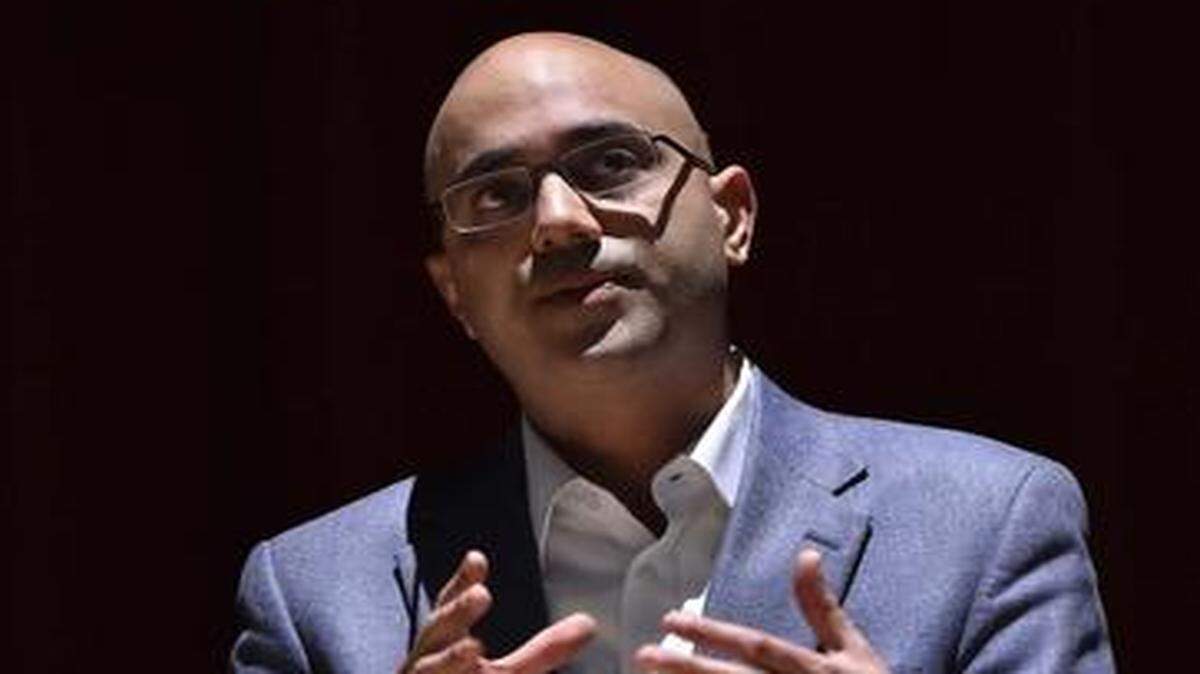
Ayad Akhtar writes plays.
Ayad Akhtar writes novels.
Ayad Akhtar writes screenplays.
And he’s an actor.
So we put it to the 43-year-old Akhtar: What are you exactly? Are you a novelist who writes plays? An actor who writes screenplays? A playwright who acts?
“I think of myself as a dramatic storyteller, whether it’s prose fiction, theater or film,” Akhtar said during a recent stop in Kansas City. “Even as an actor I think of myself as a dramatic storyteller.
“And what I mean by that is a dramatic storyteller is interested in what happens to characters as they move from one pole to its opposite.
“What are the things they come to understand about themselves and the world? And what are the transformations that that kind of reversal creates?”
Akhtar was in town for a weekend to check in at Kansas City Repertory Theatre, where artistic director Eric Rosen is staging Akhtar’s most recent play, “The Who & the What.” The play premiered earlier this year at La Jolla Playhouse in California and was later staged at New York City’s Lincoln Center as part of its developmental play program called LCT3.
That’s also where Akhtar’s 2012 play, “Disgraced,” was staged after its world premiere in Chicago. That play earned him the 2013 Pulitzer Prize and is now in previews on Broadway.
All of his work, including his 2012 novel “American Dervish,” address the tensions experienced by first-generation Pakistani-Americans between their traditional culture and religion and present-day, digitally connected, secular America. Those tensions can result in amusing incongruities as easily as intense emotional, if not physical, collisions.
“The Who & the What” depicts the relationship between a Pakistani immigrant who has become a successful businessman in Atlanta and his two adult daughters, one of whom is a writer working on a novel in which she hopes to humanize Muhammad and examine Islam in terms of “gender politics.”
When her father discovers what the book is about, he considers it blasphemous and the family ruptures, although not necessarily irreparably.
In his review of the Lincoln Center production, Christopher Isherwood of The New York Times wrote that the play “explores intergenerational and interfaith conflicts with fluid eloquence and intelligence. Mr. Akhtar writes dialogue that, while often funny and always natural, crackles with ideas and continually reveals undercurrents of tension that ratchet up the emotional stakes.”
Akhtar said he is eager to get back to the work of writing, as opposed to fulfilling the obligations of a successful writer.
But by winning the Pulitzer for his first play, he was automatically thrust into elite company.
To date he has written only three produced plays. One of them, “The Invisible Hand,” received its world premiere in 2012 at the Repertory Theatre of St. Louis. But he said he’s 25,000 words into a new novel, and he’s working on an epic play with dozens of characters.
The plays and the novels, he said, are a result of a burst of creativity that began in 2006.
“And then my life totally changed,” he said. “It’s interesting because … I’m only halfway through that creative explosion. But because of events, the wonderful success I’ve achieved of late, I’ve had to put that on hold because I don’t have the time.
“To use a business analogy, I was a business that was valued for innovation and then got caught in a cycle of exploiting existing product. I need to try to get back to innovation. That’s the challenge.”
Akhtar is one of two sons of Pakistani parents, both doctors, who immigrated in the 1960s. He was born in Staten Island but grew up in Milwaukee at a time when the Pakistani community wasn’t very big. There wasn’t a single mosque in Milwaukee during his childhood, he said. Now there are several.
His younger brother is a professor of philosophy now working on a book. Each of them chose career paths that were inconceivable to their mother and father.
“I think my parents are both profoundly confused, in a delightful way at this point,” he said. “But (they must think) where did these two guys come from? The full expectation was that I would become a doctor.
“My dad made me give him a shot when I was 3, and I still remember the experience. Apparently I kind of fainted or had some kind of episode, and from that point forward I didn’t want anything to do with needles and didn’t want to see the sight of blood.”
When Akhtar made it clear that he intended to be a writer and an actor, his parents didn’t know what to think.
“They were perplexed,” he said. “My dad always said I had a way with words and so I should become a lawyer because I could talk myself out of anything. And I think I did a pretty good job of talking myself into getting them to understand that I knew what I was doing even if I didn’t.
“I was able to make arguments at various critical points where they continued to support me, even if they didn’t understand how I was going to get where I wanted to go.”
Akhtar earned a theater degree from Brown University and then traveled in Europe, where for a year he studied acting under legendary teacher and director Jerzy Grotowski.
Upon his return, he entered Columbia University as a graduate film student. He and two of his fellow students wrote a screenplay, “The War Within,” depicting a young man from Pakistan who travels to the U.S. with the intention of hooking up with a terrorist cell, which is busted by the police before he can connect.
“We see America through this fellow’s eyes and grappling with the question of whether he’s going to go through with it,” he said. Akhtar played the role. The film was released in 2005.
Akhtar said the family arguments about culture and religion he depicts in “The Who & the What” are not unlike conversations that occurred in his home when he was growing up.
“Everything I write is some version of autobiography,” he said. “It’s often a deformed version of autobiography, but everything I write is drawn from from personal experience, whether it’s observed or lived. A lot of folks find a correlation between the father in ‘American Dervish’ and the father in ‘The Who & the What.’
“They are similar in important ways and different in important ways. Zarina (the novelist in “The Who & the What”) is kind of a version of the narrator of ‘American Dervish.’ What do they say? Every writer really only has one story in ’em, and they keep telling it over and over.”
The decision to set the play in the American South came by happenstance.
“The idea came to me in Atlanta,” he said. “I was at Decatur at the book festival, and I saw a couple of young Muslim women sitting on a park bench with their cellphones and Frappuccinos in hijabs chatting like Southern girls.… It was a picture of Muslim life in America that is much more American that it is Muslim — and yet clearly inflected by the ethos and mythology and the aesthetics of being Muslim.
“That’s the great American story, isn’t it? So much of the American story is about celebrating that process of remaking the self — the rupture from the old world, the renewal of the self in the new world.… But there’s another side to that, which is the cost of that rupture. And that’s part of our heritage as well, and it’s part of our suffering.”
Akhtar has tried to distill that idea in the family occupying the stage in “The Who & the What.” And if he has done his work well, the play should speak to everyone.
“You know Lincoln Center has a huge Jewish subscriber base, and there were so many folks who came out of that play and came up to me and said, ‘They’re just like our family, just like a Jewish family arguing on the Sabbath; I didn’t realize you guys are just like us!’ And I think that issues of faith and identity and tradition are somewhat universal.
“The colors that we use to color those outlines in might be different, but the outlines are basically the same. And finding meaning in one’s relationship to God, however we configure that, is fundamentally a similar experience.
“I do think the question of faith is central to the American experience. And I think of my work as writing about the American experience.”
To reach Robert Trussell, call 816-234-4765 or send email to rtrussell@kcstar.com.
ONSTAGE
“The Who & the What” runs through Nov. 16 at the Copaken Stage, 13th and Walnut streets. For more information, call 816-235-2700 or go to KCRep.org.
This story was originally published October 18, 2014 at 7:00 AM with the headline "Kansas City Repertory Theatre Rep stages Ayad Akhtar work about the American experience."