
Exploding technology pushes automotive repair instructors, students to keep up
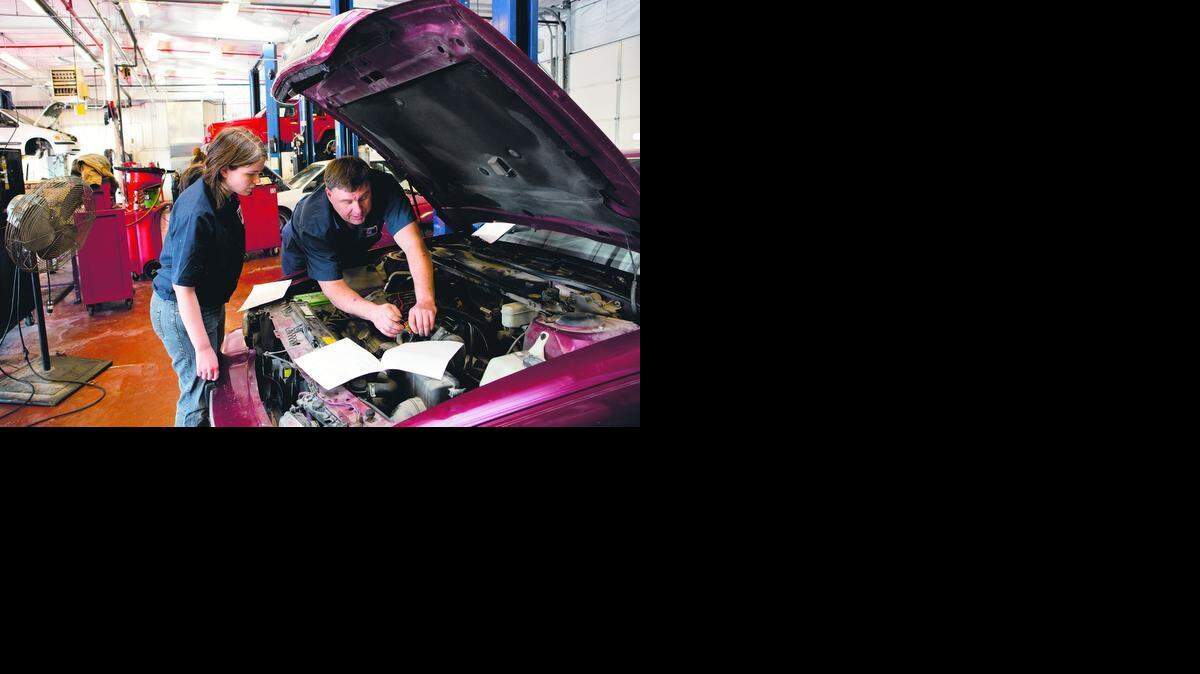
Every new redesign that crops up in the automotive industry brings a car, truck or SUV closer to being a computer on wheels.
More and more, car dealerships will spend anywhere from 30 minutes to an hour giving a tutorial to a customer who has just purchased a new car. Syncing a smartphone to Bluetooth, learning a GPS navigation system and figuring out the multitude of gizmos on the dashboard can be vexing for the car buyer.
For a person choosing a career in automotive maintenance, the almost daily evolution of technology in the automobile presents ever-greater challenges.
“If you are in this business,” said John Hattok, “you will never stop going to classes or getting information.”
Hattok, an automotive technology associate professor at Kansas City Kansas Community College’s Thomas Burke Technical Education Center, has been teaching auto tech in Kansas City, Kan., since 1992.
His students learn in a classroom setting and repair the basics in cars that are brought in from the community. Among the things they work on are brakes, steering and the engine.
Those computer functions that operate by Bluetooth or GPS? Hattok doesn’t allow his students to work on them much because they need to learn the basics first.
“We do some, but we watch what we do because we are with students who don’t have a huge background,” Hattok said. “Probably a lot of what we do is basic entry level to get them in the door so they have a good understanding of how it works.
“Most of that kind of stuff they are going to get out in the real world. We sometimes don’t take that on, not being able to fix it. It is so new, we can’t find that information.”
Over the last 10 years, Hattok has been amazed by many of the advances in car technology. In some cases, it started in the 1990s.
One thing that came out in the mid ’90s that amazed Hattok was OnStar, a subsidiary of General Motors that offers a subscription-based communications, navigation and remote diagnostics system. It was so advanced, Hattok said, that it knew you had been in an accident as soon as your airbag deployed.
“I think our biggest job here is getting students the basic skills they need to get into this business and they can make a living with and they can continue their training, especially in electronics,” Hattok said.
The training and learning never stops, Hattok said. He is proof of it. Hattok will attend the Vision Hi-Tech Training and Expo March 5-8 at the Overland Park Convention Center.
“There are people worldwide who come from hundreds of different countries,” Hattok said. “It was three days, and they expanded to four days because of the number of people and number of classes. Some of the best trainers in the world and guys who are right there in cutting-edge technology are there.
“We attend that regularly because it is required by our NATAF (National Automotive Technician Education Foundation) Certification to keep up with that. It is great, but never enough. You are always researching things to try to keep abreast.”
For instance, something as basic as a braking system seems as if it should remain the same no matter how much the technology advances. Think again.
“Brakes have changed a lot even though you think they haven’t,” Hattok said. “Just with the technology and some of the materials, with hybrid cars and the regeneration brakes, it starts getting electrical stuff in. They are looking at brake by wire.”
What is brake by wire?
A car equipped with brake by wire technology has small electric motors near the wheels that generate the braking pressure. They are governed by electronic control units connected to the brake pedal that receive input from the driver’s actions and interpret that information into a series of electronic instructions. These instructions are then communicated through a miniature, real-time network connecting the entire braking system.
And then there is traction control, which plays into the braking system.
“We keep adding things on to make the car safer to hold to the road, and that comes down to the brake system,” Hattok said. “We try to talk about all the systems in brakes. We try to apply it out here (the mechanics’ garage). We try to find jobs that fit what we are talking about at this time.”
Hattok said his students spend a month on each unit like brakes and steering and two months for engine performance and electrical.
“The electrical portion of the automobile, especially in the last 10 years has really exploded,” Hattok said. “In the electrical area, the computer use has really taken off in how we control little things like locking a door. We used to run wires and switches. Now we run what we call a module, which is basically a computer and the computer tells the door to unlock.
“We have a bunch of those modules on the car. That is really where a lot of diagnostic things are coming from. It is electrical, computer-based stuff.”
Who knows what engineers will think of next to enhance the driving experience? But whatever they think of, there will need to be people who know how it works so they can repair it if it breaks.
“I think everybody is overwhelmed,” Hattok said. “Sometimes as instructors we are amazed at what they are doing with these computers.
“You are never stagnant in this field. There is always new stuff.”
This story was originally published February 6, 2015 at 6:00 PM with the headline "Exploding technology pushes automotive repair instructors, students to keep up."