
Two days, five kidneys, 10 surgeries: How KC's longest transplant chain came together
Kansas City's largest kidney transplant chain started last year, just before Jon Sink quit Facebook.
Sink, an IT solutions analyst at Children International from Shawnee, wanted to spend less time online and more time with his wife and two kids, and he had grown tired of the divisive debates that played out on the social media platform. But just before he deleted his account, he came across something on his news feed that would eventually create powerful in-person connections.
It was a plea for help that his wife had posted on behalf of one of her co-workers. The co-worker’s husband, Tony Zins, was in kidney failure and needed a transplant.
Sink had never thought about giving a kidney, at least not while he was still alive. But when he saw the parallels between himself and this other person he had never met, he couldn’t shake the feeling that he had to do something. Zins was a husband and father with two young kids, just like him. But without a kidney transplant, he might not be able to see his kids grow up.
This could easily be me, Sink thought.
That Facebook post led Sink to make a decision that saved five lives and forever changed five more.
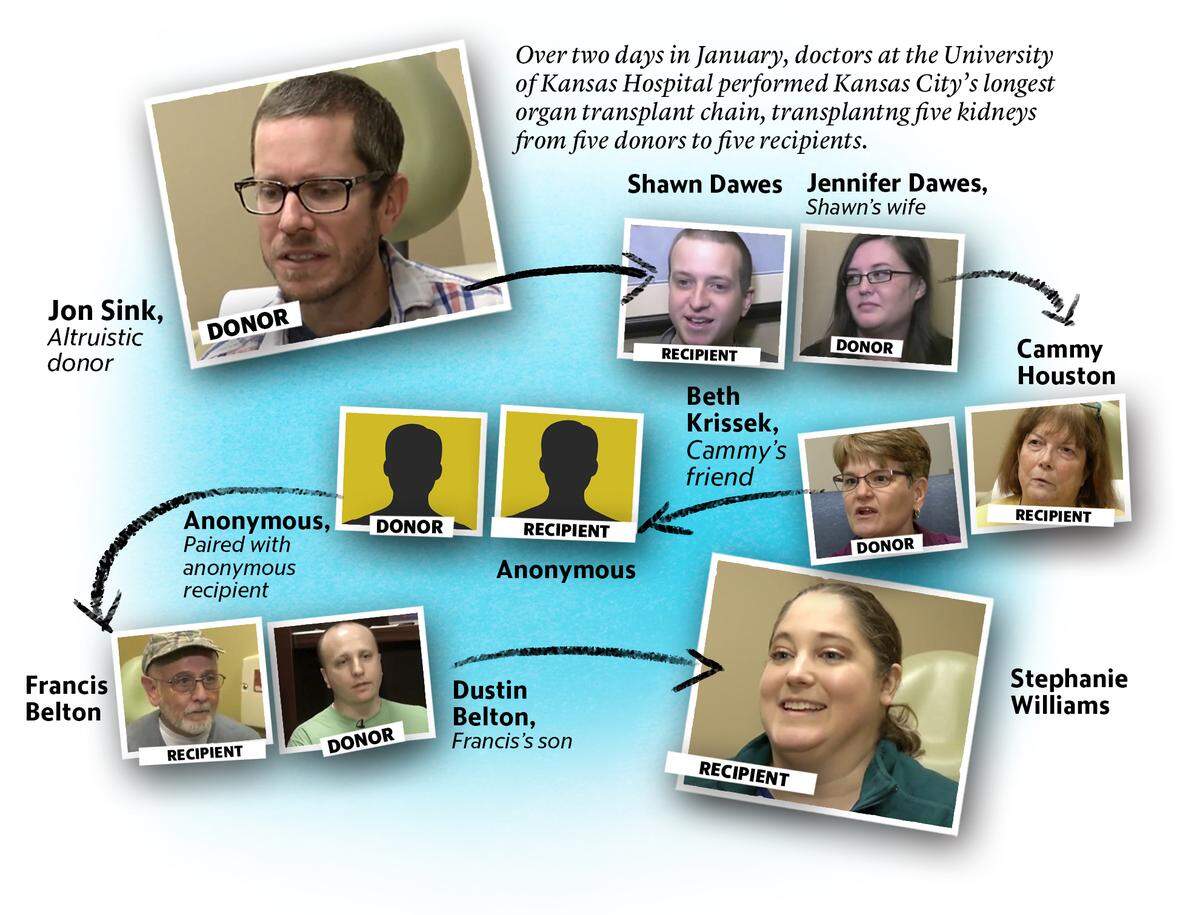
Over the course of two days, doctors at KU Hospital performed 10 procedures, removing kidneys from five people and transplanting them into five others. Most of the recipients had someone who wanted to donate to them but didn't match. So the donor gave a kidney to someone else they did match with and then that person's donor did the same and so on.
Most of the 10 people who gave a kidney or got a kidney over two days of groundbreaking surgery in Kansas City in late January met for the first time at the University of Kansas Hospital on April 20.
With a crowd of reporters and photographers in the room, 32-year-old Shawn Dawes tried to explain what getting Sink's kidney meant to him as a father to a 9-year-old boy.
"It's an opportunity to continue to be a dad," Dawes said. "To get to go to sports games and coach him and watch him grow up."
As if on cue, Dawes' freckled and spiky-haired son, Peyton, walked slowly into the room and sat down near his mom and dad, who both played critical roles in the ground-breaking transplant chain.
The donor search
There are about 115,000 Americans waiting for an organ transplant, and about 20 of them die every day while waiting. About 80,000 of them are looking for a kidney.
About two-thirds of the 20,000 kidneys transplanted in the U.S. in 2016 came from cadavers: people who had put on their driver’s licenses or told their families they wanted to be organ donors and then died in a way that allowed their organs to be harvested.
The number of deceased donors is on the rise, in part because of the national opioid crisis and the overdose deaths it has caused.
But getting a living donor is better. It lets you skip the line while allowing someone else to get the next cadaver kidney. It’s easier to schedule and prep for surgery when everyone knows when the organ will be available. Best of all, a living donor's kidney will last, on average, 15 to 18 years, while a cadaver kidney lasts an average of 13 to 15 years.
But many people who need a kidney don't have someone they know who is a match for them.
So some transplant centers like KU have begun pushing what’s called “paired donation.” They tell people on the waiting list to find someone, anyone, who’s willing to donate, even if they’re not a match. Then the transplant center will use a national database to find another unmatched pair somewhere and arrange a swap. Those closed-loop paired donations are becoming relatively common.
But open-ended kidney chains remain rare, because most of the time those chains require one or more of the most unusual type of donor: an “altruistic donor” willing to give a kidney even if no one they know needs one. KU transplant surgeon Sean Kumer said only about 2 percent of kidney donors fit that profile.
In January, Jon Sink became one of them.
Sink was not able to give his kidney to Tony Zins.
But Zins, from Leawood, would ultimately get a kidney from another young father of two: Fairway resident Craig Nelson. Nelson knew Zins from Kansas State University. Their wives were sorority sisters, and they were all big Wildcat fans. They had a lot in common. But most importantly, Nelson was a better match for Zins than Sink was.
But the testing phase had given Sink a lot of time to think about what it meant to give someone else a kidney. And the more he thought about it, the more he wanted to do it.
“Who’s to say my life is more important than somebody else’s?” was the question Sink said he kept coming back to.
So he told Melissa Fowler, a transplant nurse coordinator at KU, that he was still game to donate if the hospital had someone else on its waiting list with whom he matched.
As it turned out, there was one among the hundreds waiting.
Dawes donations
When Dawes got a call at his home in Manhattan and found out that a stranger was willing to give him a kidney, it was a lifeline.
In 2013, he had gone to the doctor for blood pressure issues and found out he was operating at about 50 percent kidney function. No explanation as to why. By 2017, he was in end-stage renal failure and on dialysis. His energy was sapped, and he was having trouble keeping up with Peyton, who loved baseball and basketball.
Dawes was suffering physically, but emotionally it was harder on his wife, Jennifer, who had to watch helplessly as he suffered. The two had known each other since seventh grade and had been married for 10 years. When Shawn went on the transplant waiting list, she figured she wouldn’t be a match because they had different blood types. But she wasn't deterred.
"I’m going to do anything and everything I can to get you a kidney,” Jennifer told Shawn when she signed up for paired donation.
When Fowler called to tell them there was a stranger willing to donate to Shawn, she said that if Jennifer was still willing to donate, there was someone else on the waiting list she matched with, too. They could keep the chain going.
Jennifer didn’t hesitate. Shawn was going to get his kidney and she could give her kidney to someone else’s Shawn.
Before that could happen, though, Fowler had to ask Beth Krissek not to give her kidney to her friend Cammy Houston.
Two social workers
Houston and Krissek met in 2004 as social workers at an agency in Wichita. They bonded through their jobs and their shared love of scrapbooking, and their families became close.
But Houston had always been sickly, for as long as Krissek had known her, and by 2017, she was on the transplant waiting list.
Krissek and another friend asked Houston how they could be her donor.
“I can’t ask you to do that,” Houston said.
But she didn’t have to ask. The other two were insistent. So finally Houston relented and gave them the information.
Testing determined that the other friend wasn’t able to donate, which put the pressure on Krissek.
She worried that at 55 she would be deemed too old and so when it came time for a stress test on a treadmill to make sure she was healthy enough, she was determined to impress the KU transplant staff.
“Do you want to stop?” they asked.
“No, let’s keep going,” Krissek said. “Let’s keep going.”
She passed, and she matched with Houston. The transplant surgery was scheduled for November but then postponed when Houston unexpectedly had to undergo a blood transfusion.
In the meantime, another opportunity presented itself. Fowler called and told Krissek she had identified another match for Houston: a woman whose husband was getting a kidney from an altruistic donor.
If Houston agreed to get her kidney from that woman and Krissek agreed to give her kidney to a stranger on a KU waiting list, they could keep the chain going.
Houston and Krissek would later say it was a no-brainer. A longer chain means more kidneys donated and more people helped.
They were social workers, after all.
The last donations
Fowler arranged for Krissek to donate her kidney to a recipient who has elected to remain anonymous. That recipient had an unmatched donor who was then able to give a kidney to Francis Belton.
Belton, a 63-year-old Wichita retiree with three children and six grandchildren, was in bad shape. He’d been on dialysis for years and had to quit his job dealing cards at a casino because the cramps caused by dehydration had become excruciating.
His son, Dustin, wanted to give him a kidney, but they found out they didn't match. The two had an Abbot and Costello-style comedy routine about it.
"After all the blood work was done, we found out he's not my son," Francis Belton would say.
"Actually, the truth is, he wants both of them," Dustin would respond. "And I told him no."
But in more serious moments, Belton would say he wasn't crazy about the idea of Dustin donating anyway. Kidney disease ran in their family, and what if Dustin went into renal failure later in life? Dustin and his wife had three kids. What if one of them needed a kidney some day?
Before he would let Dustin sign up for a paired kidney donation, Belton secretly went to Dustin's wife, Lanette, and told her his concerns. Her response: We'll cross that bridge, as a family, if we come to it. Let Dustin do this for you.
So when Francis Belton learned he was getting a kidney from a stranger, Dustin agreed to give his kidney to a stranger.
Stephanie Williams of Independence, Mo., would be the last person in the chain. Williams, 29, had found out when she was 21 that she had been born with just one kidney. Now it was failing.
She'd been on the transplant list for more than a year, and during a recent checkup, her nephrologist said that if she didn't find a kidney, she had a month left, at best, before she would have to go on dialysis. Already she was feeling sick and fatigued every day and was unable to do things she loved, like hiking.
When Fowler called to say they had found her a living donor, someone she didn't even know, it was like a ray of sunshine breaking through clouds after a long rain.
For weeks leading up to the surgery, she would break into a wide smile every time someone mentioned her upcoming transplant. She couldn't help it.
The surgeries
It had taken about six months for Fowler, nurse coordinator Samantha Brenner and KU nephrologist Amna Ilahe to handle all the testing and logistics to set up the five-kidney transplant chain.
It would take Kumer and fellow transplant surgeon Timothy Schmitt two days to execute it.
Both had hundreds of transplant surgeries under the belts, but neither had done anything like this. They would each do three surgeries the first day and two the second.
Kumer would handle the five donor surgeries and Schmitt would handle the five recipient surgeries. They always split the duties that way to prevent any conflict of interest, conscious or subconscious. Kumer's only responsibility would be to keep the donors safe, and Schmitt's only responsibility would be to look out for the recipients.
Kumer gave each of the donors the same talk he always does to make sure they were 100 percent committed: 1. This will hurt. 2. I've done a lot of these successfully, but there are risks. I'll be splitting off one of your kidneys from two of your major blood vessels. 3. Best case scenario is that you come out of this as healthy as when you went in. Even then, it will take you at least a month to recover.
None of the five donors showed the slightest hesitation.
On Jan. 29 and 30, Kumer and Schmitt did their thing.
The two doctors knew who had gotten whose kidney. But none of the donors or recipients did until Friday.
The aftermath
All of the surgeries were a success. The kidney recipients reported almost immediately a life-changing difference in their energy levels, appetite and overall health.
"It's basically giving me my life back," said Williams, who is back to work as a surgical technician at an eye center and was recently engaged to be married.
After their emotional meeting Friday, Francis Belton said he believed the donors and recipients felt a deep connection to each other and predicted they would stay in touch going forward. He said he got teary-eyed every time he thought about a stranger being willing to give him a kidney.
“It’s just amazing somebody is willing to do that," Belton said. "There’s no words for it. You can’t describe it.”
KU officials say the success of the 10-person transplant chain has them eager to try more and longer chains.
That gives a shot of hope for people like Julie Tudor of Lee's Summit, whose 67-year-old husband needs a kidney.
“We’ve certainly been telling anyone who has even a remote interest (in donating) about being a paired donor," Tudor said. "Our problem is that most of our friends and family are too old."
Tudor's husband may need an altruistic donor, another Jon Sink.
Sink said he knew that it was a big deal, what he had done and the kidney chain he started. But he said the choice to donate ultimately came down to a simple equation.
"Here I am with two kidneys and I only need one and here's a guy that's suffering," Sink said. "There's people all over the country that are suffering because they're in (kidney) failure, so it's really the least I could do. It was an easy decision."
This story was originally published April 27, 2018 at 12:42 PM with the headline "Two days, five kidneys, 10 surgeries: How KC's longest transplant chain came together."