
Kansas City was crucial to eternal sunshine of Ernie Banks
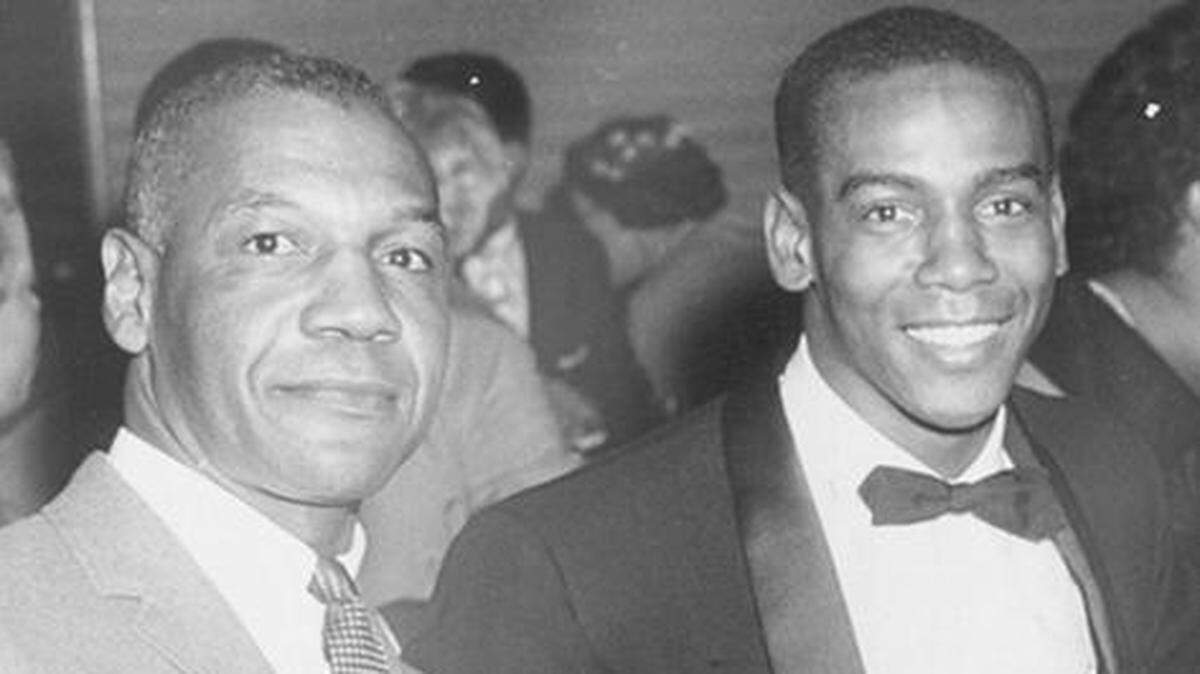
At the overflowing memorial service for Ernie Banks on Saturday in Chicago, Banks’ twin sons — of course Mr. “Let’s Play Two” had twin sons — stood before baseball royalty, a who’s who of the game, at Fourth Presbyterian Church.
But the first man they acknowledged was there in spirit only.
“Thank you, Buck O’Neil,” Joey Banks said, “for changing the caterpillar into a butterfly.”
A Monarch butterfly, you might say.
Because O’Neil and the Kansas City Monarchs of the Negro Leagues were part of Banks’ DNA and a pivotal portal to his immortality after signing him 65 years ago.
Without their discovery, cultivation and hatching of Banks, who died Jan. 23 but will live on as much for being “Mr. Sunshine” as for his baseball exploits, the world may never have been illuminated by his aura.
“He saw something in me that I didn’t know I had, and he nurtured me all the way to the Hall of Fame,” Banks told The Star upon O’Neil’s death in 2006. “If it wasn’t for Buck, I would not have played baseball and I would not have been in the Hall of Fame.
“My life would have been totally different.”
For one thing, there was the personal influence of the radiant O’Neil.
A man who would come to say “the whole theory of my life is sunshine” also would often say he got that from Buck O’Neil, who had recalled the young Banks as shy and apt to sit quietly on the back of a bus.
“I think (Banks) had (the personality) but Buck nurtured it and taught it,” said Bob Kendrick, president of the Negro Leagues Baseball Museum and among the throngs who celebrated Banks on Saturday. “No question that Ernie Banks was cut from the Buck O’Neil cloth. You could see it in his mannerisms, you could see it in his joyous outlook on life.”
From the most practical standpoint, without the conduit of O’Neil and the Monarchs nothing was otherwise assured about Banks ever even getting on the radar of Major League Baseball.
And without baseball, Banks once pondered, well, he’d like to think he would have been a lawyer.
“But what would I have been? … I can’t think of anything that would have got me out of Dallas and being poor,” he told The New York Times in 1969. “Timing is everything in life. I was fortunate with the timing.”
Banks was one of 12 children who grew up in a segregated, impoverished neighborhood in Dallas. His father was a warehouse loader for a grocery chain, and his mother was a cleaning woman for a bank.
“We didn’t have much money,” Banks told The Times, “but I can remember (his father) buying me a finger mitt. It cost $2.98.”
Apparently, the mitt was versatile: Banks’ high school, Booker T. Washington, did not offer baseball … so he played softball for the neighborhood Methodist church team.
But Banks’ athleticism — he excelled at football, basketball and track — and aptitude for baseball was apparent anyway.
Even if it remains unclear to whom it was evident first.
According to a 1958 article in The Star, Charles Mentesana, a manager of local semi-pro teams, tipped off then-Monarchs owner Tom Baird.
Other sources over the years have said Banks was first noticed by former Negro Leagues player William Blair, who got him to play on a barnstorming team he managed.
Banks then went on to play semi-pro ball for the Amarillo Colts. Or maybe it was the San Antonio Sheepherders. Or both.
But there seems to be consensus on the key point: Cool Papa Bell, then managing the Monarchs’ “B” team, saw Banks on a trip to Texas and raved about him to O’Neil.
“Cool’s word was good enough for me,” O’Neil wrote in his autobiography, “I Was Right On Time.”
Then Banks was signed either by O’Neil himself, as O’Neil wrote, or by scout/secretary Dizzy Dismukes, as Banks remembered it.
Banks would make $300 a month, which at the time was an astronomical figure to his family.
When he arrived in Kansas City in 1950, Banks stepped into eye-opening new terrain.
Segregated, yes, but upscale, starting with likely living in the Street Hotel at 18th and The Paseo with most of the Monarchs.
“Every though you were in an isolated world of your own, that isolated world was amazing: great jazz, great entertainment,” Kendrick said. “You’re playing with the legendary Kansas City Monarchs. So he definitely needed Buck to take him under his wing.”
By various accounts, Banks was as off-kilter that first year as he was still cocooned in shyness. He hit just .255 with one home run in 53 games.
But he also was absorbing everything around him, from seeing the world by rickety, breakdown-prone bus to conversations with roommate Elston Howard to the wit and wisdom of O’Neil.
“I didn’t talk a lot, I just watched him,” Banks said in 2006. “He just had a sixth sense … The man had an amazing mind for the game.”
After two years in the Army, Banks returned to the Monarchs in 1953, all the more mature emotionally and physically developed. He hit .347 that season for the Monarchs.
After the Negro Leagues’ 1953 East-West All-Star Game, O’Neil wrote, Monarchs owner Baird called O’Neil and told him to bring Banks to Wrigley Field the next morning.
“When we got there, Wid Matthews, the Cubs’ general manager, said, ‘Buck, I’ll tell you what: (Baird) is going to sell his ballclub pretty soon because that baseball of yours is just about over. When he does, we want you to come to work for us,’” O’Neil wrote. “I thanked him, and then he said, ‘You signed Ernie to a contract with the Kansas City Monarchs. Your first assignment as a scout with us is to sign him to a contract with the Chicago Cubs.’”
And so O’Neil did, paving the way to a Hall of Fame career that was accented and enhanced by Banks’ personality.
Not surprisingly, then, Banks remained forever grateful to O’Neil, the Negro Leagues and Kansas City.
Over the years, he’d do about anything he could to help the museum. Even long after O’Neil’s death, he was apt to call Kendrick to see how things were going and what he could offer.
“Playing in the Negro Leagues meant something to him, it really did, even though it was a stop-off point for him,” said Kendrick, noting it was the same for the likes of Aaron and Willie Mays and others.
He would leave the Monarchs, he would later write, “misty-eyed” … even as he was fulfilling his dream.
So when Banks hit a home run in the 1960 All-Star Game at Municipal Stadium, Banks would tell The Star in 2012, “I wanted to do it … in Kansas City.”
After all …
“I loved Kansas City because there were two of them,” he said. “There was Kansas City, Kansas, and Missouri. So I played two.”
All part of his metamorphosis.
To reach Vahe Gregorian, call 816-234-4868 or send email to vgregorian@kcstar.com. Follow him on Twitter: @vgregorian. For previous columns, go to KansasCity.com.
This story was originally published February 6, 2015 at 9:26 AM.