
Rams’ players’ ‘hands up’ gesture was an important, honorable action
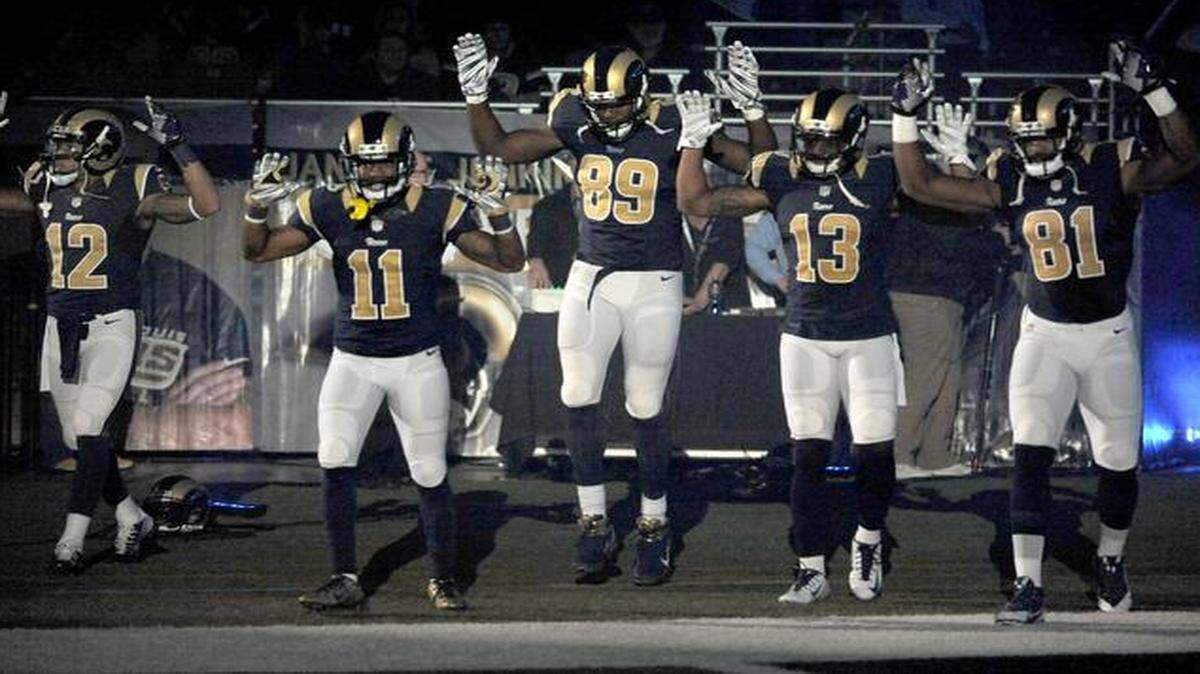
Maybe the gesture made you uncomfortable. Maybe you resent “politics” mixed with your sports.
Maybe you think because there’s debate and dispute and doubt over exactly what happened Aug. 9 in Ferguson, Mo., that the stance taken by five pro football players before a Sunday game was misguided or disingenuous.
But the five St. Louis Rams who entered the Edward Jones Dome and raised their hands in solidarity with the “Hands Up, Don’t Shoot” movement that has bubbled up out of Ferguson did something honorable and substantial.
They used their grand platform to take a boldly constructive stance, no matter how the reflexively defensive might view it.
They didn’t do it to assess blame or even insinuate they know what led to Michael Brown’s death in the St. Louis suburb.
They did it to reflect harmony with a campaign whose overriding message ultimately is, or has to become, that enough is enough.
“There has to be a change that starts with the people that are most influential around the world,” tight end Jared Cook told reporters after the game, a 52-0 victory over Oakland. “No matter what happened on that day, no matter how the whole situation went down, there has to be a change.”
At a time the broader reputation of NFL players has suffered by association with several of them implicated in domestic-violence cases, Cook’s perspective and the act of the five is a significant reminder that the league is brimming with bright, thoughtful young men.
Of all that’s been written about Ferguson, I’m not sure anyone has offered a more important, balanced and thought-provoking view than what Saints tight end Benjamin Watson wrote in a Facebook essay that went viral.
Even the NFL, so tin-eared on so much lately and often uptight about the wrong things, seemed to follow the lead of these players. The league, as well as Rams coach Jeff Fisher, indicated it would not discipline them, even in the wake of calls to do so.
“We respect and understand the concerns of all individuals who have expressed views on this tragic situation,” NFL vice president of communications Brian McCarthy said Monday.
Alas, the St. Louis Police Officers Association, or at least its business manager, Jeff Roorda, had no such sentiment Sunday.
In an appalling instant reaction, Roorda inadvertently illuminated what the other baseline is here by, in fact, going berserk over … five black men raising their hands.
“I know that there are those that will say that these players are simply exercising their First Amendment rights,” he’s quoted saying in a news release. “Well, I’ve got news for people who think that way, cops have first amendment rights, too, and we plan to exercise ours.”
In this case, with what might be read as a veiled threat that’s at least wrapped in inflammatory terminology.
“I’d remind the NFL and their players that it’s not the violent thugs burning down buildings that buy their advertiser’s products,” he continued. “It’s cops and the good people of St. Louis and other NFL towns that do.
“Somebody needs to throw a flag on this play. If it’s not the NFL and the Rams, then it’ll be the cops and their supporters.”
For charity’s sake, let’s assume there is at least one disconnect here between Roorda and the act of the NFL players … a disconnect that’s all the more regrettable because police and NFL players share the common denominator of the acts of the few tainting the names of the many.
Roorda is interpreting the players’ “hands up” gesture as a direct statement that perpetuates “a myth” that Michael Brown “was executed by a brother police officer,” Darren Wilson.
Now, seems to me it’s actually not unreasonable that Roorda could take the signal that way even if his response was absurd.
Roorda seemed to calm down Monday after phone calls and a meeting with Rams vice president Kevin Demoff that St. Louis County police chief Jon Belmar, in an email to staff, characterized as an apology.
But Demoff later told the Post-Dispatch that was an oversimplification.
“In none of these conversations did I apologize for our players’ actions,” he said. “I did say in each conversation that I regretted any offense their officers may have taken.
“We do believe it is possible to both support our players’ First Amendment rights and support the efforts of local law enforcement as our community begins the process of healing.”
That’s just it.
Even if it’s hard to reconcile.
If I’m being honest with myself, I’ve had conflicting thoughts about the implications of what it means for demonstrators to continue embracing that act as it has become less clear that Brown raised his hands.
But I also believe this is the most crucial point, one that Roorda and many others would do well to consider:
Because there is no known Zapruder film, or its modern equivalent, the cell-phone video, of the scene …
Because we only have conflicting witness testimony from a grand-jury proceeding that was conducted by a prosecutor who by many indications was more intent on seeking exoneration than an indictment …
Because the nature of being a witness is inherently unreliable, as well-illustrated per the St. Louis Post-Dispatch by five family members passing by that all saw it differently …
Because probably only two people really know what happened, and one is dead …
It simply can’t be known with certainty whether Brown, in fact, raised his hands and stood in surrender before Wilson shot him dead.
But if there is anything to be gleaned or gained or changed out of the embers of Ferguson, it’s not going to be by furiously guessing at and taking a stance on unknowns.
It’s going to be by dealing with the known:
However it started, however it escalated, another young, unarmed black man has been killed by the police — whose jobs in moments of heated conflict we all must remember are vastly more complicated than many understand or want to admit.
However it started, however it escalated, this one, finally, was one too many.
And it spawned a national mass movement of conscience that despite the warped, malicious, distracting acts of the few is provoking important dialogue.
The most visible, visceral symbol of this is, in fact, the act of “hands up, don’t shoot.”
Even if we don’t know if Brown did that, the gesture speaks volumes not to a debatable literal truth but to the essence of the crusade.
It doesn’t say Michael Brown was an angel and all police are evil.
It really just says … mercy, no more.
And that whoever you want to blame, there has to be another way.
All of which is why, regardless of what happened that day in Ferguson, those Rams’ players, — Tavon Austin, Stedman Bailey, Kenny Britt, Chris Givens and Cook — rendered a public service and should be commended, not condemned.
To reach Vahe Gregorian, call 816-234-4868 or send email to vgregorian@kcstar.com. Follow him on Twitter: @vgregorian. For previous columns, go to KansasCity.com.
This story was originally published December 1, 2014 at 3:42 PM with the headline "Rams’ players’ ‘hands up’ gesture was an important, honorable action."