
Energized MU football coach Gary Pinkel has Tigers surging anew after 2012 lull
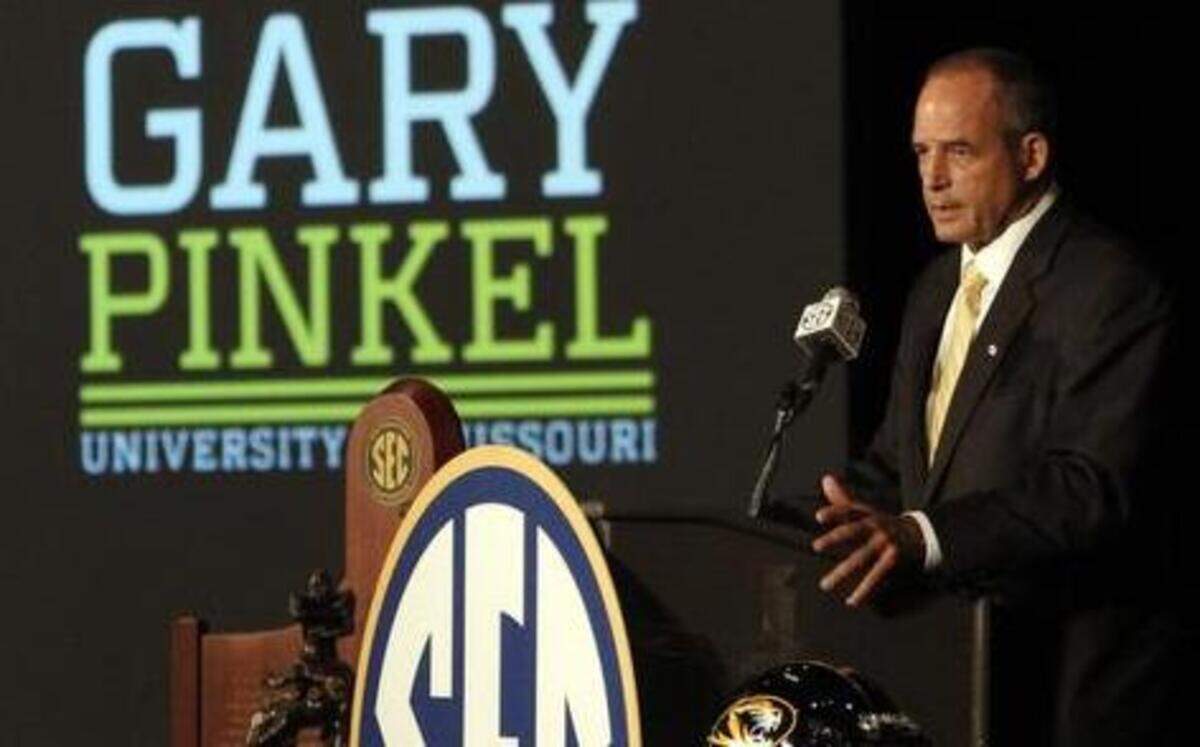
When Bill Snyder returned to coach Kansas State at age 69 six years ago, Missouri coach Gary Pinkel marveled. He also suggested that he had no intention of coaching to anything approximating that age.
“If I do that when I’m 69,” he said then, “I hope somebody comes and takes me out.”
To pasture, he presumably meant, not altogether.
But at 62, with his Tigers in the catbird seat for a second straight SEC East title, an invigorated Pinkel has a revived, revised perspective.
Amid gushing about Snyder as one of the wonders of coaching, he joked that if Snyder can still be thriving at 75, why can’t he shoot for, say, 77?
More seriously, Pinkel, who leads Missouri in coaching victories, said in his office Thursday during MU’s bye week, “I want to accomplish a lot more here.”
He added: “I don’t intend to fall.”
Only two years ago, Pinkel appeared somewhere between having achieved all he was going to and, in fact, falling.
In its first season in the Southeastern Conference, MU dipped to 5-7, its first losing campaign since 2004.
“Everybody’s pointing the finger at, ‘This is the SEC,’” he said. “Everyone jumped on. And everybody in the SEC didn’t want us to do well, because we were the newbies.”
Those Tigers were ravaged with injuries, almost geometrically more than Pinkel ever had contended with before.
In the moment, it was impossible to discern whether it was that phenomenon, or the SEC, or some combination thereof (injuries because of the toughness of the SEC) that led to the lapse.
But it was easy to envision the dominoes falling from there for a team that might have been as close to 2-10 (three wins by five points or fewer) as 8-4 (three losses by seven or fewer).
At least from the outside looking in.
“Everyone’s crying out, ‘Change this coach.’ You know how people are. That’s normal. ‘(Pinkel) is getting old, can’t coach any more,’ that sort of thing,” he said.
Pinkel, though, still felt steeled by faith in the “Mizzou-made” development of his program that had fared well in the upper tier of the Big 12 for years.
From his viewpoint, publicly, anyway, the mass panic was really a matter of one game.
One more measly win would have kept intact MU’s bowl streak and kept buoyant its reputation.
“We just didn’t overcome our problems,” he said. “All we had to do was win one more game. If Gary Pinkel would have done a better job of dealing with that, then we could have done that. So that’s on me.”
In more ways than one.
Because of the enormous financial stakes as MU was investing heavily in facilities upgrades, athletic director Mike Alden, who hired Pinkel and has been a steadfast supporter, started using words like “urgency” and “accountability” when it came to the football program.
Pinkel probably didn’t need any outside incentive, though.
He had taken over a program that had fired its last five coaches and had two winning seasons from 1984 through 2000 and made it a perennial winner and occasional powerhouse (2007).
Now, he felt something precious in jeopardy.
He drilled back into his roots.
“One thing I’ve learned is that when you have adversity, you go back to who you are and focus on all the little things that got you there,” he said. “And that’s what we did. We zeroed in on the little things.”
Pinkel is fond of saying that nothing changes, or has changed, in the base or foundation of the program. It makes him sound obstinate or stubborn at times.
There’s a disconnect, though, between what he’s saying and what that means.
In fact, Pinkel is proud of the fact that every phase of his program is under constant review, in good times and bad.
(This season’s success 7-2 overall record and 4-1 SEC ledger with a young team is a streaming testament to that: MU has become reliant on defense and the kicking game and slowing the game down as its offense tries to get traction.
“You can’t say, ‘Heck we’re going to keep doing this, it doesn’t matter,’” he said. “You have to adjust a little bit. We’ve adjusted, and we’re knocking on the door.”)
After 2012, he said, “It wasn’t like all of a sudden you have difficulties, and now you’re going to search (for answers).”
Still, there more questions than there had been for a while.
And more answers, too, it turns out.
To reduce injuries, MU softened some practice routines, particularly in the preseason.
The offense was tweaked and simplified, in part through what Pinkel insists was a coincidental change in coordinators when David Yost decided to leave and Josh Henson was promoted.
There also were a few subtle but substantial changes in approach.
For one thing, Pinkel extended himself further to players, even allowing music at practice.
He doesn’t agree that this came all at once, saying he’s been moving that way for a few years, but the difference was noticeable to the team and many around the program.
“I’m a lot different now than five, six years ago with players. The longer I coach, the more I hang around players,” he said.
Pinkel also seized upon a message he’d heard from 49ers coach Jim Harbaugh about moving from Stanford to the NFL.
“I’ll never forget that. He said, ‘It’s the best football in the world, it’s the most competitive football in the world, it’s got the best athletes on earth, and you get to go compete,” Pinkel said, sitting forward in his chair, mimicking Harbaugh. “He has this great enthusiasm, and I said, ‘I better change my attitude a little bit.’
“So I just started taking that approach to my team instead of sitting back and saying, ‘This is a tough league, gosh, guys, we’ve got to try our best here, we’re playing in these tough places.’
“Not that (in 2012) we were walking around going, ‘Oh, my gosh, this is going to be so difficult.’ That’s not true. But I presented this, ‘Let’s go have fun and attack every week and … isn’t this awesome to do? …’
“It’s just an attitude change.”
One other thing Pinkel did may have something to do with the fact that MU has won seven straight true road games, the longest active streak in the SEC.
“God, don’t say that,” Pinkel said, laughing at the prospect of jinxing it.
A potential key to that has been demystifying the SEC, particularly as MU is passing through conference outposts for the second time now.
Two years ago, on their first trips out, Pinkel and his staff made it a point of telling players to soak in the stadiums on Fridays, both for their historic significance and just to get acclimated.
But that was muddling the message that it’s not about who they play or where but how they play.
Why do they need to tour the place, players might say, if it doesn’t matter where we play?
All of this and a hungry, experienced senior class led to MU reaching the 2013 SEC title game against Auburn.
The Tigers trailed 45-42 entering the fourth quarter, four points and a quarter away from playing in the national championship game, before falling 59-42.
It was one thing to do that, of course, and demonstrate that 2012 was the exception, not the rule.
It’s another to have a firm chance to get back to the SEC title game, a topic Pinkel won’t touch.
“I’m too much right here, right now,” he said, smiling and adding, “I always have a burning desire to win.”
For this season … and maybe many to come.
To reach Vahe Gregorian, call 816-234-4868 or send email to vgregorian@kcstar.com. Follow him on Twitter: @vgregorian. For previous columns, go to KansasCity.com.