
How Kansas City’s 2026 World Cup reiterates Lamar Hunt’s vision from decades ago
AI-generated summary reviewed by our newsroom.
- Hunt showed unusual sentiment as Kansas City hosted its final 2026 World Cup match.
- Hunt said Kansas City seized the World Cup moment that will last a very long time.
- Kramer noted over half a billion watched the last time Argentina played in a quarterfinal.
Chiefs chairman and CEO Clark Hunt tends to exude a self-possessed public presence no matter the topic or occasion.
Even when it comes to memories or the legacy of his father, Lamar — the franchise founder who also was a catalyst for the rise of soccer in this country — the son is apt to be sentimental but not flash deep emotion.
But something about Kansas City at last becoming a FIFA World Cup host, an aspiration of his dad’s going back more than half a century, moved Hunt beyond what he might normally reveal on the eve of the last of the six 2026 matches here.
Speaking Friday at KC House, a hospitality venue for global leaders, civic stakeholders and business partners, Hunt pointed to Kansas City having seized the moment in a way “that will last for a very long time.”
He referred back to KC2026 CEO Pam Kramer’s remarks that more than half a billion people had been watching the last time Argentina played in a World Cup quarterfinal — and would be again on Saturday night, when Argentina played Switzerland in a 2026 quarterfinal at Kansas City (Arrowhead) Stadium.
“A staggering thing to think about,” Hunt said.
Then he suddenly appeared staggered himself as he transitioned to speaking of his father.
Briefly but visibly, he became choked up, and even seemed to mist up, as he thought of attending numerous World Cups with Lamar going back to 1974 — and how his father would have reveled in this event taking place at Arrowhead, one of his favorite places on earth.
And he thought of how, even 20 years after his death, the man who moved the fledgling Dallas Texans franchise here in 1963 to essentially alter the KC brand was behind another transcendent, transformative turn in the city’s history.
“He would have loved every single game at Arrowhead,” Clark Hunt said. “He would have loved the competition in the field. He would have loved the fans chanting and singing. He would have loved the Fan Fest, and he would have been right there in the middle of that Fan Fest with them.”
Much has been made, and rightly so, about how Kansas City’s run as a World Cup host — a role that commenced and culminated with Argentina victories — was the grinding work of a decade.
So it was in terms of the nitty-gritty of the bid process (catalyzed by KC Sports Commission leader Kathy Nelson and former KC2026 executive director Katherine Holland) and execution of an incomprehensibly complicated plan by Kramer and her “team of teams.”
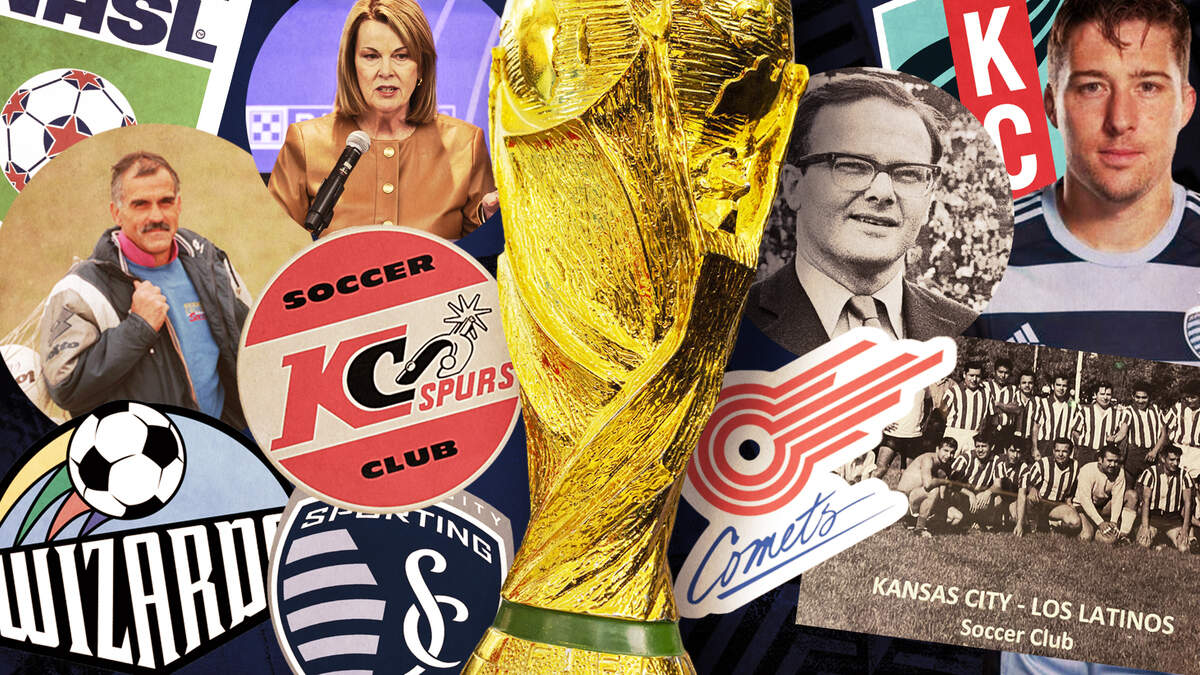
It’s also true that a montage of reasons altered Kansas City from “a hick town” for soccer, as longtime Rockhurst coach Tony Tocco once saw it, into a facilities mecca that lured four nations to hold base camps in the region: Argentina and England, which will meet in a semifinal in Atlanta on Wednesday, as well as The Netherlands were in the metro, while Algeria set up in Lawrence.
The most fundamental force, though, was Lamar Hunt.
His introduction to soccer actually came before he moved the Chiefs to Kansas City: in 1962, when he visited his future wife, Norma, as she was studying in Dublin, Ireland on a Rotary Club Scholarship.
He was intrigued enough by witnessing a Shamrock Rovers match. But what he saw when he turned on the “Wide World of Sports” in 1966 was life-changing.
For him and, in fact, many others.
At Wembley Stadium in London that day, England beat West Germany 4-2 for its only World Cup championship.
“My dad was absolutely enthralled by what he saw,” Hunt said. “Not only the competition on the field, but what he saw in the stands (such as) the fans singing and chanting.”
The same sorts of things we’ve seen here for the last month — a full-circle reflection of what 1966 set in motion: That match became the impetus for the elder Hunt to co-found the North American Soccer League; become a founding investor in Major League Soccer; build the first soccer-specific stadium in the nation (in Columbus, Ohio); and otherwise dedicate himself to bringing the World Cup to the U.S. in 1994.
Dashed as he was that Kansas City didn’t make that cut back then, maybe that just reinforces how far ahead of the curve he was.
“I think what we’ve seen here over the last month is more proof that my dad was an amazing visionary,” Hunt said, smiling. “Now, how in the world he had the vision in 1966, I’m not really sure.
“(But) as a family, we’ve joked that his vision for soccer in North America was exactly right. But it was 40 years early. And, fortunately, we’re on the other side of that 40 years. Everything that he believed the sport could be in this country is unfolding before our eyes.”
Alongside Hunt on Friday, Sporting KC co-owner Cliff Illig recalled what he called the “very poignant moment” 20 years ago when the ailing Lamar Hunt urged him and Neal Patterson to buy the then-Kansas City Wizards — another key development in KC’s currency and credibility to become a World Cup host.
“As we’ve gone through this World Cup, there’s not a day gone by where I haven’t thought about how Lamar would be reacting to something that was going on here in town,” Illig said.
Wasn’t it amazing?
From the Dutch fans’ “Oranje Fanwalk” to the awe-inspiring Algeria-Lawrence saga to Argentina’s quest to repeat as champions …
From the incredible efforts of volunteers to public safety and nimble adjustments to transportation issues after the first match …
From some 420,000 attending virtual sellouts of each match at Arrowhead, nearly 400,000 attending our FIFA Fan Fest and being the nation’s top TV market for the World Cup …
Kansas City, the smallest of the 16 North American host cities, absolutely thrived on the world stage.
Asked how Kansas City’s heart has shown through, Illig thought of the now-iconic 65-foot heart that anchored Fan Fest on the grounds of the National World War I Museum and Memorial.
“That whole theme, I think, stuck incredibly well,” Illig said.
As it happens, that heart made for another sentimental moment for Hunt — who upon a Fan Fest tour before the official opening had his photo taken with that structure in the background.
“Just seeing that heart, there was no doubt that that was going to become the iconic photo associated with Kansas City (and) the World Cup,” he said.
So he told his children they can dig out his words 25 years from now, when the World Cup comes back to the United States, and show people “what it was like in Kansas City back in 2026.”
A phenomenon itself 60 years in the making — and fresh tribute to the genius who somehow still is changing Kansas City.