
With future of Truman Sports Complex unclear, its name still matters. Here’s why
AI-generated summary reviewed by our newsroom.
- Officials honored Truman with stadium name after his influential 1967 bond endorsement.
- Both franchises prospered over many years while the venues bore Truman’s name.
- A recently formed task force is evaluating redevelopment that could affect complex name.
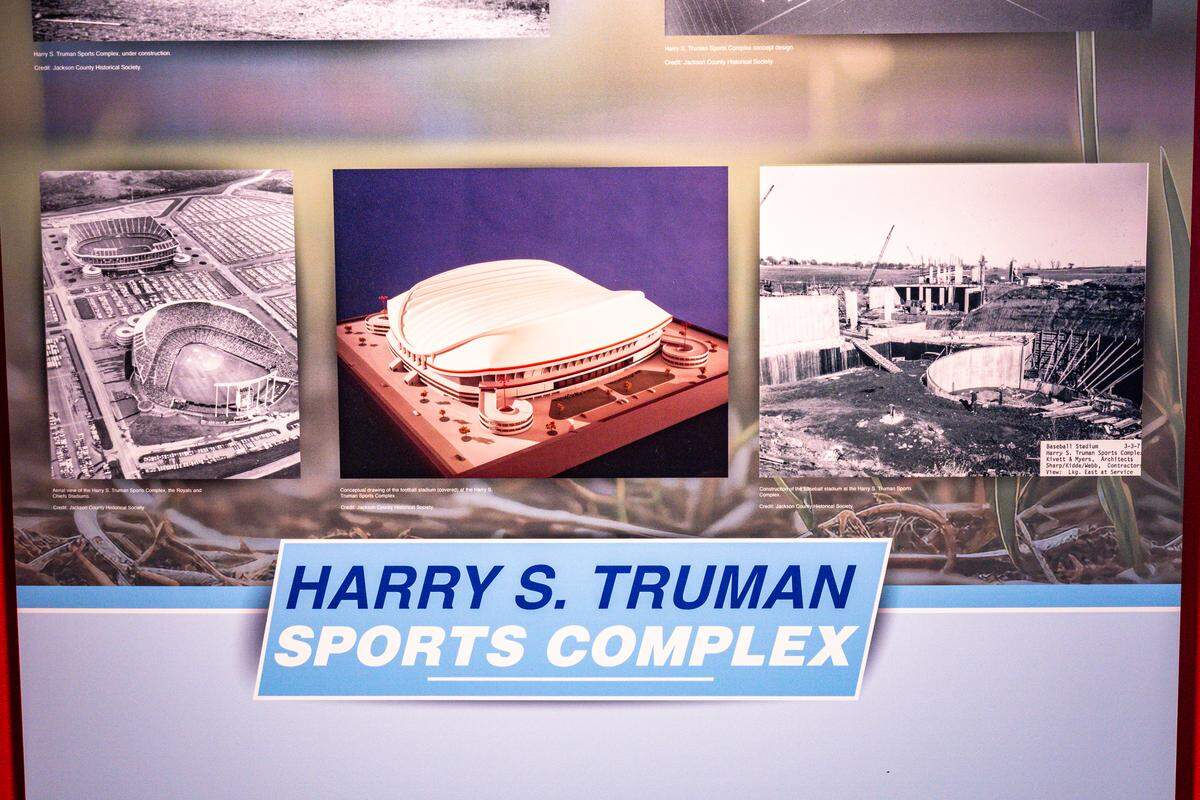
As Jackson County officials contemplated what to call the state-of-the-art twin stadiums due to open in the early 1970s, one obvious name emerged.
That of Harry S. Truman, who after serving one of the most consequential U.S. presidencies in history relished returning to his roots in Independence. Moreover, he also had influentially endorsed the momentous $100 million-plus bond initiative in 1967 that included $43 million earmarked for the stadiums.
While the ever-humble Truman didn’t much like such fusses made over him, he felt compelled to accept this one. As long as it was made explicitly clear, per a National Park Service archive, that he had not suggested it.
“It was pretty unusual,” said Mark Adams, director of the Harry S. Truman Presidential Library and Museum, noting Truman typically said “no” and that most things named after him were affixed after his death.
That wasn’t the only obstacle to clear in that era’s iteration of naming rights. Chiefs executive vice-president Jack Steadman bluntly tried to dissuade the idea.
Speaking for the franchise in a 1969 letter to Dutton Brookfield, then-chairman of the Jackson County Sports Complex Authority, Steadman wrote that they “certainly are not anti-Truman; however, it is my opinion, developed out of experience, that naming stadia after political or other prominent figures is a mistake.”
.jpg "unnamed (2).jpg")
But then-Eastern District judge Alec Petrovic pushed back at Steadman in correspondence with the Chiefs. And Petrovic publicly proclaimed “it would be a great honor to a great man. A living memorial is more appropriate than one after the fact.”
The sentiment was echoed by sports authority vice-chair William E. Clarkson, who through reporting then saw it as a chance to pay homage to the “county’s most distinguished citizen for all-time …”
What’s next at Truman Sports Complex?
“All-time,” alas, can be a fleeting thing.
With the Chiefs in the process of embarking for Kansas in the 2031 season and the Royals also seeking to be in a new stadium elsewhere by then, the future of the Harry S. Truman Sports Complex — including the appropriateness of its name — is murky.
Last month, interim Jackson County executive Phil LeVota announced the formation of a task force to evaluate the future of the site.
“This is not just about what’s leaving,” he said then. “It’s about what we’re going to build.”
The presentation included renderings and numerous development concepts with one element looming over it all: One or both stadiums figure to be torn down in the process.
It’s unclear in what way or whether at all the area would retain its name if it’s indeed no longer a sports complex.
And thus would fade out what began as a frequent point of reference to Truman, who died in December 1972 — months after the opening of Arrowhead Stadium and months before the inaugural season at what became Kauffman Stadium.
That day, hundreds parked at the sports complex named in his honor to take shuttle buses to view his casket at the library.
All of which now makes for a sad twist, particularly considering how both franchises prospered by the association along the way.
It’s also surely an unintended irony for Royals owner John Sherman, who has been dedicated to preserving Truman’s name through philanthropy with the Truman Library.
Because the anticipated end of the Truman Sports Complex also will mark the end of a tribute.
At least unless those in charge make it a priority to extend it in some fresh way.
“This was supposed to be a lasting memorial to him,” said Mike Manners, whose father, Mike Westwood, was a longtime bodyguard for Truman after he returned from Washington in 1953.
‘Kicking It with the Trumans’
All of this somewhat serendipitously coincides with a new exhibition at the Truman Library, the most enduring and vibrant memorial to the fascinating man. His complicated legacy is book-ended by having unleashed nuclear bombs on Japan in 1945 and working to put the world back together over the next seven years of his presidency.
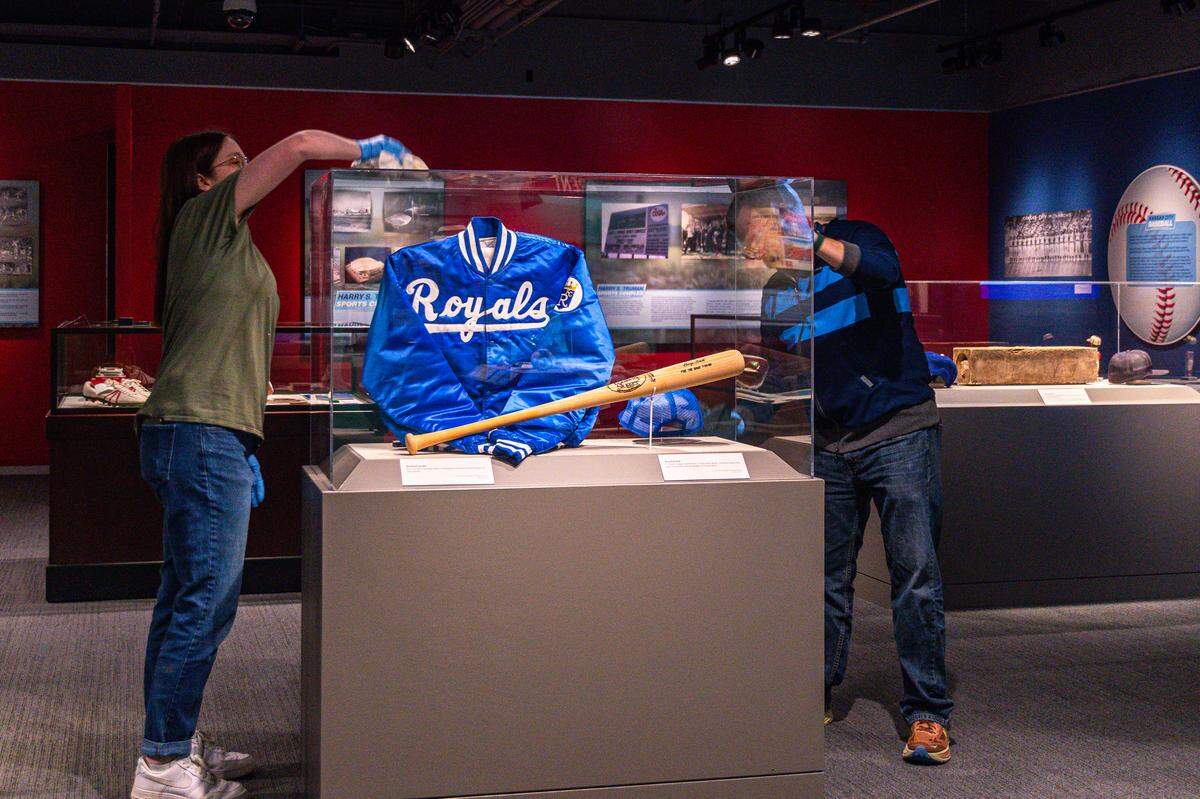
A lesser-known but lighter aspect of Truman and his wife, Bess, is a love of sports and recreation animated in a display that opened April 1 and runs through the end of the year: “United We Play: Kicking It with the Trumans.”
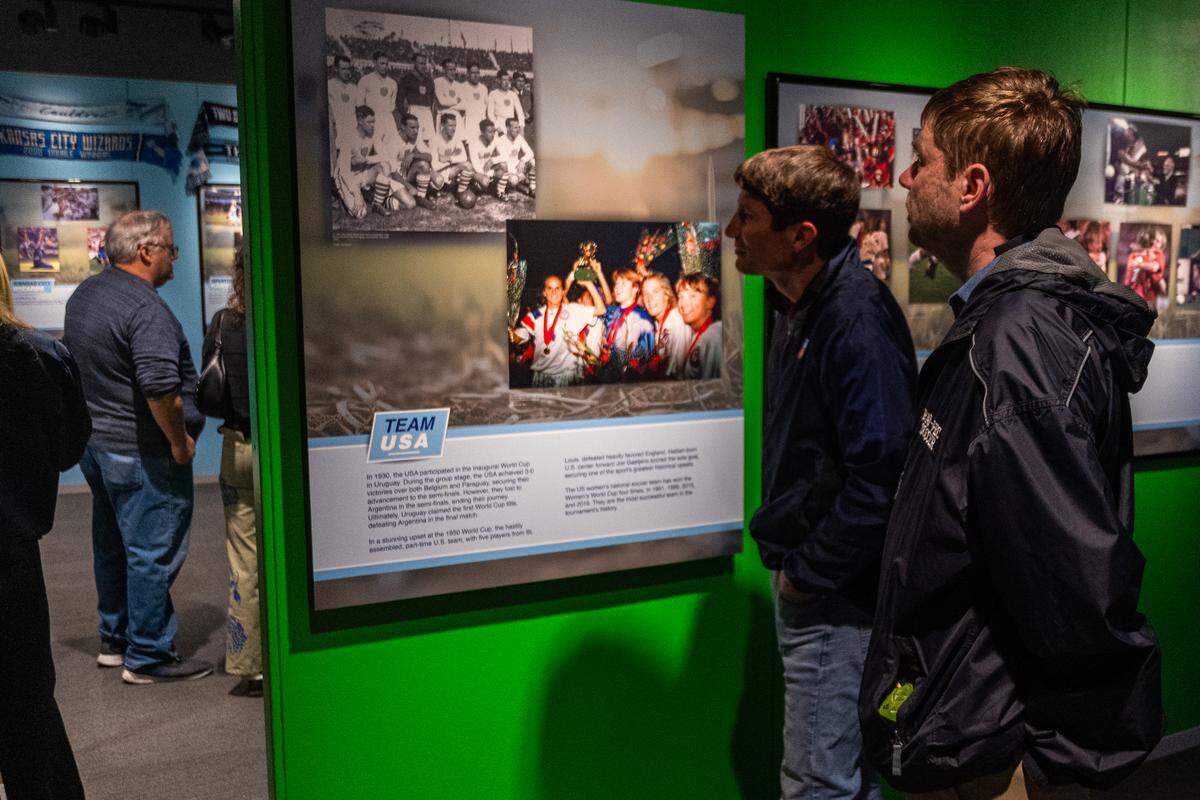
The exhibit is multi-faceted but launched with an eye toward the impending 2026 FIFA World Cup and the anticipated hundreds of thousands of visitors to Kansas City as one of 16 host cities in North America.
Six games will be played here in June and July, including a quarterfinal, and the area also will play host to four national team base camps — including those of Argentina, England and The Netherlands.
So it seeks both to celebrate “the inspiring and defining power of sports to unite a community” … not to mention unite the word itself.
“As a global leader, President Truman championed the United Nations, the Truman Doctrine and the Marshall Plan,” the museum writes. “Truman preferred a policy promoting cooperation among nations for common goals like peace, economic development and cultural exchange.
“President Truman would welcome the 48 countries uniting across the United States, Canada and Mexico to play in the largest sporting event in history.”
The captivating spectrum of memorabilia, photos and newsreels features Truman connections to the seven nations we know will play here. (Albeit finessed when it comes to Curacao, once part of the Dutch empire and thus counted through Queen Juliana’s 1952 visit to Truman.)
“It’s kind of like playing six degrees of separation with Truman,” Adams said as he led The Star on a recent tour. “You can connect him to anything.”
He added, “I think he would have really welcomed those countries to the Truman Sports Complex to play.”
How Truman understood sports
Perhaps most appealingly to anyone locally, though, is Truman’s seemingly improbable enchantment with sports.
While the exhibit is intended to meet the moment, Adams said, “it’s also to tell the stories that are untold.”
As a youth, after all, Truman was ordered by doctors to avoid sports and any rough games because of vision issues that required what the Truman Library calls “thick, expensive and fragile glasses.”
Nonetheless, sports became a through line in his life.
Even his courtship with Bess Wallace was accented by Truman contriving a tennis court for her — the dynamics of which are captured through photos of and letters about his efforts. Bess also was an ice skater, whereas a photo on the ice of Truman himself seems to capture him in still life.
Bess, in fact, was an athlete of such renown that her exploits included playing on a YWCA team for future Kansas coaching legend Phog Allen — who grew up in Independence.
“If you tossed Bess the ball, you could be fairly sure that she would score, even at a phenomenal distance,” friend and teammate Mary Paxton Keeley, the first female graduate of the University of Missouri, said in an oral history.
As for the president himself, though, baseball fandom apparently took early and only grew. Among the items on display is a “1927 Kansas City Monarch Base Ball Club” season pass for “Judge H.S. Truman & Wife.”
While it’s not known if Truman attended any Negro Leagues games, the mere fact he had and kept such a pass perhaps speaks to the sensibilities of the man who in 1948 integrated the U.S. military.
.jpg "BeFunky-collage (19).jpg")
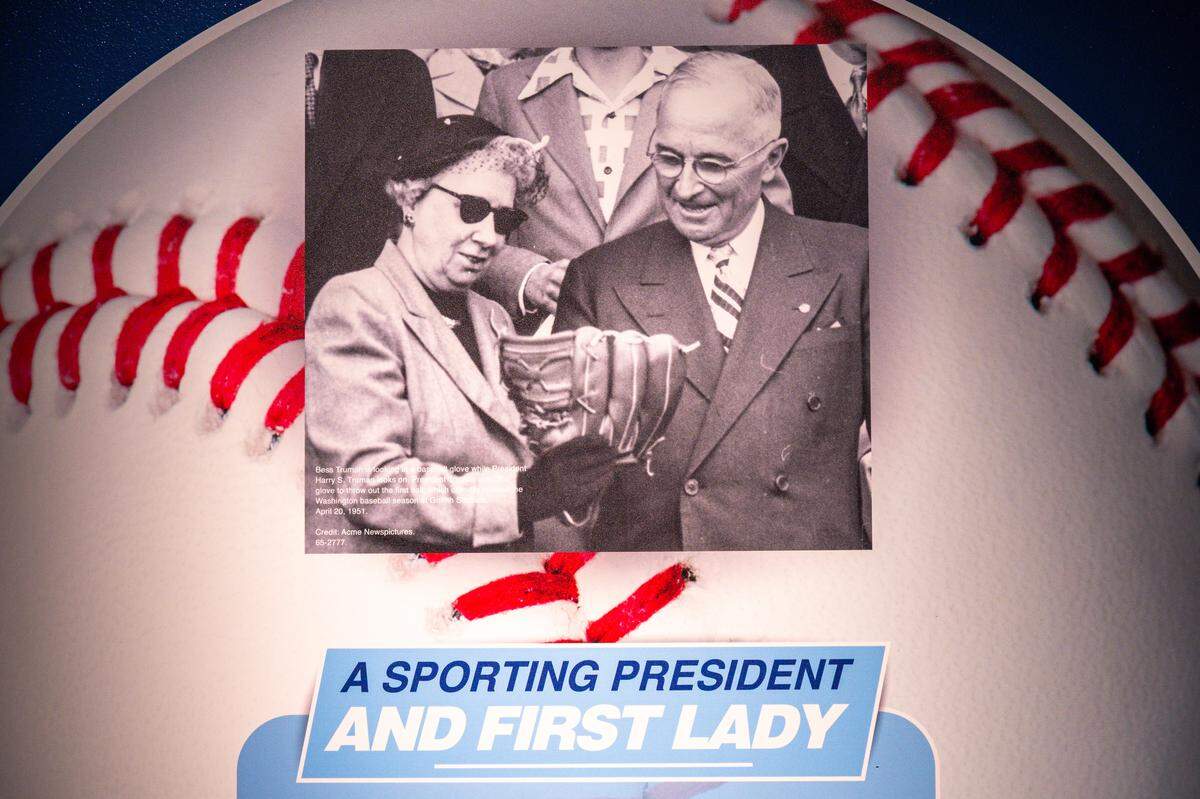
And despite having felt as a child “incapable of (anything) involving a moving ball,” as biographer David McCullough put it, the left-handed Truman made up for it by throwing out many ceremonial first pitches — including ambidextrously — while attending more MLB games in office than any other president by going to 16 Washington Senators games.
In office as captured in newsreels, Truman also was a frequent attendee of the Army-Navy game. In color footage from 1948, he welcomed the University of Missouri football team to the White House after their game against Navy in Baltimore.
All of this and plenty more in the display reflected not just a man who appreciated sports in themselves but also one who understood their cultural and social significance.
Truman’s name resonated
Out of office and back home for two-plus years, Truman threw out the first pitch of the first Kansas City Athletics game on April 12, 1955 — also the day John Sherman was born. Featured in the exhibit is Truman’s glove from that day, including an etching of his signature in the palm.
That moment reiterated Truman’s ongoing stature and relevance as he returned to civilian life, and his clout was underscored anew in the mid-to-late 1960s even as he was in his 80s.
As the June 1967 bond vote neared, Petrovic and two other judges asked to meet with Truman — who was understood to be sympathetic to the cause since he had been the force behind the most recent previous such endeavor here in the late 1920s.
According to Petrovic per The Kansas City Times, the group found Truman to be “as sharp as ever, very alert and very well-informed on matters in Jackson County and throughout the state.”
Apprehending the nature of the visit, Truman approvingly brought up the bond issue himself, Petrovic said. Asked if it was OK to say he was endorsing it, Truman was reported to have said “most certainly.”
Avid baseball fan Bess, known to listen to many games and keep score, added, “Why, of course we’re for the bonds.”
All seven of the bonds passed, with the one designated for the stadiums earning 69 % of the approximately 90,000 votes.
To what degree Truman’s influence cleared the way can’t be quantified. But Petrovic and other officials believed it fundamental.
Between that and Truman’s lifetime achievements, they honored him with the naming.
One that had a certain unifying resonance locally, nationally and even internationally.
At least for a half-century-plus, that is, and a few more years.
This story was originally published April 16, 2026 at 5:30 AM.