
Amid World Cup safety preparations, fears of ICE presence in KC loom as challenge
AI-generated summary reviewed by our newsroom.
- FIFA and KC planners mobilize multi‑agency security for 2026 World Cup games in KC.
- City leaders place moratorium and propose badge rules amid ICE detention concerns.
- Officials balance law enforcement presence with efforts to preserve visitor comfort.
At the recent “11 Cities Summit” of leaders from United States sites for the upcoming 2026 FIFA World Cup, FIFA’s chief safety and security officer G.B. Jones stressed the unparalleled scale and scope of a spectacle that will include six games in Kansas City and also be contested in five cities in Canada and Mexico.
Calling it “the most significant” and biggest sporting event in history, Jones pointed to 48 nations (previously 32) playing 104 matches (previously 64) in 16 cities in three nations.
As such, he said at the meeting held in Colorado Springs by the U.S. Northern Command, the call is to “rethink all of our assumptions” about best practices for safety and security, be more dynamic and “go bigger and bolder than we’ve ever done before.”
That’s why more than 50 federal, state and local agencies with thousands of personnel funded by tens of millions of dollars will be collaborating in Kansas City (and elsewhere), even as FIFA for the first time oversees overall World Cup security.
If that sounds like a pretext for a show of force, Jones emphasized a contrasting point: Beyond “guards, gates and guns,” he highlighted service — how people are treated — as “absolutely essential” and the importance of resources, relationships and responders.
Balancing all of that for the optimal experience will pose an enormous challenge as Kansas City prepares for an estimated 650,000 visitors — a number that could balloon if the likes of Argentina, England and the Netherlands make base camps in the area.
“In all of our planning verticals, including safety and security, we’re thinking about the experience …” KC2026 CEO Pam Kramer said last week, later adding, “So we want it to feel joyful. And so certainly we’re thinking about the experience in everything we’re doing.”
But this all comes with an unprecedented and distressing twist looming over it: the specter of the anti-constitutional impunity of Immigration and Customs Enforcement (ICE) tactics, how that is affecting international perception and the question of whether ICE may be deployed in World Cup host cities during the June 11-July 19 tournament dates.
‘Where they won’t be dragged off the streets’
Months of increasingly un-American and brazen actions in the name of immigration enforcement were further amplified Saturday in Minneapolis with the slaying of Alex Pretti, a 37-year-old ICU nurse.
Multiple video angles reveal Pretti trying to protect a woman, being shoved to the ground, pepper sprayed, stripped of a holstered gun and being shot an estimated 10 times.
“How many people must die? How many rights must be ignored? How much cowardice must persist? Before our leaders bring an end to the reckless federal assault on Minneapolis and America’s cities? …” Kansas City Mayor Quinton Lucas posted on social media, later adding, “Stop the occupation. Stop the chaos. Stop creating a civil war in Middle America.”
With ICE’s intensifying rampage dominating news cycles while it is reportedly seeking to create a detention center in the Kansas City area, Lucas is cognizant of the implications of ICE coming to Kansas City ... where another recent Minneapolis ICE victim, Renee Good, used to live.
He spoke Friday about his concerns, particularly as they apply to the World Cup, in an interview with The Star.
“I respect the laws of our country: I think they’re important, and I think there are vital law enforcement steps that need to be taken at every agency,” he said. “That being said, I abhor the politics of fear, and I have further concern that (because of that), some may believe that Kansas City … is a place that they will not be welcome.”
To the contrary, he added: Every step the KC2026 organizing committee and the city will take in the months to come will be to make the Kansas City area feel as welcoming as possible.
A place, he added, where visitors “can feel safe and protected where they won’t be dragged off the streets.”
Acknowledging that there are circumstances beyond local control, he added, “I’m going to control what I can and … work with people here to make sure that we will have one hell of a World Cup.”
In the spirit of controlling what can be, city officials last week placed a moratorium on granting a special use permit for ICE to potentially operate a mass detention center in city limits. And KC-area lawmakers have introduced legislation seeking to compel all law enforcement officers here to show their faces and badges while on the job.
The effectiveness and enforceability of each remains to be seen.
But such efforts, among others likely to come, speak to seeking ways to address the threat of anarchic immigration enforcement and how the region sees itself — both in terms of immediate concerns and in the context of the World Cup.
“No matter the political discourse around us, no matter all the other steps along the way,” Lucas said, “we have worked too hard to be a place that says folks aren’t welcome.”
Will Trump Administration rule out World Cup ICE raids?
Nonetheless, perceptions of what’s happened to the United States will be its own issue in the weeks and months to come.
Shocking images are going global as potential World Cup visitors assess a new level of risk to attend. Which is saying something given that the last two were held where human rights issues are rife: Russia and Qatar.
While humane immigration reform is a worthy cause, any such notion has been tread on now. In numerous instances, lawless tactics are being thrust not only on the so-called worst of the worst, but also on immigrants seeking asylum or otherwise operating in good faith within a once-established system.
And, more and more evidently, unleashed on U.S. citizens — often as they simply exercise freedom to protest and monitor or even in the once-safe confines of their own home.
When the U.S. government condones, even endorses, such acts and defends them even when contradicted by overwhelming video evidence, it’s open to question how prospective foreign visitors feel about their own vulnerability visiting here in the next few months.
In fact, that’s been a bubbling international worry long before recent extremes.
Perhaps overshadowed nationally by the World Cup draw in Washington, D.C., in December, was a revealing news conference two days before with World Cup White House Task Force executive director Andrew Giuliani.
At the Washington Foreign Press Center, per transcript, virtually every question from journalists around the world was about safety.
Many, though, were about safety from U.S. forces.
A reporter from the Netherlands, whose national team will play in Kansas City, asked if people will be welcome regardless of their beliefs, race and color of their skin. Or should they fear they might not get in or be deported upon arrival?
A reporter from Turkey sought reassurance over concerns raised by human rights groups about the safety of non-citizens.
A journalist from a Colombian TV news station wanted to know if ICE could be deployed at or in stadiums.
The question later was echoed by Sky News Australia as it asked: “Will the Trump Administration rule out any ICE raids at any of these matches?”
Like most of his other responses, Giuliani did not answer specifically.
“We’re having continuous conversation with this,” Giuliani said to the latter. “The one thing — and I’ve known the president for 25 years — the president does not rule out anything that will help make American citizens safer.”
Largest law enforcement deployment in KC history
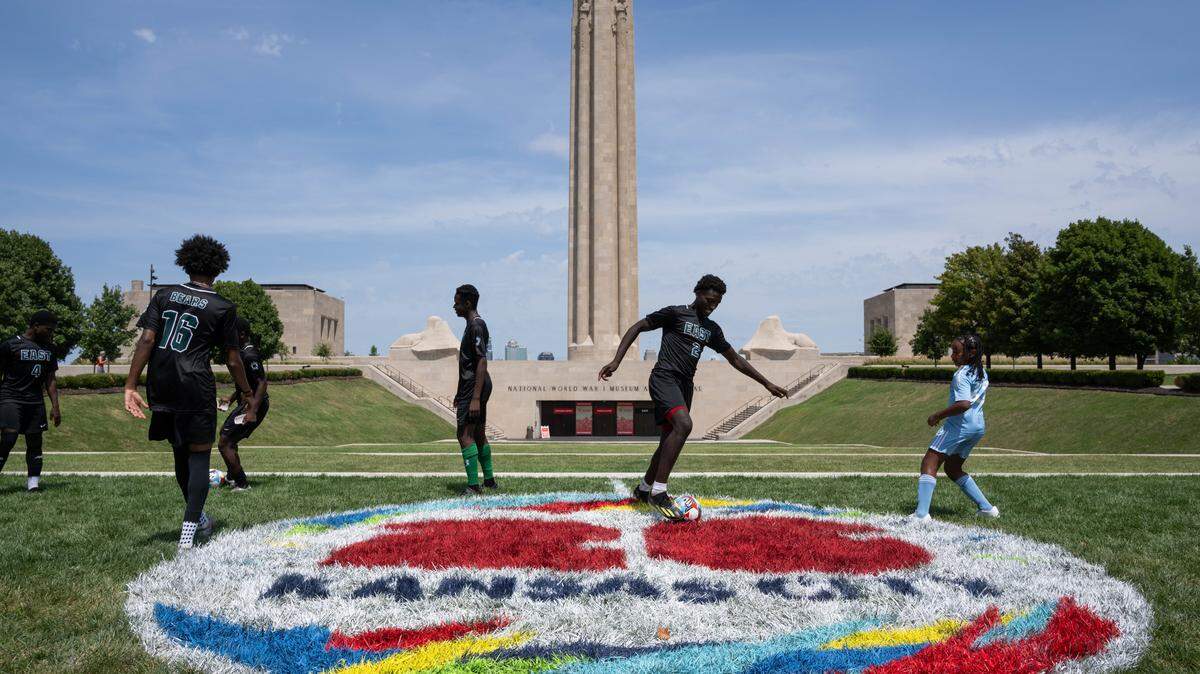
As for more traditional safety concerns, it can be assumed that Arrowhead Stadium, the Fan Fest site at the National World War I Museum and Memorial, Kansas City International Airport, training centers and base-camp hotels will be blanketed.
And while KC2026’s role in this realm largely is to provide coordination and it is not law enforcement, per se, Kramer pointed to FIFA administering what she estimated was 23 or more safety and security exercises over the last 18 months.
For a sense of some of the preparations, KCPD on social media shared a video of its SWAT team working with the Missouri State Highway Patrol on public transit rescue operations. Calling the scenario “extremely rare,” it added that it’s “among the countless trainings we are conducting.”
By general protocol, specifics of security measures at mega-events aren’t divulged in advance.
Or as Kramer put it: “Lots of the security measures will be visible. Many will be invisible to fans.”
So what it will all look like isn’t immediately clear — though you can expect some fusion of old school and new tech: from a new KCPD command post bus to mounted patrols, helicopters and drones.
But the balance of visible and invisible, not to mention oppressive and reassuring, is much on the minds of all — particularly considering the shooting near Union Station that killed Lisa Lopez-Galvan after the Super Bowl LVIII parade.
Lucas pointed to that tragedy as something to be learned from among other recent events held here, including the 2023 NFL Draft.
“Ultimately, I think this World Cup will be safer than us going out on the street on any normal day,” he said. “But even though people tell us … it’s safer to fly than it is to drive somewhere, you still get a safety presentation at the beginning of every flight.”
As he considered how that will appear here, Lucas said, “I think that there are a few things that you can understand will happen, and then there are probably many more things that one may never know.”
Speaking to the knowns, he reckoned that we will witness — or at least be enveloped in — the largest deployment of law enforcement ever seen in this area.
That will include, Lucas underscored, KCPD’s entire force (approximately 1,150-strong) being on duty for the duration — a dynamic most likely to be paralleled in several other local law enforcement agencies.
Lucas also alluded to Missouri Gov. Mike Kehoe’s stated intention to deploy the Missouri National Guard. And that’s in addition to more than $63 million — including $59,522,190 from Homeland Security’s FIFA World Cup Grant program in security funding — he wants passed by the state to KC2026. Overall, the state has invested around $150 million in the World Cup.
The state of Kansas, which could host two base camps and represents a substantial part of the World Cup transportation plan, committed approximately $28 million for the World Cup in 2024. About a quarter of that was intended for security.
None of that, of course, includes what it may cost — financially and otherwise — if ICE perpetuates its harsh and scattershot ways here.
“You know, this is the world’s cup; the world should be represented,” Lucas said. “And the world isn’t just always our friends. The world also includes a lot of folks with whom it’s more complicated.
“But we get to pause for several weeks during the summer and enjoy the beautiful game. I hope we remember that central part of what this is all about.”
This story was originally published January 28, 2026 at 5:30 AM.