
Despite KU blowout, Mizzou coach Dennis Gates says rivalry ‘should never stop’
AI-generated summary reviewed by our newsroom.
- Rivalry returned to Kansas City after 28 years; Kansas dominated 80-60.
- Event revived regional tradition and energy, though attendance lagged.
- Mizzou’s Dennis Gates called for continuity. KU’s Bill Self says its complicated.
The 23rd and last time the Kansas and Missouri men’s basketball teams had played a game in Kansas City that counted was at the inaugural Big 12 Tournament in 1997.
So long ago it was at Kemper Arena, Dennis Gates still was in high school, Bill Self was coaching at Oral Roberts and the schools still played in the same conference and all.
Back then, you would have figured the fevered forever rivalry would always be in play twice a year on campuses with the prospect of the bonus round here.
That year, MU split the regular-season series with Kansas but meandered much of the rest of the season. The Tigers were facing their fourth game in four days against a terrific KU team ranked No. 1.
So then-MU coach Norm Stewart reckoned Mizzou would have to play lights out to win and added one of his typical witticisms.
“Does anybody know where the light switch is?” he said.
Nowhere to be found that day, as KU swamped Mizzou 87-60.
Alas, though, out went the lights on the series thereafter:
For more than a quarter-century, fate never indulged us with another KU-MU game in Kansas City (other than the 2017 hurricane relief exhibition) as the series itself went dormant in the wake of Mizzou’s move to the Southeastern Conference.
That’s what made Sunday at the T-Mobile Center so striking and significant even if the game proved an anticlimactic dud: Not the frenzy of a tight contest but an 80-60 Kansas win that the 21st-ranked Jayhawks (7-3) essentially put away early in the second half when they completed a 23-3 binge.
Still, this was the return of a dynamic that’s part of our regional DNA. And a reminder on multiple levels of why it needs to be extended beyond the final year of the current six-year deal that previously featured four on-campus games and expires after another one here next year.
Part of that was the energy in the building.
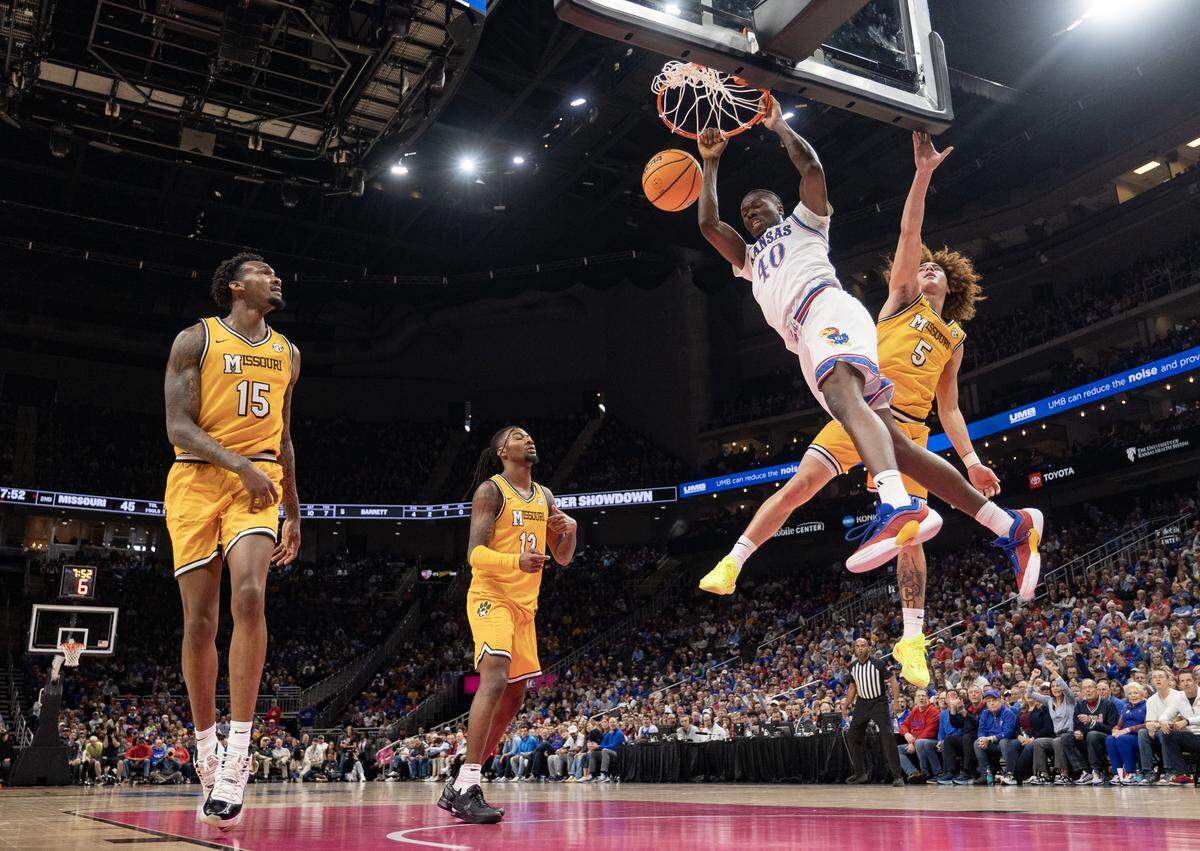
Enough so that MU coach Dennis Gates raved about it despite the lopsided loss and even as he repeatedly emphasized that it was a Kansas home game in terms of hosting the event and ticket allotment, etc.
Calling it a game that “reinvigorates” both schools and fan bases, Gates described it as “college basketball at its best” and added: “It should never stop. We should not want an atmosphere to look another way.”
Somehow, the volume and sense of pageantry felt right and good despite the oddity of the building not being sold out: The announced crowd of 15,407 would have been about to capacity at 15,601-seat Mizzou Arena and overflow at 15,300-seat Allen Fieldhouse, but it meant roughly 3,000 open seats in a venue that holds 18,000-plus.
While overpricing might well have been part of that (nearly $300 for lower-level seats and $67.39 for the “cheap” seats), and maybe 50-50 distribution would be a better idea, the absence of a sellout brings us to another reason this needs to be continued.
Counterintuitive as that might sound.
Because what was once a local birthright of sorts now has been rendered an intermittent bonus.
That lack of constancy makes it less of a regional rite and dilutes what it’s all about. It’s not yet a novelty act, but it needs consistency and cultivation.
Not that the meaning has been lost on coaches or players.
Gates last week violated the prime directive of coach-speak when he said it’s not just another game.
And after scoring 20 points to lead all scorers, KU’s Tre White said Self had conveyed the urgency of the moment — something Self alluded to when he told the team that “this one game” will get more attention than the Duke, Connecticut, Notre Dame and Tennessee games combined.
“All week, every day, practice has been more intense,” White said. “The message has been more clear. And, you know, I feel like everybody was a little more ramped up than (in a) normal game. …
“Coach did a great job all week bringing us back, telling us about the history of what this game really meant. I feel like tonight we all kind of played with that kind of fire.”
As for Mizzou’s own fire, it sure was doused by ice-cold shooting.
The Tigers entered the game shooting 54.4% from the field, second in Division I, but MU made only 21 of 61 field-goal attempts (34.4%).
Following their loss last week at Notre Dame, Mizzou’s 8-0 start against substantially lesser opposition looks less impressive than it might have before. It also leaves it an open question how much this early schedule will have prepared them for the long haul.
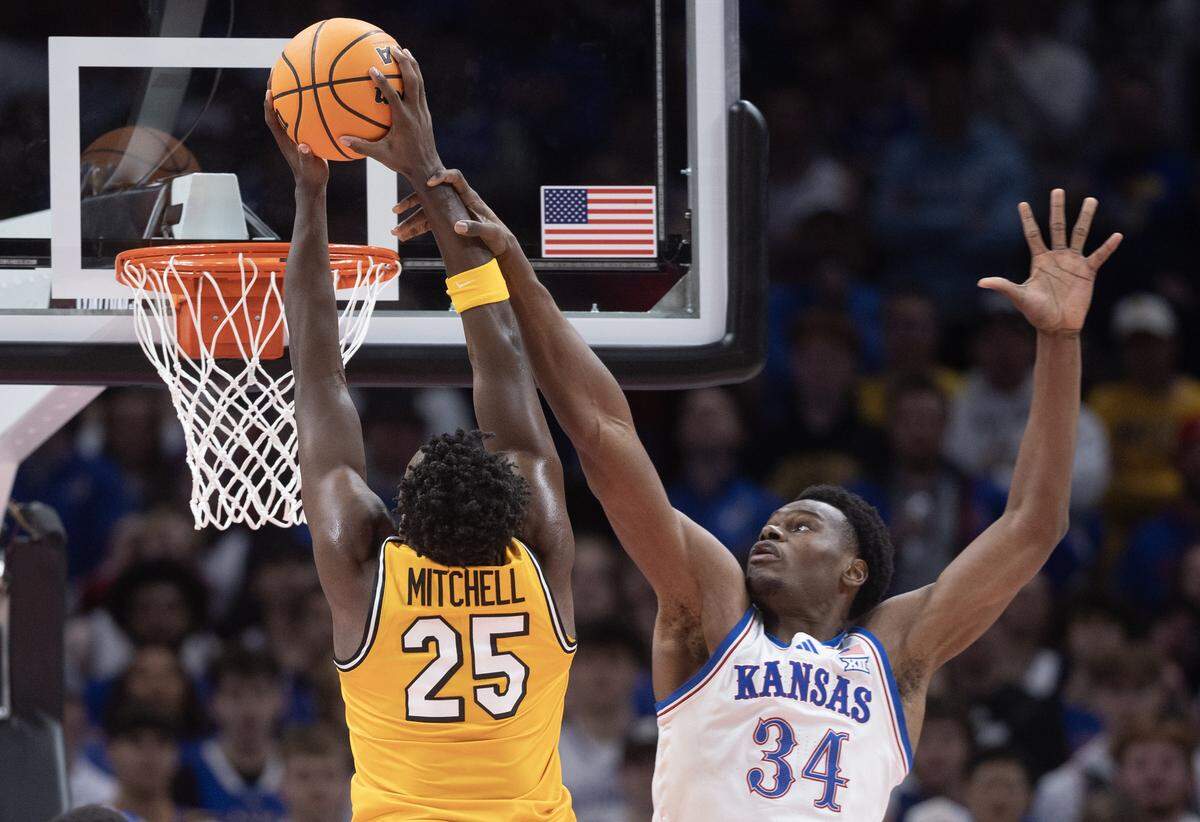
Still, it bears mention that MU played a similar sort of nonconference schedule last year leading into its 76-67 victory in Columbia over then-No. 1 KU — part of a turnaround from an 0-18 SEC season into an NCAA Tournament berth (and first-round loss to Drake).
Even this result could be a building block for MU. Certainly, it makes for some reflection on where the program is this season.
Meanwhile, Self said with a smile that on the way home from that loss at Mizzou he found himself thinking he would just as soon have the series be put to rest then.
While Gates expressed the opposite after MU fell to 1-4 against the Jayhawks since they resumed playing, Self still wondered where it will go from here.
“I don’t know what’s going to happen in the future with scheduling …” Self said. “But guys, on scheduling moving forward, you schedule based on where you can go make some money. Because that’s the world we’re living in.”
Case in point was KU’s recent appearance in the Players Era tournament in Las Vegas, where Kansas was awarded a bonus $300,000 in NIL compensation.
“It’s hard to pass those things up,” Self said.
But it should be harder to pass this up.
So it can be passed down and cared for and preserved as the singular rivalry it is.