
KC legends George Brett, Tom Watson hope Royals’ Jac Caglianone heeds this advice
At spring training in Surprise, Arizona, George Brett was wowed by the phenomenon of top prospect Jac Caglianone — who all of a sudden will make his major-league debut on Tuesday in St. Louis.
But what struck the Royals’ National Baseball Hall of Famer most was how riveted everyone else was.
Especially at the casual, limber-up time of year when players seldom appear for more than a few innings and soon thereafter typically either leave or stop paying attention.
“All I know is every time Jac Caglianone came to home plate,” he said Monday, “not only was everybody on our team on the (dugout) railing watching but everybody on the other team was, too.”
A moment later at the Nicklaus Golf Club at LionsGate in Overland Park, Brett turned to friend and fellow Kansas City sports legend Tom Watson — his longtime co-host at the annual Joe McGuff Golf Classic on behalf of the ALS Association.
And his question to the longtime Royals fan was the start of a captivating discussion between two of the greatest there ever were (and guys who can finish each other’s sentences) about the much-anticipated arrival of Caglianone — and how he might best meet the moment.
“Tom had a chance to meet him in spring training,” Brett said. “What were your impressions?”
Watson smiled as he considered Caglianone’s size, 6-foot-5, 250 pounds, a demeanor defined by his “infectious smile (and) manners” and the nuanced self-assurance that left Caglianone telling Watson “I expect to be up at the end of the year.”
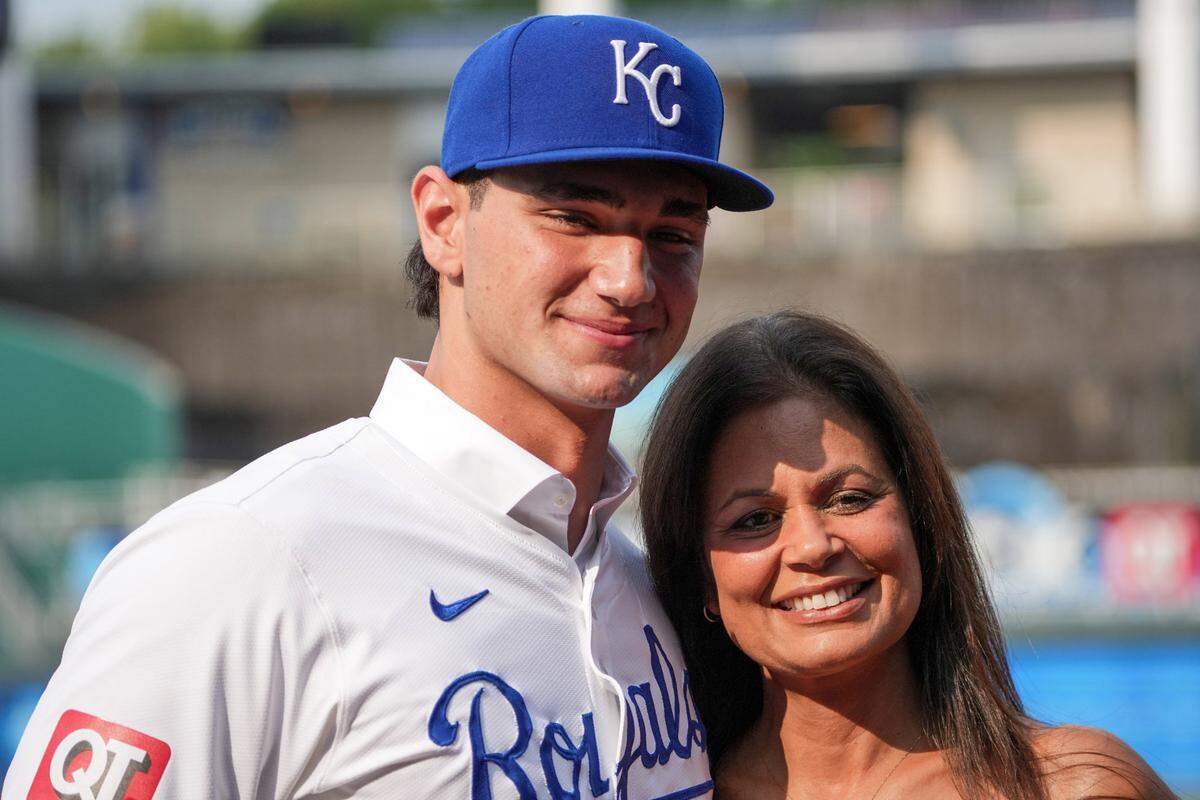
So, yes, this is much ahead of both Caglianone’s timeline.
Not to mention what the Royals had planned before he created a critical mass that they hope can rectify the critical mess they are offensively ... and not squander some of the best pitching in Major League Baseball.
No wonder Watson and Brett each thought about what this fanfare will be like now for the 22-year-old Caglianone, the No. 6 overall pick in the 2024 MLB Draft.
How will microphones in his face every day affect his mind and preparation, Watson wondered, calling that the only “warning” signal he’d have for Caglianone.
With a laugh, Watson found himself thinking of the movie “Bull Durham” and the speech Crash Davis (Kevin Costner) gives Nuke LaLoosh (Tim Robbins) about how to dumb down every interview.
Embrace that as Nuke did, Watson added, that didn’t change the pressure — externally or internally.
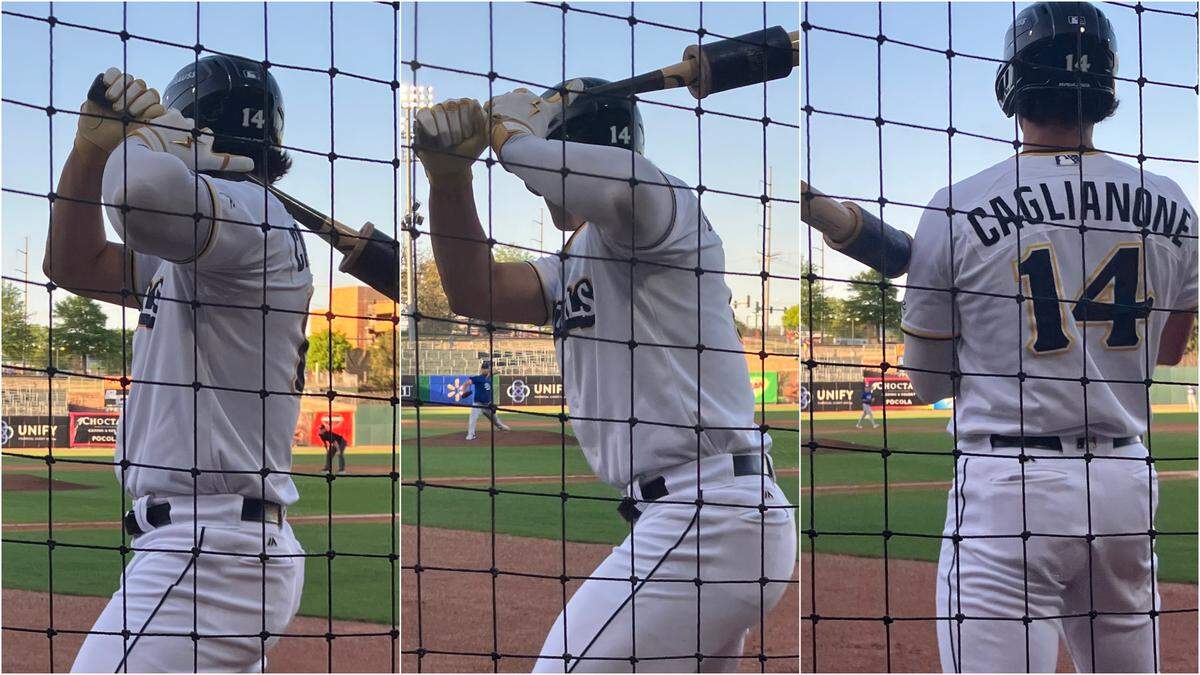
Cue an exchange for the ages between the men whose abiding friendship largely was kindled by their own personal experiences with ALS and their ongoing passion to eradicate the sinister disease that was further in the spotlight Monday on the occasion of Lou Gehrig Day.
Nevermind that Brett in some ways couldn’t quite relate to this moment for Caglianone.
When he was called up from Omaha in August 1973, Brett arrived at O’Hare International Airport in Chicago with his suitcase and a Royals bag bearing his gear and hailed a cab to Comiskey Park.
He got dropped off outside the stadium with no idea where to go, no credential or ticket or greeting committee awaiting and had to navigate his way in.
Surmising that Caglianone would join the team on the off-day Monday, Brett smiled and said, “It’ll be a lot easier for Jac to get to the stadium tomorrow.”
As for once he’s there?
The best approach would be the embodiment of a seemingly paradoxical term Brett has used for years: try easier.
“Now we’ve just got to get him to calm down a little bit …” Brett said. “He’s got unbelievable power; we all know that.
“But now he’s got to just try to control his swing and not try to have more power, if that makes sense.”
Watson interjected, “You never tried to hit a home run,” and noted the impact of Brett’s hitting guru, Charley Lau.
Picking up where Watson left off, Brett quoted one of Lau’s mantras: “A home run comes as the result of a good swing” … and not from the harder you swing.
Then Brett referred to Watson’s mentor, Stan Thirsk, who also occasionally tutored Brett in golf.
“‘George, when you learn to swing easier, you’ll learn to live with the added distance,’” Brett recalled Thirsk saying every time they played together.
Toward that end, Brett had some advice in mind as he pictured what Caglianone would be living Tuesday and on into such milestone moments as his home debut next week against the New York Yankees.
“It’s going to be 38,000 people (at Kauffman Stadium). He’s going to get a standing ovation,” Brett said. “Now, he’s just got to step back a little bit and don’t try to do more. Try to do less. You see what I’m saying?
“You’ve got to breathe. … He’s got to breathe, and I’m going to remind him of that: Breathe. Keep breathing.”
Brett anticipates the camaraderie of the clubhouse will help settle him and that he’ll get the message that he just has to be himself. And that this is no different than what he did in Double-A or Triple-A.
Trouble is …
“That’s a lie,” Watson said, laughing.
With a laugh himself, Brett added, “well, it is a little bit.”
Proper preparation and creating routine, each believes, are the most true way to the right state of mind.
So is being in the moment by what Watson called making every shot “a tournament in itself.”
To Brett, it’s about a “short memory” and a clear mind — informed by all the fundamental work in order to be mentally free in the moment at hand to simply “see the ball and hit it.”
Citing the example of watching television and trying to absorb both the spoken words and written crawl, Brett said “your mind can only do one thing at a time.”
And it can do it a lot better with Watson’s corollary to Brett’s point about breathing.
Before Watson became perhaps the best golfer in the world from 1975 to 1983 by winning eight majors (still the sixth-most ever), he’d allow pressure to make him go faster.
“And when I went faster, I made mistakes,” he said. “And I had to learn; I had to learn through a lot of failure.”
Changing his breathing was part of that, but he developed another trick.
“Just walking a pace slower; that helped me,” he said, smiling as he recalled how he might outrun Arnold Palmer. “Arnold was the charger. He always took over from the first tee … down the fairway. Everybody’s following him, and I could beat him back in those days.”
Over time, though, Watson learned how to pace himself and find his own stride — in more ways than one.
“It’s about rhythm in golf — grip pressure and rhythm,” he said. “And I got the grip pressure down pretty well, but the rhythm was too fast. I wanted to get it over with.”
He added, “You can’t get it over with it. You’re in it. You’re in the water without an inner-tube, man. You’ve got to deal with it. And I finally learned how to deal with it. It took me several years to do it, but I finally did it.”
So did Brett, who remembers how his mentality changed through the confidence he began to develop.

By way of example, he recalled how he once would stand in the on-deck circle and see stellar lefty reliever Sparky Lyle warming up and tell himself, “Man, I hope they don’t bring him in to face me.”
When they did, well, Brett essentially already had made the out.
Through achievement over time, Brett found himself in the on-deck circle saying, “I hope they bring him in,” because by then he expected to hit him.
Caglianone’s path, of course, will be his own, with its own peaks and pitfalls and learning curves.
But the young man who’s been filling notebooks with observations and advice these last few months no doubt would benefit from some of what each of these Kansas City icons can share — including to breathe and slow down even amid his rapid rise.
The Star’s Blair Kerkhoff contributed.
This story was originally published June 3, 2025 at 5:00 AM.