
Chiefs’ DeAndre Hopkins’ bond with mother forged by a secret only they knew for years
Maybe by now you know that every time DeAndre Hopkins scores a touchdown he gives the football to his mother, Sabrina Greenlee, who was blinded and scarred by a despicable attack in 2002 that sent her into despair before it became her salvation.
Even when she’s not there to get the ball in person as she was with field-side seats in Houston, the gesture remains as tender, touching and telling now as the first time he surprised her with it.
But for a far deeper and more poignant reason than most could know — a reason that helps explain why she is thriving today and speaks to how DeAndre came to be the man and player he is.
When DeAndre came her way with that first ball years ago, she said in a recent interview with The Star, she was awed by the intensely personal act of her son — who is now the second-leading active receiver in the NFL (984 receptions) behind only Chiefs teammate Travis Kelce (1,004).
More unexpectedly yet, she also felt the power of sensing thousands and thousands of people suddenly becoming part of her healing and support.
It was a perception she’d never really known before.
Especially after the immediate post-attack years of not wanting to be seen by anyone and feeling that she didn’t matter and didn’t know who to trust.
“It’s like he automatically knew what I needed in that moment …” the South Carolina native said shortly before a Dec. 20 meet-and-greet and signing of her new book, “Grant Me Vision,” at Bliss Books & Wine. “He knew I needed something tangible to touch.”
.jpg "BeFunky-collage (21).jpg")
Something that represented the intangible of love that revived her life, redeemed her faith and helped inspire the purpose and radiance you will feel the moment you meet this resilient force of nature.
‘The bond that me and my Mama have’
While all four of her children saved her in their own ways (all are “my heroes,” she said), no one act was more vital in the most dire of moments than what DeAndre somehow knew to do in the middle of one night when he was 12 or 13 years old.
That was the moment that most established what she calls their unbreakable and unspoken bond.
A moment that indeed never was shared with others or even discussed between them until a celebration of her life on the 20th anniversary of the attack.
On that 2022 night in Houston, her son revealed their secret to family and friends.
“I want to tell y’all about the bond that me and my Mama have,” she recalled him saying. “I saved her life.”
DeAndre, she said, spoke with his head bowed and tears falling from his eyes as he told the story and read a poem he wrote for her.
Telling the story and demystifying that night was empowering to her in numerous ways — including making her realize she had to include it in the book she had started working on that would be subtitled “a journey of family, faith and forgiveness.”
Including forgiveness from her family that gave her faith.
As DeAndre spoke that night, she wrote in the book, he also said “he now realizes God put him on Earth to save his Mama’s life.”
One-hundred phone calls
To hear and read her story is to evoke the Book of Job in the Bible. Because how much suffering can one person endure?
Her book chronicles it all: raging battles between her parents, including once seeing her dad put a gun to her mother’s head while driving; being raped by a reverend who, she wrote, “took a piece of my soul”; the deaths of both her beloved brothers, one because of an uncle’s drunk driving and the other in a police shooting during a domestic dispute; losing DeAndre’s father, Steve Hopkins, to a car accident when DeAndre was just 6 months old; and being gripped in repeated abusive relationships.
That’s hardly the full extent of it.
But all of that was part of a generational cycle consuming her and leading to a life on the edge in which she committed violent acts of her own and supported the family as a stripper and a drug dealer.
The chaos, she said, often compelled DeAndre to go for long runs late at night just to get away from it all.
“I was a train wreck, waiting on something to happen,” she said. “I knew something was going to happen. I just didn’t know when, right? … I didn’t want it to be that tragic or that hurtful, but I knew something was going to happen.”
The pivot point of her life, the horrific ambush that at once nearly killed her and made her who she is today, was unleashed by a woman also dating a man she was seeing at the time.
Greenlee was splashed in a concoction of lye, bleach and boiling water, as she describes it in the book.
She immediately felt her face begin to tingle and skin start to come off in her hand before she collapsed in shock and was taken by medevac to a Georgia burn center.
She thought she was dying and didn’t wake up until a month later from a medically induced coma.
In those first few days, DeAndre wrote in the foreword of the book and expressed in the poem, he called her phone 100 or more times.
“To hear her voice on the ring back,” he wrote in the poem. “My dad died when I was 6 months
“So the only thing I knew was to keep calling
“And hope that God would give me a ring back” …
She was mercifully alive but with the worst ahead.
Blinded and scarred on 17% of her skin, she said, she at times was unable to even feel her body and scant notion of who she really was as she lay engulfed in the cumulative damage of a lifetime.
“Depression, anxiety, the loneliness, the bitterness, the shame,” she said. “The shame is what can really take over. Because I was so ashamed of like, ‘Oh, my God, I did this to these kids.’”
It would “be cute,” she added with a smile, to be able to say one day a lightbulb just flicked on.
And that through that snap of the fingers she found forgiveness and the striking beauty she now exudes.
.jpg "unnamed (25).jpg")
And the uncanny strength to be a role model for victims of domestic abuse and, really, anybody who’s paying attention.
But the important real story is that it didn’t happen right away.
The saving grace
In her case, amid days at a time locked in her room, she contemplated suicide.
One night, soon after another of dozens of eye surgeries failed, she decided to act on her most agonized thoughts.
She planned to sneak out of the house when everyone was sleeping and find her way to a nearby road through mailbox markers up the driveway. Then, she wrote in the book, she would run into the street when she heard a car coming.
In her pajamas, she left the house at around 3 a.m. without even closing the door to avoid making any noise.
She had walked some two-thirds of the way to the road when she felt DeAndre’s touch on her shoulder.
Something had awakened him and impelled him to check on her.
“I turned around, and he grabbed my arm,” she wrote. “We went back into the house together. He locked the door. I went to my bed. He went to his room, and for years we never spoke another word about that night.
“I finally saw that it was my children who were the people in my life I could fully trust.”
A long process remained ahead.
But if ever she had an epiphany it was through that.
Per her book, she soon called Pastor Ova McCauley, who had been a regular presence even when Sabrina didn’t want to engage, and asked, “How do I pray for my children?”
Before long, she was working to make it all up to them, by cooking and apologizing to each and all and just being there for and with them again.
And by forcing herself to forgive the attacker who got 20 years in prison.
Not just out loud but in her heart.
Meanwhile, through the endless efforts of a doctor, she even regained some blurry sight for a few years as she gradually came to view everything differently.
It wasn’t a seamless transition, she wants you to know, and she still was selling crack to make ends meet for a while.
But she was on the road to redemption and true vision that she now embraces even over the eyesight that she ultimately lost altogether in 2015.
Choosing vision over sight
Much as she still wishes to see, she wouldn’t trade having her sight back for what its absence has allowed her to stand so powerfully and at ease in her own skin as she is now:
As an abiding inspiration who works through her S.M.O.O.O.T.H. non-profit (with critical support from DeAndre) to “empower women impacted by the perils of domestic violence.”
A testament to not just the human spirit of never giving up but the capacity to do the painful work of looking hard at your own actions and forgiving yourself so as to be able to forgive others.
This is what it looks like to be on the other side of all that, she’ll tell you, to know the freedom that comes from unconditional forgiveness and be able to dance and smile and give despite it all.
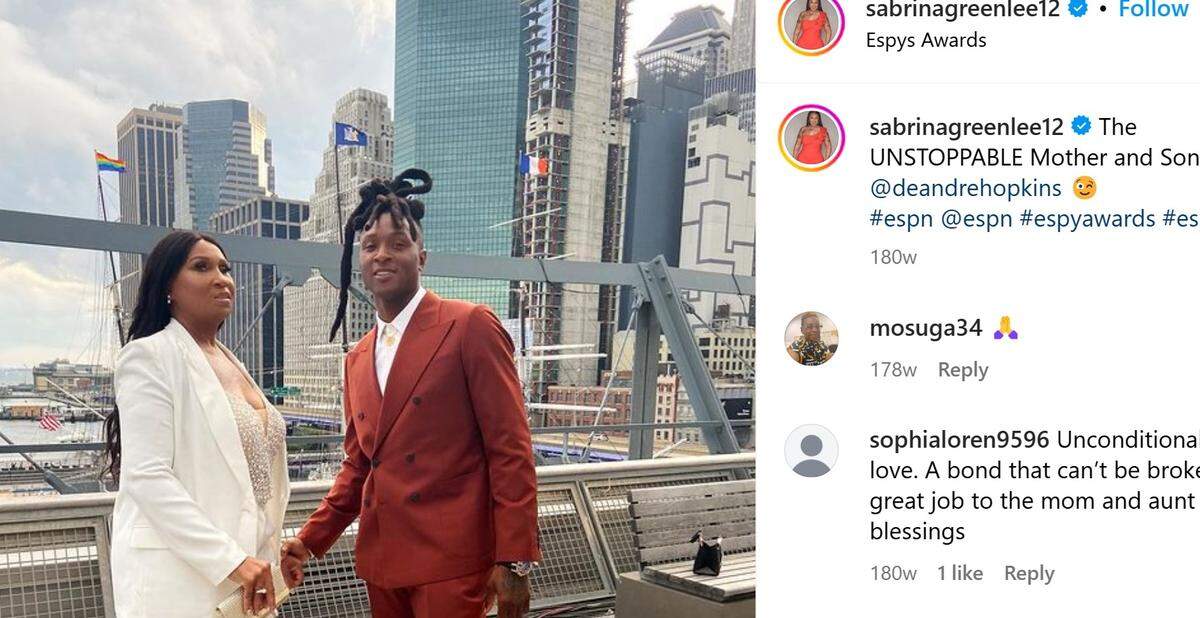
In some ways because of it all.
“Knowing who I am when I walk in a room, or who I am when I speak, and knowing that people are looking at me and I’m an inspiration because I got through all of that? I can’t change that,” she said, later adding that she has come to see herself as a vessel of God. “And if I have to walk this walk without sight, then so be it. I’m still here to be a vessel and to be a light …
“Why change something that made me and molded me into who I am today?”
‘He’s always been driven to succeed’
All of that is entwined with DeAndre’s identity in ways we can only hope to understand but that are easy to appreciate.
In certain ways, she said with a laugh, he’s still “the same little boy” that was so antsy in lines to compete in rec football or track that she thought he had to pee.
Instead, it was because he couldn’t wait to perform — something he continues to demonstrate at age 32 with 41 catches for 437 yards and four touchdowns in his 10 games with the Chiefs.
“He never stopped …” she said. “He’s always been driven to succeed.”
For some time when he was very young, that was fueled less by the love that later emerged than by a certain fury created by the wretched circumstances around him.
At around age 13, he wrote in the foreword, he vowed never to ask anyone for anything.
“I think the real reason I was better at sports than everyone else was because of the emotions built up inside of me. And my own struggles, too,” he wrote. “A relative once told me to take that anger and aggression out and put it somewhere good: I did that, and I left it all on the field.
“As a result, my success is linked directly to my (Mama) in many ways.”
If it hadn’t become clear before, the nature of that dynamic changed fundamentally on the day DeAndre left for college at Clemson: His mother flushed the last of her crack-dealing stash down a toilet to free him from the burden of worries of that life as he set out to create generational change for the family.
“I knew that that was the last day that I’d be doing that,” she said. “I didn’t want to do anything to hurt him.”
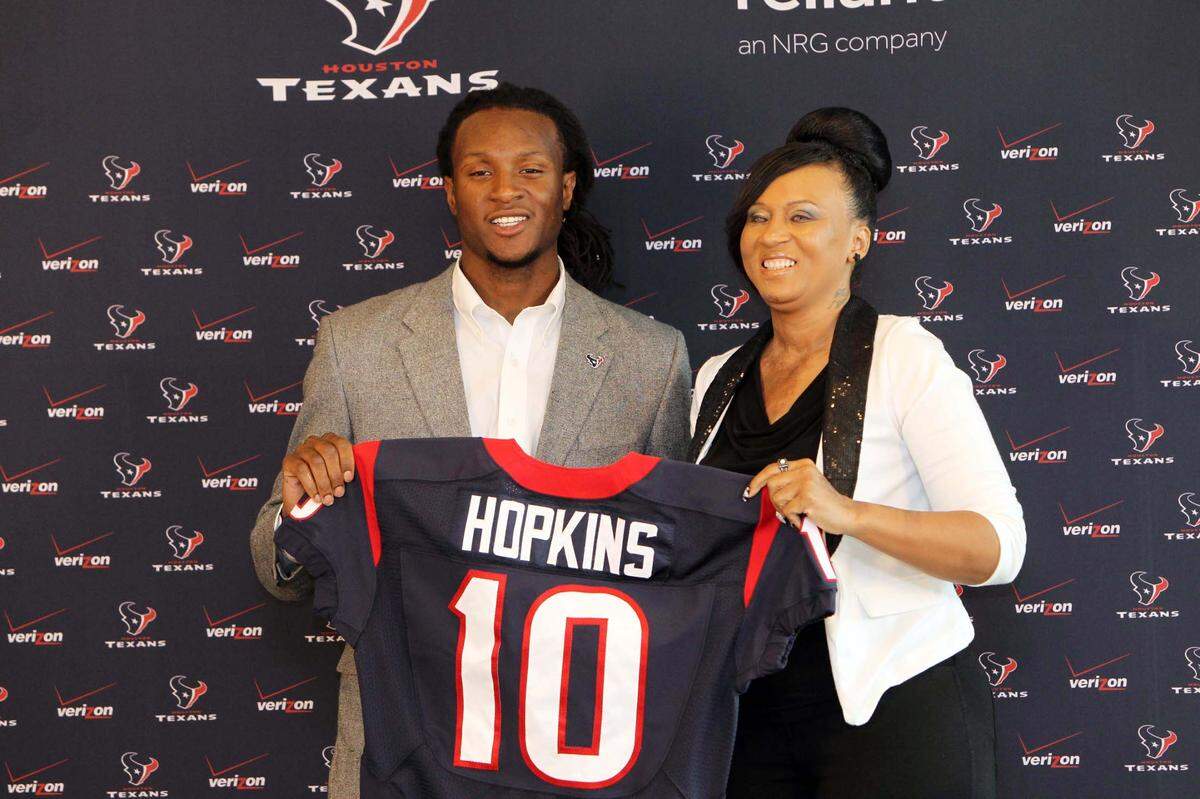
On their flight to Houston after the Texans had made him the 27th overall pick in the 2013 NFL Draft, he wrote in the foreword, Hopkins fell asleep with his head on her shoulder wondering what the future held.
As they toured Houston, he turned to her and said, “Mama, we made it. You’ll never have to struggle again. We made it out.”
All part of a bond, she said, “that can’t be broken.”
Intent on helping her sell copies of the book and perhaps not wishing to publicly revisit the intense matters he’s addressed a few times over the years, Hopkins spoke only briefly with me about his mother’s story a few weeks ago.
But maybe he said all there was to say about how he sees her and this journey together.
“It’s the love,” he said, “that every son should have for their mom.”
This story was originally published December 27, 2024 at 6:30 AM.