
As Title IX turns 50, KC Current are part of ‘not just a moment but a movement’ to more
Given the momentous news last week that Kansas City had been named a men’s FIFA 2026 World Cup site, one of the points NWSL commissioner Jessica Berman made here the other day should have been no surprise.
“People are talking about Kansas City in Europe,” she said.
But she didn’t mean because of the World Cup.
She meant because of the level of investment for unprecedented breakthroughs in the world of women’s sports being orchestrated, and almost entirely funded, by the Kansas City Current.
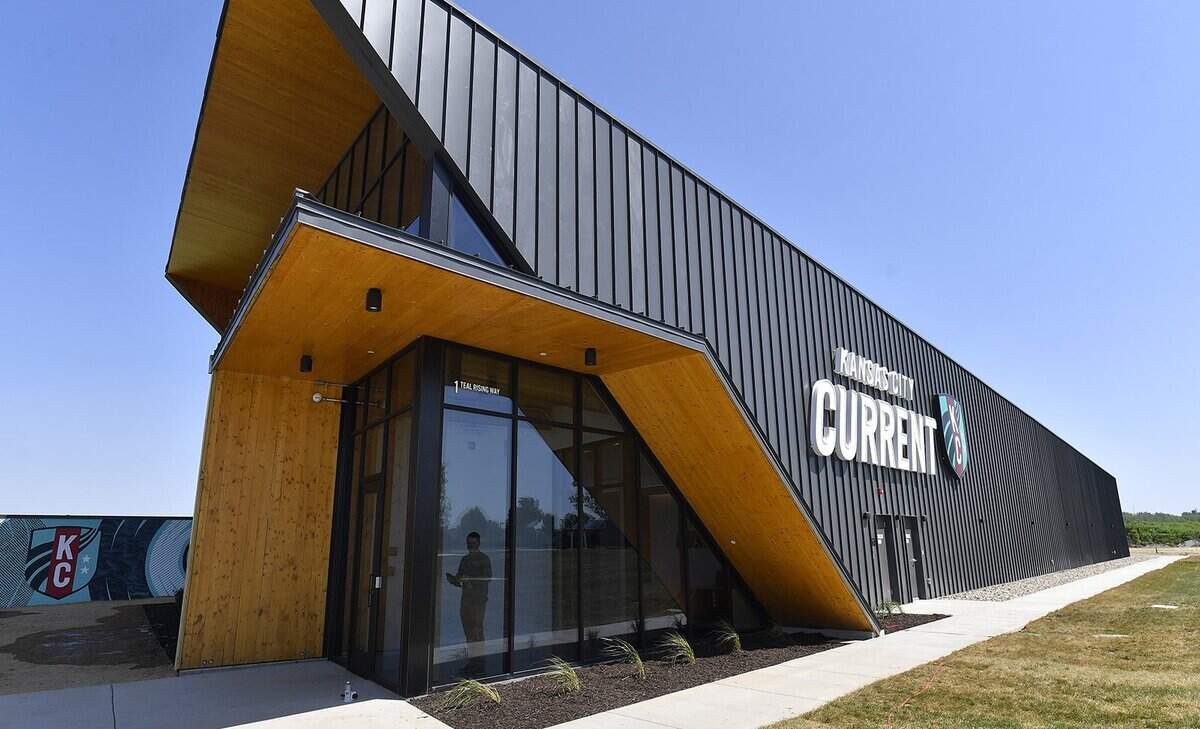
Deftly timed 50 years to the week that Title IX was signed into law, the team opened its $19 million training facility in Riverside on Tuesday. Part of its increasingly global profile also is the impending construction of what is believed to be the first stadium in the United States specifically for a women’s professional soccer team.
Co-owners Chris and Angie Long confirmed that they still expect to break ground this fall with the anticipation it will be completed in 2023 and open for the 2024 season. Projected to be 11,500 seats at a cost of $117 million (the club is seeking $6 million in state tax incentives), the state-of-the art stadium to be built on the Berkley Riverfront of the Missouri River will be among the first sites entering Kansas City from the new KCI and other points north.
But we digress. This week was about the training facility, a statement in itself.
We didn’t get to go inside on Tuesday, alas. From what we’re seeing on the Current’s website and social media platforms, though, we can surmise that the Current’s 35-year-old Kristen Edmonds had it about right when she joked that the only thing missing “is a time machine for me to get five years younger.”
If they do get ahold of a flux capacitor or whatever else they might need to contrive that wayback machine, maybe June 23, 1972, in Washington, D.C., would make for a worthy pop-in.
That’s when and where Title IX of the Education Amendments Act of 1972 was signed by President Richard Nixon and stipulated this: “No person in the United States shall, on the basis of sex, be excluded from participation in, be denied the benefits of, or be subjected to discrimination under any education program or activity receiving Federal financial assistance.”
Before the ceremony on Tuesday, we asked the Longs about the significance of the timing.
“It’s a pretty powerful statement; this is like the real, physical embodiment of Title IX,” Angie Long said, later noting the arc of its influence in her lifetime. “It’s fun to think about generationally. My mom wasn’t even allowed to play sports, and I was but I was wearing the hand-me-down jersey.
“And our daughters look at this and say, ‘I want to be a professional athlete.’ … It’s taken a while. But it’s so impactful; it’s changed everything.”
Or at least helped enable the possibilities of change. Because this also hits at the crux of the old history exam question: Do people make the times … or do the times make the people?
If you’ve read about the Longs or spent any time with them, you can see a perfect case for the former.
When I asked them about the sense of creating a movement, Angie Long put it this way: “I think there’s a movement happening in this country, and I think that we’re in a position to not only ride that wave but push it. Because I feel like when these times happen, we have to take advantage of them. Because there are times when there is no movement.
“So when there is, you’ve got to push as hard as you can to make sure there’s no going back.”
That’s what it took to engage Title IX to begin with … and to make it come to life against the grain and gravity of a culture too often and too long (and still) underscored by the suppression of women.
When I spoke with Claflin, Kansas, and Missouri State basketball sensation Jackie Stiles in March about a documentary of her life, we also talked briefly about what Title IX had meant to her. She thought mostly of how she had stood “on the shoulders of those who came before us.”
When WNBA superstar Sue Bird was here in February as the keynote speaker for the annual WIN (Women’s Intersport Network) for KC banquet, I asked her about her sense of the impact of Title IX.
“I don’t know a world without Title IX,” said Bird, 41, adding that she had never lacked for opportunities. “That means it worked.”
But she also was saving some more substantial points for her terrific address. She spoke of how even as a five-time Olympic gold medalist and four-time WNBA champ that she still is prone to “a form of self-doubt we know as imposter syndrome.”
And she traced it back to what she believes many girls still face from the get-go:
“From our first days here on Earth, through the media, in school, even within our own families, we get the message early and often that boys are better at most things. That girls are different by comparison. That we are ‘the other’ and should really just feel grateful to participate.
“That it would be best to keep the noise down and not to climb too high or play too hard. That there are limits to what we can do mentally, physically or with our own lives.
“That the boys and men around us know things that we don’t. That they’re just smarter and more capable than we are. That we should be questioning ourselves every step of the way.”
Her message was deeper and more intricate and eloquent than this, but much of it was about how opportunities in sports have had the power to change that equation. By creating chances to be part of something bigger than yourself and teaching discipline and empowerment and selflessness and the joy of teammates and so many other aspects.
Not that Title IX has by any means been a panacea. There have been fewer gains for Black women in sports, as an Associated Press report amplifies, and many strides yet to be made across the spectrum.
“We are still light years away from equal pay,” Bird said in February. “We still have to fight for the respect our male counterparts earn so automatically. We are still being overtly sexualized and judged on merits other than our ability to play the game or speak our minds. And we’re still subject to an economy and media landscape… that pits women against each other by throwing so few scraps our way.”
Still, what the Longs and co-owner Brittany Mahomes are engineering here is a re-framing of the status quo.
That’s in terms of what it says to Kansas City and Current players (and prospective Current players), but also to those with whom they compete.
“We have a building here which is more than a building,” Berman said. “It’s a representation of what the Longs have decided to invest in this community and hopefully sets the standard not just in our league … but globally.”
That prospect figures to gain considerable momentum with the further exposure of the practice facility, likely development around it, the building of the stadium and the prominent use of each for training during the World Cup.
“It’s setting a standard; it’s continuing to push,” said Current general manager Camille Levin. “And that’s how change happens at a larger scale.”
At the NWSL office, Berman said, they’ve been talking about not only celebrating the 50 years since the advent of Title IX but also how to ensure that it’s “doing its job for the next 50 years.”
This time has the makings of going a long way toward that and being “not just a moment but a movement,” as she put it.
With ripples from the Current perhaps to become the wave of the future.
This story was originally published June 23, 2022 at 5:00 AM.