
The struggle and the triumph in LaVannes Squires’ legacy at Kansas
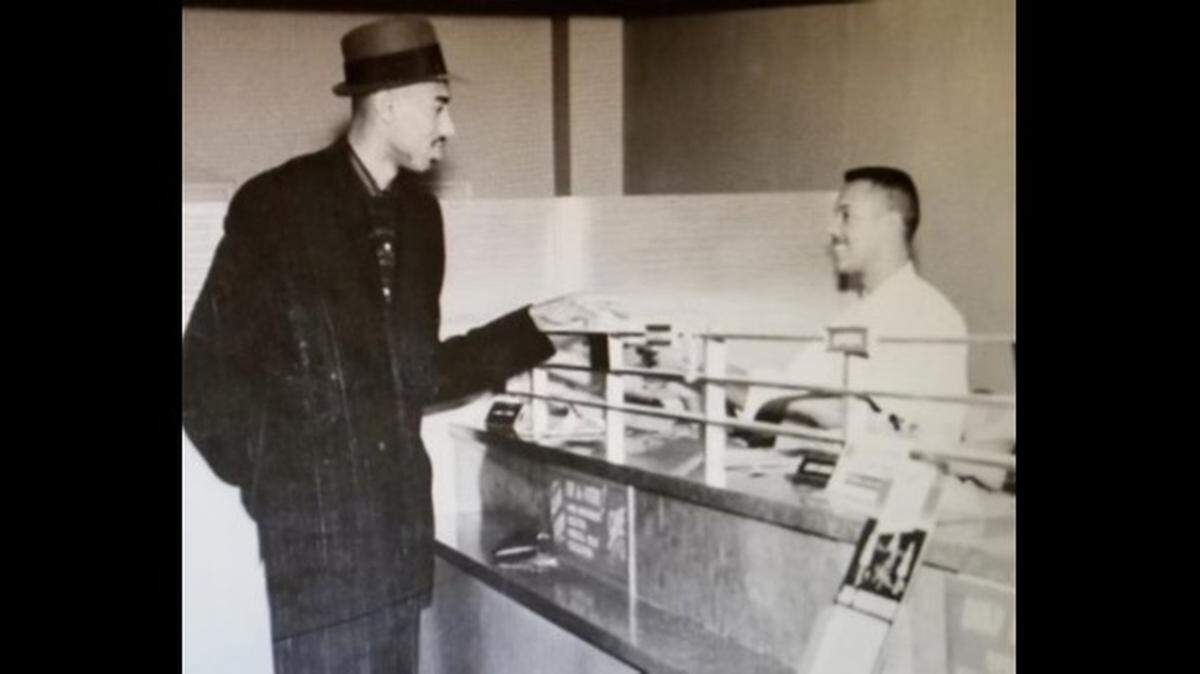
Three years after Jackie Robinson integrated Major League Baseball but still four years before the watershed Brown vs. Board of Education ruling, LaVannes Squires entered the University of Kansas campus as the first Black basketball player in the storied program.
Amplifying its meaning, his arrival in Lawrence was as fraught in some ways as it was a harbinger of change that will remain his legacy (along with a notable business career) long after his death on Feb. 19 at age 90 in Pasadena, California.
“Any time you’re dealing with stuff that’s very controversial and people don’t want to deal with reality, somebody who’s taking it on has to have a lot of guts,” said Tommie Smith, who played for KU from 1971-1975 and befriended Squires as past president of the K Club of former letter winners. “We were always talking about the issue of guts: how much he had to deal with.”
For starters, like much of the region on both sides of the border, the town around Squires in 1950 still was largely segregated and thus inherently hostile to Blacks.
Many restaurants and hotels refused to accommodate them. Movie theaters relegated them to balconies. A private swim club, the Jayhawk Plunge, was segregated (and Lawrence wouldn’t provide an integrated municipal pool until 1969).
With the arrival in 1955 of megastar Wilt Chamberlain, the persisting Jim Crow culture sustained a jolt towards an awakening in ways Squires never enjoyed even as chancellor Franklin Murphy sought to advance civil rights around campus and across Lawrence. Chamberlain’s stature, in every sense of the word, helped evoke meaningful progress … even if some of it simply was contoured to him.
But that was enabled by Squires, as well as the arrival of Maurice King in 1954, considering Chamberlain had determined not to be the first Black player wherever he went.
Chamberlain understood Squires’ significance and maintained a relationship with him. In fact, as he left KU to join the Harlem Globetrotters in 1958, he visited Squires at his bank job to thank him and say goodbye.
Squires once emailed a photo of that scene to Smith, captioning it, “The Best & The First!”
“This ought to be hanging up at KU,” Smith said.
Now, it’s well-understood that Squires blazed a trail, with KU coach Bill Self going as far as to say that Squires’ role in the path for Chamberlain “helped shape the landscape of the history of our game. It would never get as good as it is now without somebody like LaVannes Squires.”
But Squires’ trials in the process are underappreciated.
Because even in the relative cocoon of being on the basketball team, he constantly was challenged … if not downright confronted.
While he didn’t like to talk about himself, his daughter and only child, La Tanya Squires, said, and wanted no fanfare upon his death, over the years she pried loose some of his experiences.
Such as at times being compelled to lie on the floor of the team bus when KU traveling because of the implied risk in his being seen … and not wanting to endanger the team, as she put it. And the indignity of frequently being faced with “whites only” entrances at arenas or admission at all to road restaurants.
The never-ending experiences in which he was “thought of as ‘less than’ ,” she said, ultimately were soothed by the team rallying around him.
Even that, though, seemed a work in progress.
Enlightened as Kansas coach Phog Allen was, he had exhibited “ambiguous” ideas about integration in athletics, my friend and colleague Blair Kerkhoff wrote in his biography of Allen, “Phog Allen, The Father of Basketball Coaching.”
John McClendon, who would become a groundbreaking Black coach, attended KU but wasn’t allowed on the team.
“It was Dr. Allen’s job to resist integration then,” he said in an interview for the book. “He was the AD and the whole school knew it was an area where he’d be challenged. He practically apologized to me. But as quickly as he could he got black players on the team.”
By the late 1940s, with Harold Robinson about to integrate the Big Seven as part of Kansas State’s football team in 1949, Allen was asking players to vote if the team should integrate. Jerry Waugh, a captain of the 1950-1951 team recalled in the book that the team voted against it because of Allen explaining the difficulties a Black player could face in the conference.
To say nothing of perils closer to home, including a particularly alarming episode in October 1953: Squires’ fraternity, Alpha Phi Alpha, accepted a white student named Roger Lee Youmans, who would room with Squires and Wilbert Crockett, The Star wrote then.
Despite some people teasing him about what became national news, Youmans said, “Everyone has been real swell about it, and now nobody thinks it is out of place.”
A week later, a burning cross, a hate symbol popularized by the Ku Klux Klan, was placed near the house. (Youmans died in 2019 and Crockett died in 2005, and little information about the incident could be found in various databases.)
Jarring as that must have been, the day-in, day-out grind was the more fundamental struggle. Squires often spoke or e-mailed Smith about commencing that year, during which Gene Wilson also became the first Black basketball player at Kansas State.
(Missouri’s first Black scholarship athlete was basketball player Al Abram in 1958, though it bears noting that Coach Spark Stalcup had met with Chamberlain and offered him a scholarship).
While Squires received support from most of his teammates, surely including Dean Smith, later to be a Hall of Fame coach and renowned civil rights advocate, there still was an edge to some of it.
“So here’s a high school guy (from Wichita) who is asked to come do something that’s never been done before,” Smith said. “And he’s going to get criticized even by own teammates: ‘Why are you here? What are you doing? Go home. We’re not letting you travel with us.
“ ‘If you do travel with us, we have to find you an African-American family to stay with. Because they’re not going to let you stay in a hotel. The people in town where we’re playing won’t allow that. You can’t drink from the same water fountain. You can’t eat at the same table as us.’ ”
He added, “And that works on you. It builds on you. And it just makes you mad. But you have to take it. Because you have to prove, ‘I can be here. I can play. I can do this. I’m not going to let anybody tell me what I can’t do.’ ”
In certain ways, Squires was uniquely girded for the moment. Much as he loved basketball, he understood the real opportunity was education. And he was steeled by a childhood of harsh circumstances after being the eighth of 12 children born to Arthur and Charlotte Squires in Hartsdale, Missouri.
His father died when he was 3, his cousin, Gwen, said, and one sibling died at birth and two others at a young age.
His mother had a fifth-grade education but “was their rock,” La Tanya Squires said. “She was the one who made it so the family could survive.” That included factory work during World War II and eventually moving to Wichita.
Her work ethic inspired him, both to help the family effort and to become the first to go to college. As a teen, Gwen Squires said, he filled coal bins and worked in wheat fields and did construction.
“He used to talk about that there was no job beneath him,” La Tanya Squires said. “He’d dig ditches. He’d dig graves. He did whatever he had to do.”
The same attitude applied at KU.
After a year on the freshman team, per the rules of the day, Squires made his varsity debut on Dec. 3, 1951. In the first game of what would become an NCAA championship season for KU, Squires scored four points in a victory over Baylor at Hoch Auditorium.
A cringe-worthy wire service story wrote that “the boy … gave a good account of himself, scoring four points and turning in some fancy floor work.”
(Years later, as a child, La Tanya Squires recalled witnessing him stand and firmly tell a vendor at a Chiefs game, “I am not a boy.” Then he simply sat down and put her back on his lap.)
According to extensive research done in 2019 by freelance writer David Garfield from Lawrence Journal-World archives, Allen after the game said, “He shows fine early coaching and has a lot of fire, enthusiasm and ability. If he continues to improve as he has in the past few weeks, he’ll play a lot for us.”
But Squires never did for a variety of reasons, some more tangible than others. In 1952 and 1953, he missed time after being diagnosed with tuberculosis — which La Tanya Squires said he believed “probably had to do with the poverty he lived in growing up.”
Beyond that, though, as gleaned by Garfield, Bill Mayer of the Journal-World wrote at the time that the crowd “went for” Squires.
But in the hindsight of 2009, Mayer wrote that during his first game a number of “the KU ‘faithful’ … took a huffy hike from Hoch Auditorium the night Phog Allen broke the basketball color line with LaVannes Squires in the early 1950s.”
Squires appeared in just 32 games in three seasons. And while it’s been known that Allen kept him home from at least one road trip to Louisiana, Tommie Smith suggested that was hardly the only travel Squires missed because of the institutional unwillingness to further confront racism.
Per Smith, Squires would show up at times for a trip and be told, “Well, you can’t go today.”
“Can you imagine? You do all the work … and play by the rules, and then you get slapped in the face again?” Smith said. “So every time he had to pick himself up and regroup. Every day he goes to practice, he has to regroup.”
This was about life for Squires, though, not just basketball. So he persevered and earned the respect of Allen and teammates. As Squires prepared for his senior season after KU had been to back-to-back NCAA title games, Allen called him “a real gentleman, a fine athlete and a splendid student” in a book inscription.
Still, no doubt Squires had mixed feelings about his time at KU, his daughter said. But even if Smith said he believed Squires only returned to Lawrence once, he always appreciated the springboard it became.
“All those experiences really just pushed him to do better, just to do more,” his daughter said. “He wanted more for his life. But he also wanted to set an example.”
So he did in the banking world in Kansas City. In 1970, he was honored as the small businessman of the year in Missouri in a ceremony in Jefferson City. True to form, he downplayed it.
“I don’t know what I’ve done to deserve the award, unless it’s more to do with the race issue,” The Star quoted him saying at the time. “I’ve done only what any other banker would do, and that is to do all they can to serve their clients. At least this is what I assume they do.
“If everything was taken on the basis of a person’s merit, there would be no need to give honors for being black or white. This is the American way.”
Told the quote, La Tanya Squires said, “That’s very telling about how he viewed the world.”
But, she later added, he also was cognizant of there being two different Americas.
So after moving his family to California in the 1970s, Squires did his part to make sure La Tanya went to the best school they could afford, Stanford. She got one degree in industrial engineering and another in economics but went into television production and documentary work and now is the media manager at The California Endowment.
Of all the things she thinks of now, she perhaps admires most how he loved trying to help others.
“That’s why he thought he was here on this Earth,” she said. “To be a good neighbor, to be someone that people looked up to.”
So he was until his heart stopped beating on Feb. 19.
And so he shall be even now.
“I’m sure he went through a lot of mess that we won’t ever know about,” said Smith, who played on Kansas’ 1974 Final Four team. “I’ll always appreciate it until I go to my grave, what he did for the rest of us.”