
Remembering Mizzou’s Charlie Henke, who was much more than what some remember him for
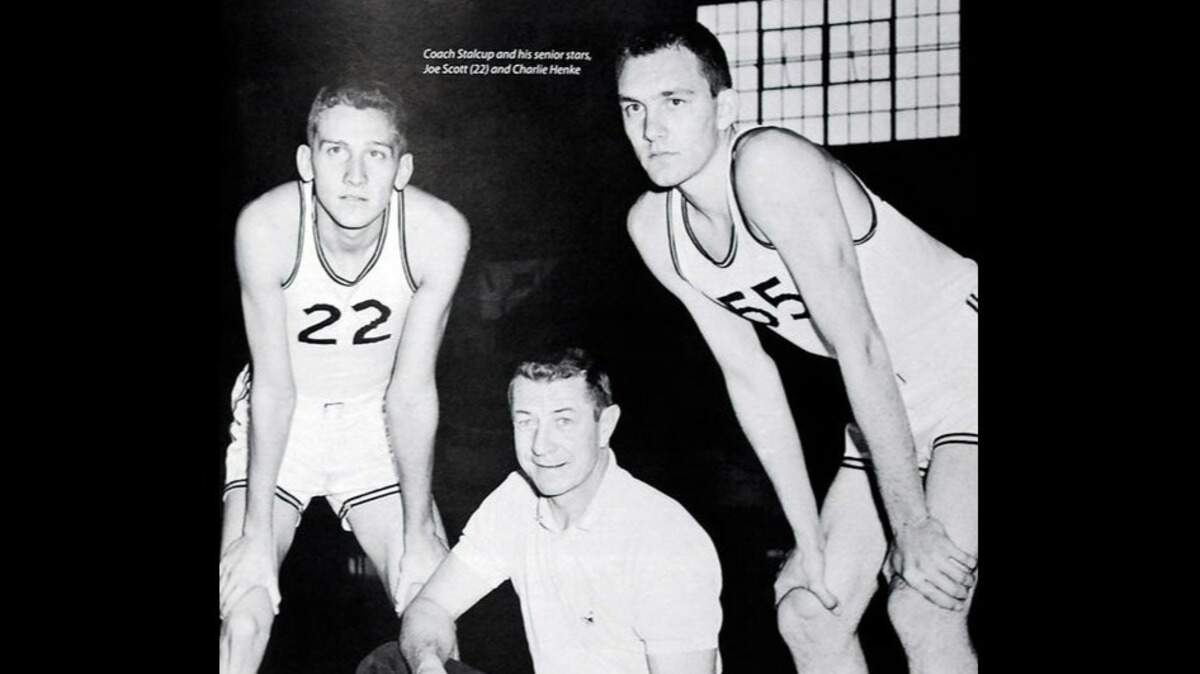
Charlie Henke grew up in Malta Bend, Missouri, a town of about 400 with roughly 55 students in the high school at the time. When he arrived at the University of Missouri in 1957, his freshman coach had reservations about the “country guy” even if he might have recognized parts of himself in that rural background.
“He was such a nice guy, I wondered if he would be competitive enough to be successful,” Norm Stewart, who went on to become a multi-Hall of Fame coach, said by phone Monday.
Stewart had a role in assuring otherwise, as Henke (pronounced Heenk) later told the Missouri Sports Hall of Fame: Stewart “told me what he wanted me to do,” he said, and reinforced that not just by throwing balls to him but, at times, at him.
When Stewart reflected on that time, though, he thought of the devastating hook shot Henke developed as they refined his footwork — a shot that was part of Henke rising to All-America status his senior year and finishing his career as MU’s scoring leader.
His 24.2-point average in his final season remains second in Mizzou history, and he was named to Misssouri’s All-Century team in 2006.
Never mind that from afar and superficially, Henke remains best known for his last game at MU … and being in the eye of the mayhem in a frightful brawl with Kansas. We’ll come back to that episode to set some points straight.
First, though, let’s consider the more substantial and revealing last 60 years of the life of Henke, who died on Feb. 3 at age 81 and was to be buried on Monday in Concordia, Missouri.
Henke spent a year in the American Basketball League with the Kansas City Steers, during which time his obituary says he was given a key to the city of Kansas City by President Harry S. Truman. Then he coached and taught all over the state, from Nevada to St. Louis (Mehlville) to Carrollton, where he also taught biology.
It’s testament to his influence in the role that former students dominated the tributes to him in the online guestbook at www.campbell-lewis.com.
“I remember him as quiet and kind and always (having) good stories about weird science stuff,” wrote one.
Wrote another, “We all adored him.”
After retiring in 1996, he moved to Concordia with his wife of nearly 25 years, Sandy. Per his obituary, he spent as much time as possible on trips to Estes Park, Colorado, reading western novels, fishing on his pontoon boat or playing cards with longtime friends.
“Many will remember him for his basketball accomplishments,” the obituary stated, “but those closest to him will be most-grateful for his wit, sense of humor, and often-imparted wisdom (welcomed or not).”
Let’s flash back to a moment unwelcome to all: the events of nearly 60 years ago now, on March 11, 1961.
As much as many of us might miss the MU-KU rivalry, days like that illustrated something deeply troubling bubbling between the factions.
An already contentious series had become all the more amped up because of football: Only months before, then-No. 1 Missouri had lost 23-7 to Kansas … which later was compelled to forfeit for using an ineligible player.
Each party felt aggrieved in its own way, and it all boiled over that day at Brewer Fieldhouse before a national television audience on ABC. Anticipating the potential for trouble after an intense meeting at Allen Fieldhouse weeks before, according to the Columbia Daily Tribune upon the 50th anniversary, then-MU athletic director Don Faurot stationed football players near the floor … ostensibly to deter violence.
The tension was palpable by halftime, when MU’s Joe Scott was assessed a technical foul for taking down a Jayhawk attempting a half-court shot.
Midway through the second half, Henke fouled Hightower — who almost immediately took a swing at him.
Twenty years later, Henke told The Star that he had fouled Hightower twice in the game without being called for it and had even looked at an official wondering why he hadn’t been whistled.
Perhaps that explained the decisive action that ignited chaos. Amid the ensuing flurry of punches, The Star wrote that day, “both teams cleared the bench, punching, wrestling and kicking.”
Hundreds of fans, surely including some of those MU football players, came onto the floor for the free-for-all. The “actual combat,” as The Star put it, lasted about three minutes but seemed like forever.
“Brother, they are really slugging in there,” Jack Buck said on the ABC telecast, according to the Columbia Daily Tribune. “You were waiting for something to happen, hoping at the same time that it would not happen. But it finally did.”
When it was over, Henke and Hightower were ejected and MU won 79-76 … Buck took action in his own way with Hightower and Henke.
“He brought them both to midcourt, and he said, ‘Now guys, this game is over. You guys shake hands,’ ” then-MU basketball player Terry Turlington told Dave Matter of the St. Louis Post-Dispatch last week. “And I’ll be damned, they both shook hands. …”
In the aftermath, though, there was serious talk about at least pausing the rivalry then.
“If this extreme bitterness continues, we will have to discontinue playing each other, at least for a while,” Kansas AD Dutch Lonborg told The Associated Press soon after the game.
That came about for entirely different reasons, of course, when MU left the Big 12 for the Southeastern Conference just over 50 years later.
All these years later, the brawl shouldn’t be forgotten as a disturbing lesson.
But it also should be understood that Henke’s role in the fateful first swing was absorbing it, not initiating it. And understood that all through his life he remained the same sort of guy Stewart initially thought him to be.
“He was,” Stewart said, “a sweet person.”
This story was originally published February 15, 2021 at 3:29 PM.