
A Brutus Hamilton sequel: Of popcorn, Al, Slim, Red and poignant snapshots of WWII
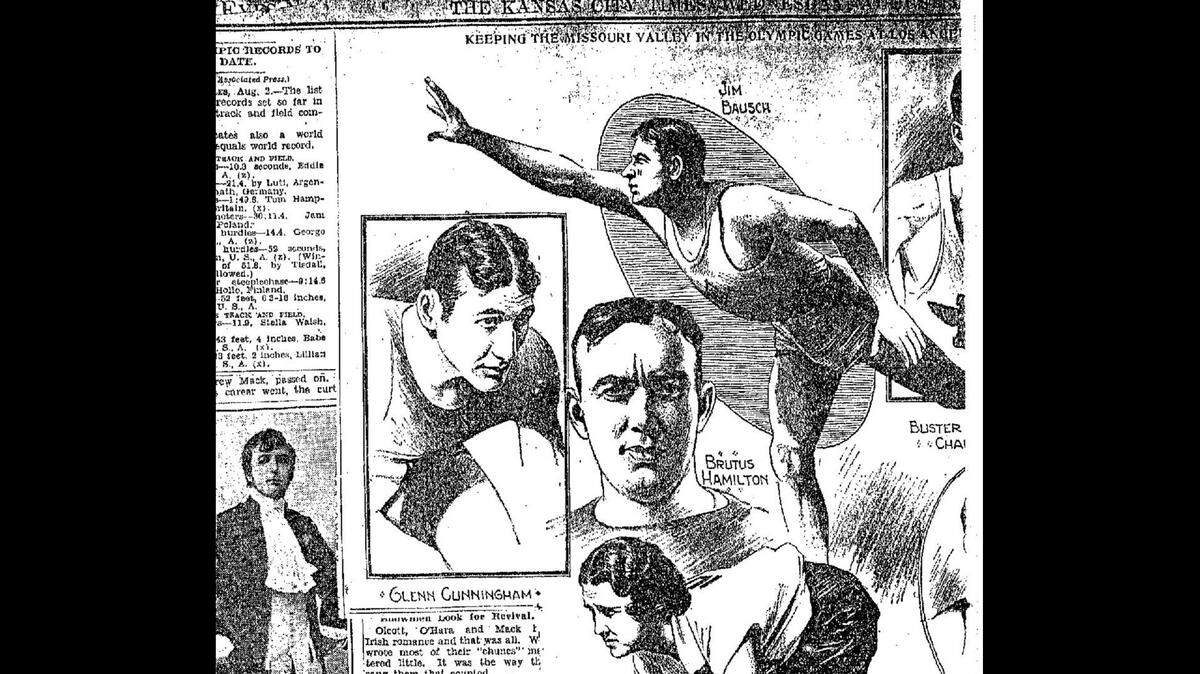
The impetus for delving into the life of Brutus Hamilton the other day was the 100th anniversary of his grasp of the decathlon gold medal at the Antwerp Olympics ... only to finish the runner-up by a margin so close it required a recount.
But that silver medal turned out to be only a sliver of the fascinating life of Hamilton, who was born in Peculiar, Missouri, attended the University of Missouri, coached at the University of Kansas and went on to international renown coaching the U.S. Track and Field team and athletes such as the first American to break the four-minute mile.
More than all that, he was a gracious and learned man some considered a poet and whose spirit was revealed by serving in both World Wars — including volunteering for World War II at age 41 after largely burying bodies stateside back home in Missouri during the 1918 pandemic.
Previously, we scratched the surface on his role in WWII through Star archives that chronicled some of his time in England and North Africa as a ground officer for the 93rd Bombardment Group: He briefed crews for targets, debriefed them upon return and lectured on everything from enemy aircraft to how to contact French and Dutch undergrounds and what to do if captured.
He also wrote thousands of citations for Air Medals, hundreds for Distinguished Flying Crosses, scores for Silver Stars, several for Distinguished Service Crosses and two for Congressional Medals of Honor.
There was obviously more to it all and Hamilton himself, perhaps exemplified by the fact that a copy of a paperback collection of his writings (“The worlds of Brutus Hamilton”) is listed for $1,500 on Amazon.com.
And on Sunday evening, another element arrived with the kind assistance of Kim Hayden, archivist for the Center for Sacramento (California) History: The papers of the late Jean Runyon, Hamilton’s daughter and a major force in Sacramento, featured a letter of his sent home during World War II and a speech he made about the war nearly a decade after it ended 75 years ago.
Much of it seemed compelling and moving to me, more details of a great man of the Greatest Generation. So I’m sharing some edited aspects in hopes some of it might resonate further, as both telling of the experience and perhaps instructive now.
The undated letter from late in the war actually was addressed to the Postmaster of Berkeley, California, ostensibly in protest of the 5-pound package limit that was keeping popcorn supplies scarce with the 93rd.
Really, though, it was a vivid snapshot of circumstances and conditions and the meaning of the little things in maintaining morale.
“Sweets, clothing, and all other items — hold us to the letter of the law,” he wrote. “But popcorn, that’s special; and let’s not be a mean old unsentimental precisionist in interpreting the regulations on this important item. … You laugh and think I’m foolin’ when I say it’s important? Listen, Mister.
“Darkness comes early in this part of England now. A chill damp creeps in from the North Sea across the few separating miles of bogs, fens and low country and steals right into our thin huts. One has to fight not only the enemy (the evil, crafty, ruthless and damnably efficient enemy) but homesickness, and the terrible temptation to feel sorry for ones self. “These long, (chilly) evenings make all the young fellows, and one, at least, who is not so young, think of home and parents, wives, sweethearts, children. And Drum, the old hunting dog who wonders what’s become of you; and Cuchie, the cat who does all kinds of foolish and unpredictable things in her lazy independence; and coon hunting; and daylight vigils in the duck blind; and quail shooting; and the fellows at the office; and leaves turning and corn stalks being burnt; of farm chores in the crisp, fall air; the hay mow, and the warm friendly smell of cattle; of valleys you know where the fog lands, and of churches and chairs — in short, of all the old familiar haunts and dearly remembered spots and all the good relatives and friends we’ve left behind. Yes, it’s easy to be homesick these long, Fall evenings and it will be worse in the longer, colder winter evenings.”
So Hamilton told of how much they craved popcorn and how they came to have “the most beautiful popcorn popper in the world,” assembled and donated by an English wire craftsman “most anxious to please.”
“A brass chain at the end by which it can be hung up has a polished brass disc attached with these words neatly chiseled upon it: ‘To the Yanks — from a Limey,’ ” he wrote.
The man would accept no payment for the work. His young daughter soon entered, Hamilton continued.
“ ‘She did the disc, daughter did,’ ” the old man said proudly. I thanked her sincerely and she seemed immensely pleased. Of course I noticed that her left arm had been horribly mangled and that her face was badly scarred. ‘We were lucky to save her,’ the old man said after she had gone upstairs. ‘She got it that night the Huns first dropped bombs on this city — the night they killed four hundred of us.’ ”
That night as they “initiated the new popper,” Hamilton told “the boys” how he came by it and the story of the old craftsman and his daughter. His colleagues wanted to do something for the man and his daughter:
“ ‘Tomorrow is ration day,’” Bake said. ‘We’ll get him some cigars.’ ‘And our candy rations can go to the girl,’ Buckwheat said. When I came back to my room the next evening there on my bed was about twelve rations of candy, a full box of cigars and two pairs of silk stockings Packy had bought in Cairo. I couldn’t possibly describe the pleasure with which they were received by the old man and his daughter.”
The popcorn, he said, “sets a tone of sanity as well as decency. (And) we used to have music when Al was with us.”
Al loved music and had his “gramophone and records” with him in England, he added.
And with this Hamilton turned to some shattering tales of those lost in the war … a number of whose families he was called on to write after their deaths, particularly after the devastating toll taken during the bombing of Romanian oil plants:
“Came the time to go to Africa and Al wanted his gramophone and some of his favorite records to go. ‘Of course you can take them,’ said the Commanding Officer, himself a music lover. ‘It’s essential equipment. That music will sound mighty good down there.’ And it did sound mighty good down there, those long desert evenings.
“The night before the Ploesti raid Al came to my tent and left the gramophone and records. ‘Just in case,’ he laughed. Two days later I turned them over to Special Services, for Al’s plane crashed at the target without any survivors.
“Then there was Slim. I loved that Kid. Tall, clean, clear blue eyes, well educated, sensitive, efficient and warm hearted. Slim from up Montana way. Reared on a ranch he was and had time to develop his own personality and a picturesque manner of speech all his own. Never met a boy of sounder character or one who could talk so interestingly or intelligently of his own country, its history, its mountains, the seasons, the streams, the cattle and sheep, the majestic grandeur of it all. ...
“He was a brilliant lad and would have gone a long ways. But his plane was hopelessly wounded over Ploesti. Slim was brilliant to the last, though. Knowing at a glance there was no hope he quickly nosed the plane up in a steep climb and gained enough altitude for four men in the rear to bale out and before fires exploded and disintegrated the ship.
“So Slim won’t be with us any more to nibble his popcorn (he always ate slowly one kernel at a time) and to tell his grand stories of the peaks, the trout streams, the ranges and all the glories of his beloved northwest. He wasn’t with us long but he’s immortal in the hearts of all his comrades who knew him.”
In closing, he appealed again to the Postmaster to let through more popcorn “to bring a little bit of America to some far away kids …
“Yours for Victory and Peace and Understanding among all peoples …”
Incidentally, in his 1954 speech to a Lions Club, Hamilton noted “newspapers got hold of the letter” about popcorn.
Pretty soon, five-pound cans were coming his way overseas from all over the country.
“In the winter of ‘44, I received over a thousand pounds,” he wrote in his prepared remarks. “It was all eaten, too, for it was not only tasty but was good for the morale and helped the boys pass the long, lonesome winter evenings.”
But what stood out about the speech was his ongoing anguish about the war, which he called “more or less a blacked-out episode in my life” that resided “well back in the recesses of my mind” until this talk.
Calling himself “no hero,” he said he volunteered in early 1942 because “it was a dismal picture, even a despairing one to some of our citizens. Think back and you will remember how very gloomy those days were.
“I went into the service without any illusions. It was a grim job and I hoped to do my bit. There were no romantic urgings which prompted me. So many of my track boys had already gone before I was called up and I wanted to get out of the grandstand and down on the field with them.”
Even removed from combat, he said, he knew well most of the 1,500 men they lost and never again could hear Taps played without choking up because of “the fine lads I helped to bury in North Africa and England. The pity of war. What a universal tragedy it is. What an indictment upon man as a thinking animal.”
He shared some sweet stories of that time, though, including one about five English children he met when he was riding his bike and they were gathering wild flowers. He’d visit with them frequently and give them candy and gum before he was sent to North Africa.
Upon returning three months later, he could “hardly wait to bike over” and see them.
“Sure enough, there they were and they greeted me as warmly as though I had been one of the family,” he said, adding that by request he taught them the song “Pistol Packin’ Mama.” The mother “didn’t appreciate the song, I’m afraid, but she forgave me and invited me to tea.”
He also told of the “Red-Headed Bombardier,” who joined them in late 1944. Soon after he arrived, “Red” received a cable that he was the father of a 7-pound girl. He was thrilled but told Hamilton, “You know, I have never really paid any attention to little babies. I don’t even know what one looks like. What are they like, anyway?”
Hamilton suggested that the best way to find out would be to go to City Hall in nearby Norwich and find out if perhaps there was a baby born on the same day as his daughter. If so, maybe it could be arranged for them to meet. And by watching her development, he would be better prepared for his own child when he got home.
“Sure enough, he found that there had been a little girl born in Norwich on the same day as his own,” Hamilton told the group. “He made arrangements to meet the parents, who were very gracious and kind and who were completely captivated by the good-natured bombardier.”
As it happened, the bombardier was “a wealthy boy” who deposited $1000 in an education fund “for his little English friend” before returning home.
“He also unknowingly deposited a lot of money in the bank of international goodwill,” Hamilton added, “because the story got around in Norwich and such a tender and generous action helped to over-balance some of the mischief we Americans got into on our liberty runs to this lovely old Norfolk city.”
Pained as he remained from World War II, though, amid the Cold War, Hamilton was worried more about World War III.
“No one can possibly win that war any more than one can win a terrible earthquake, a devastating flood or fire, or a destructive tornado,” he said. “The instruments of war have been so terribly improved since 1945 that they should preclude any possibility of another war.
“Yet one sees the old aggressions building up. Hatreds, greed, avarice and prejudices are beginning to grow. It’s not reassuring to read history and to realize that the signals for so many of the great historical movements are called by the emotional firebrand preaching hatred rather than the reflective and good man preaching love.”
Which, in fact, he was doing.
“I was never a good hater. Even in war I could never hate much,” he said. “It saddened me to see the broken dead bodies of the Italian and German soldiers. My heart went out to them as I saw the living ones behind the barbed wire, all so very young, frightened and homesick, playing sad tunes on their harmonicas and accordions and singing ‘Lili Marlene.’ I tried to do my duty but I could never learn to hate.
“I don’t mean to imply that I’m a rabid pacifist. So long as there are bullies in the world, or as long as ideologies permit the possibility of bullies, we must have a strong defense. We must keep training young men to protect what we stand for.
“But in a larger sense weapons are not the answer. No weapon can save us from ourselves or from some foreign enemy if we allow the moral and spiritual fiber of our country to decay. “
He saw and shared rays of hope he saw in the athletes of the 1952 Helsinki Olympics and on a trip to Israel, noting the meaning of the one word he said he learned: “Shalom.”
“It means ‘Go in Peace.’ We should all say ‘Shalom’ to each other, both as individuals and as nations. ‘Go in Peace.’ ”
So he did say, in many ways, this man who did his bit many times over.