
Credit Mark Emmert, NCAA for seizing day against Indiana discrimination
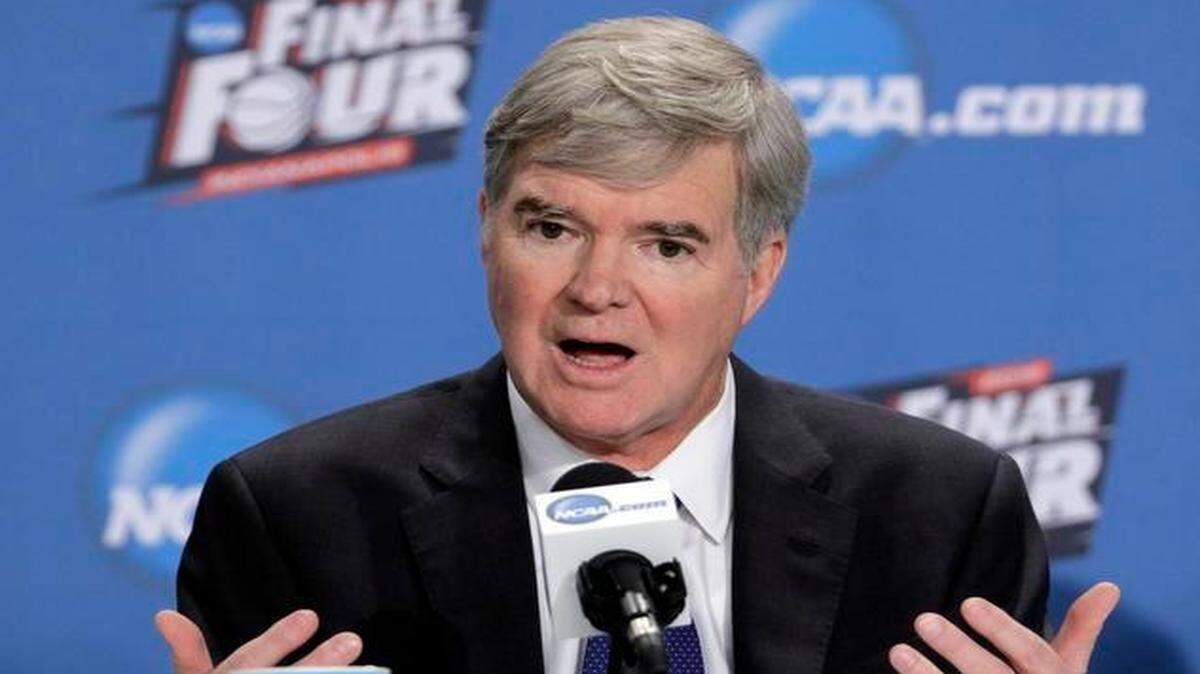
Long before he became NCAA president in 2010, Mark Emmert had displayed an uncanny knack for slinking away before scandals erupted under his jurisdiction at Montana State, Connecticut and LSU.
Under scrutiny after he took over at the NCAA, the appearance of the pattern was unsavory.
If his way wasn’t quite like shoving down children and senior citizens to get out before the posse arrived, it was at best shrewd or expedient — and not what you’d seek in a leader.
Since taking the helm of the NCAA, a task inherently fraught with complexities, Emmert has grappled with command presence in part because he tends to project smugness and in part because of bungled issues.
His harsh, reckless stance on Penn State in the wake of the Jerry Sandusky sex-abuse scandal ultimately may not have been misguided, exactly, but it certainly was misdirected in the swath of its wrath.
His investigative staff botched the festering Miami case with a breach of ethics that forced Emmert to call for an independent investigation of … the NCAA.
Particularly in the chaos of realignment and the power-five conferences wresting more autonomy, it’s all bred such disillusionment that calls for dissolution of the NCAA never have been more vocal.
This backdrop is what makes the actions of Emmert in the last 10 days so improbable — and so remarkable as to be redemptive as the Final Four arriving in Indianapolis this week.
His sense of the moment doesn’t necessarily absolve his past or assure his future. But it does say that when called to stand and be counted at a pivotal moment, Emmert led in a monumental way.
Most significant was the immediacy of his eloquence nearly as soon as the news broke March 26 of Indiana Gov. Mike Pence signing the Religious Freedom Restoration Act — passive-aggressive legislation that basically was concocted to create shelter for bigotry.
That very day, Emmert shedded the image of the NCAA being as gridlocked in gray as its rulebook.
He shrugged off the monolithic constraints that often leave it seeming to have the fast-twitch muscles of a sloth.
And he issued a calm, clear and direct message suggesting the NCAA won’t abide by such a statement of intolerance, setting a tone that ultimately led to Pence and the Indiana legislature retreating.
The NCAA has taken conscientious action before, of course, including a decision in 2002 to ban South Carolina from hosting championship events because of the Confederate flag flying at the Statehouse.
But that was in a much more deliberate time-frame than this one, which called on the NCAA to be nimble in the wake of the stealthy movement to pass the legislation.
While other objectors tried to parse a way to respond, the NCAA ventured forth.
“I wasn’t hesitant about the speed with which we made our commitment … The reality that no one could offer any reassurance that this bill would not protect people from discriminatory acts based upon sexual orientation, gender identity, was completely inconsistent with all of the things that I know the membership values …” Emmert said at a news conference Thursday in Indianapolis.
After he spoke with members of the Board of Governors, he added, “There really wasn’t a lot of reason to debate it further. We were quite clear about what it meant and what it didn’t mean.
“So we came out fairly early in this process and we were hopeful that we could instigate some change.”
It will be said that the tide turned on the economics of the situation, and surely the hammer was the protests or hints of various forms of sanction impending by such business interests as Angie’s List, American Airlines, Apple, Marriott, NASCAR and others.
But the catalyst was the NCAA, and Emmert.
And even if you believe that the times have-been-a-changin’, and that there might have been a gust of prevailing wind behind him, it took real strength and conviction to do that.
All the more so because Emmert didn’t mince words that made it seem like this was just about money — even if that obviously is the leverage.
He made it about moral clarity, not a measured political calculus.
And he has continued running through the tape even as the issue seems to be ebbing with amendments but yet simmers.
“The issue here was one that was, first of all, near and dear to us because we have 500 employees in this state,” Emmert said. “We run the enterprise from here. We have to attract a diverse workforce, we have to have a workforce that is attractive to all walks of life. We have a particularly young staff.
“These issues for young people are very, very different than they are for old codgers like me. The fact is we have to have an environment that works for us to conduct our affairs.”
Even if this issue might have muddied up its affairs this week, the NCAA didn’t shrink from addressing it because of the controversy it could spark or, say, the inconvenience of it arising during its marquee event.
Instead, the NCAA seized the day.
If it was too late to move this year’s Final Four out, well, it wasn’t too late to move next year’s women’s Final Four. Or start talking about moving the 2021 men’s event. Or, in fact, moving NCAA headquarters, which has been in Indy since the organization left Overland Park in 1999.
While stressing such a decision also would rest with the Board of Governors chaired by Kansas State president Kirk Schulz, Emmert bluntly said: “If I believed we couldn’t conduct our affairs in any place in a fashion that didn’t prohibit discrimination against people for any number of reasons, then I would surely recommend that we move. I hope that we don’t find ourselves in that place.”
Largely because of the variety of nuance in similar legislations enacted in 20 states, including Missouri and Kansas, it’s too early to know to what degree this means the NCAA will further consider such implications as it makes decisions going forward.
“Unfortunately it’s not something for which any of us can come up with a really clear, simple scenario, that we will or will not tolerate X, Y or Z,” Emmert said. “It’s more complex. It’s going to take a lot of thought and a lot of care.”
But as Schulz put it, “I’m tired of playing defense.”
And now there is a precedent of one shining moment to build on for Emmert, who ran into this fray instead of from it.
To reach Vahe Gregorian, call 816-234-4868 or send email to vgregorian@kcstar.com. Follow him on Twitter at @vgregorian. For previous columns, go to KansasCity.com.
This story was originally published April 3, 2015 at 5:22 PM.