
Mike Moustakas’ October surprise has potential to be transformative
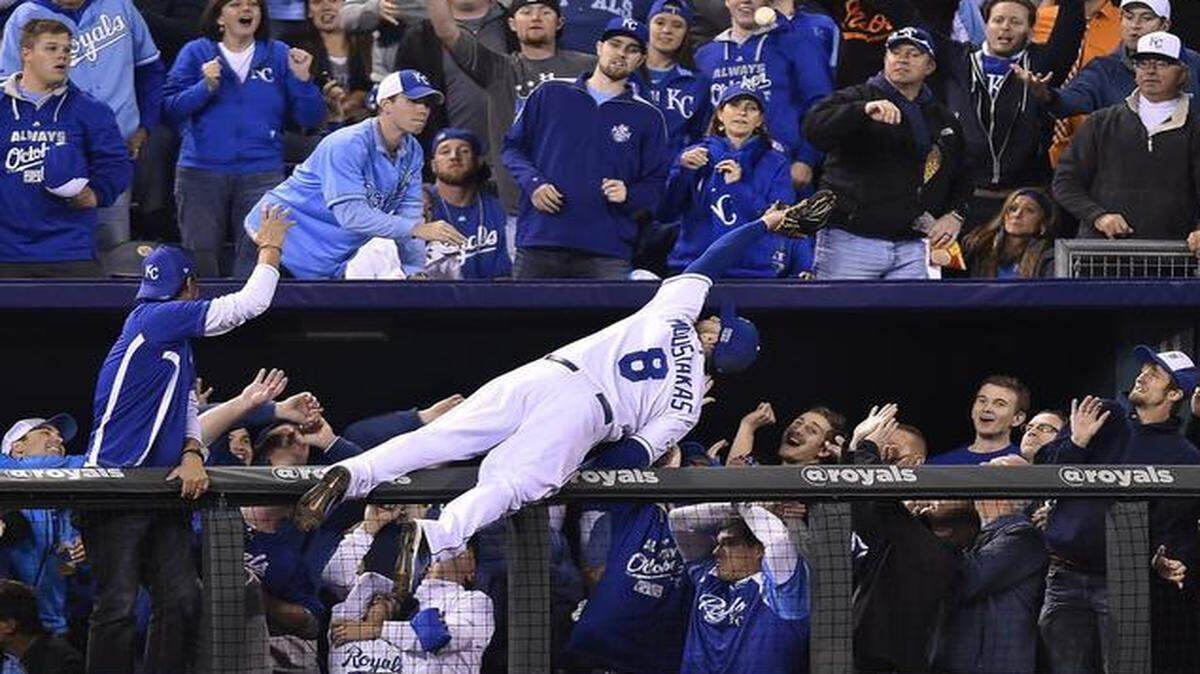
Among the vast indelible images from the Royals’ 2014 postseason, no snapshot will prove more enduring than the spectacle of third baseman Mike Moustakas sprawling into a dugout suite for a foul ball against Baltimore in game three of the American League Championship Series.
Clear as that might be, it’s still is an out-of-body blur to Moustakas, whose postseason was a redemptive revelation that featured a Royals’ record five home runs and altered perceptions about him … and maybe even within him.
He remembers laser-tracking Adam Jones’ popup, calculating its trajectory as he scrambled to the railing and recalibrating as the ball “backed up” on him a little bit.
He remembers a leg going up, then leaning and twisting and suddenly being airborne as he stretched like Mr. Fantastic.
And he remembers sensing people surrounding but not impeding him in the most absolutely apt symbol of the synergy that had developed between the team and its fans.
“First of all, they let me catch the ball, which is huge, and second, they pinned me up against that wall and didn’t let me fall and hit my head on the ground,” he said, smiling, as he sat at his locker in Surprise Stadium. “I don’t know how I got up, and I don’t know how they were able to lift me up.
“But I know I got up quick and got the ball to (shortstop Alcides Escobar), not really knowing what just happened. Then I looked at Esky’s face, and Esky was kind of like, ‘Wow.’”
Anyone who saw it had to have that reaction in one form of the term or another — perhaps varying in tone by the allegiance of the beholder.
And even if there are no known plans for a statue commemorating it, the next-best thing is already set: The Royals on June 20 will be giving away a bobblehead of Moustakas going over the rail.
“My first bobblehead, so that will be awesome,” Moustakas said. “I’m really stoked about that.”
Singular as the play was, that wasn’t what unshackled Moustakas from another discouraging regular season that included being sent down to Class AAA Omaha for remedial work on his swing and psyche.
If the postseason truly was a transformative event in his career, the turning point was his 11th-inning home run in the Division Series opener at Anaheim, Calif., an hour or so drive from his hometown, Chatsworth.
As the topic turns to the meaning of that moment, it’s as if Moustakas is living it anew.
He says, “You just gave me the chills,” and, sure enough, goosebumps erupting over his arm.
“You work your entire life to get to that point,” he said. “I wanted to do something great for the team.”
Paradoxically but tellingly, though, he insists he had learned to contain that feeling.
He was just being himself.
“I didn’t want to do anything too big, just get on base,” he said.
And then he did the most momentous thing he’d ever done on a baseball field, at least to that point, under unfathomable pressure and scrutiny.
When he was rounding first, he remembers, he “kind of lost it a little bit.” He remembers the crowd going silent, except for a section of Royals fans that included a lot of his family.
Then, most emotionally of all, he remembers rounding third and the sight of “all the boys coming out of the dugout.”
So much had become bottled up in Moustakas as he navigated yet more of his seemingly perennial ups-and-downs in 2014.
It was compounded by the sense of failing others he’s grown up with as they were coming of age, and he was stuck still finding himself.
When he calls his teammates his brothers, he says it in a fierce sort of way that resonates. And that resounds all the more when you see his attachment and devotion to those players he came up with, like Eric Hosmer, Jarrod Dyson and Danny Duffy.
So there he was in the grips of a cycle, trying harder and flailing more and feeling all along like he was letting down everyone around him.
You can see how that might spiral, and of course there were ample technical reasons for his struggles, too, and so all of this would be a psychological forest to negotiate for anybody.
But it probably was particularly so for Moustakas, 26, whose intensity is both his greatest asset and a hovering nemesis.
“I’m a pretty emotional guy; I get fired up when I don’t get the job done,” he said. “I like performing for my team. I really beat myself into the ground when I don’t get the job done.”
At times, it looked like he was so lost in a funk it was hard to tell if he’d ever find a way out or up.
The very height of that was when Moustakas was sent down to Omaha, a demotion that he’ll tell you now was the best thing that could have happened to him.
“That roller-coaster ride,” he said, “led me to where I was at the end of the day.”
He did play better after returning, but not appreciably enough to make his regular-season stats particularly appealing (.212 batting average, 15 home runs, 54 RBIs in 140 games).
Then came the liberating October that Royals’ manager Ned Yost reckons will show up in April.
“I think so,” Yost said. “Time will tell.”
Yost’s belief, or at least strong hope, for Moustakas has been tested through his first three full seasons.
After all, he’s hitting .236 with just 52 home runs and 199 RBIs in 514 regular-season games.
His struggles spawned such moments as Yost’s there’s-no-“third-base-tree” rant and Moustakas being relegated to Omaha last May.
But there is reasonable logic to the case that Moustakas’ October was a breakthrough, not a blip, and that he can continue to play with an uncluttered mind.
Or as Duffy puts it: “like a 12-year-old playing Little League.”
To Yost’s way of thinking, Moustakas (and Hosmer) had to deal with “unbelievable hype” when they came up as the perceived cornerstones of the future of the Royals.
“That’s a lot of pressure where you’re not lying in the weeds getting your experience, right?” he said.
And it seemed to snag Moustakas in its clutches, just like maybe the voices of too many hitting coaches in too short a time.
Add it all up, and he was a mess at the plate even as he managed to excel in the field.
“When you press and you try to do more than you’re capable of doing,” Yost said, “you actually suppress the natural ability and you fight yourself.”
Especially last season.
Despite playing winter ball and having a great spring, Moustakas was hitting .152 when he was sent down — a point Yost playfully alluded to Saturday after the Royals’ 3-2 victory over Cincinnati in a Cactus League game.
“If it were up to me,” he said, smiling, “I hope he has a horrible spring.”
Actually, Yost figures he doesn’t have to think about such things as jinxes at this stage because of the playoff run that started with a fresh slate for Moustakas and ended with him being the player the Royals had long expected to see.
“All of a sudden, the (statistics) went away, and the focus got off of him and onto our team. And look at what he was able to accomplish,” Yost said. “So now we come into this spring with him not having to live up to those expectations.
“Because he has already.”
And maybe, just maybe, an ounce of redemption will be worth a pound of cure for Moustakas.
“Just maybe a little more confident now,” he said, “knowing I can perform on the toughest stage.”
To reach Vahe Gregorian, call 816-234-4868 or send email to vgregorian@kcstar.com. Follow him on Twitter: @vgregorian. For previous columns, go to KansasCity.com.
This story was originally published March 7, 2015 at 7:25 PM.