
Royals need to think long-term when deciding where to put Brandon Finnegan
The revival of the Royals under general manager Dayton Moore hinged on the astute navigation of one key philosophical issue as much or more than any other:
Managing the delicate balance between the precious present and vital future.
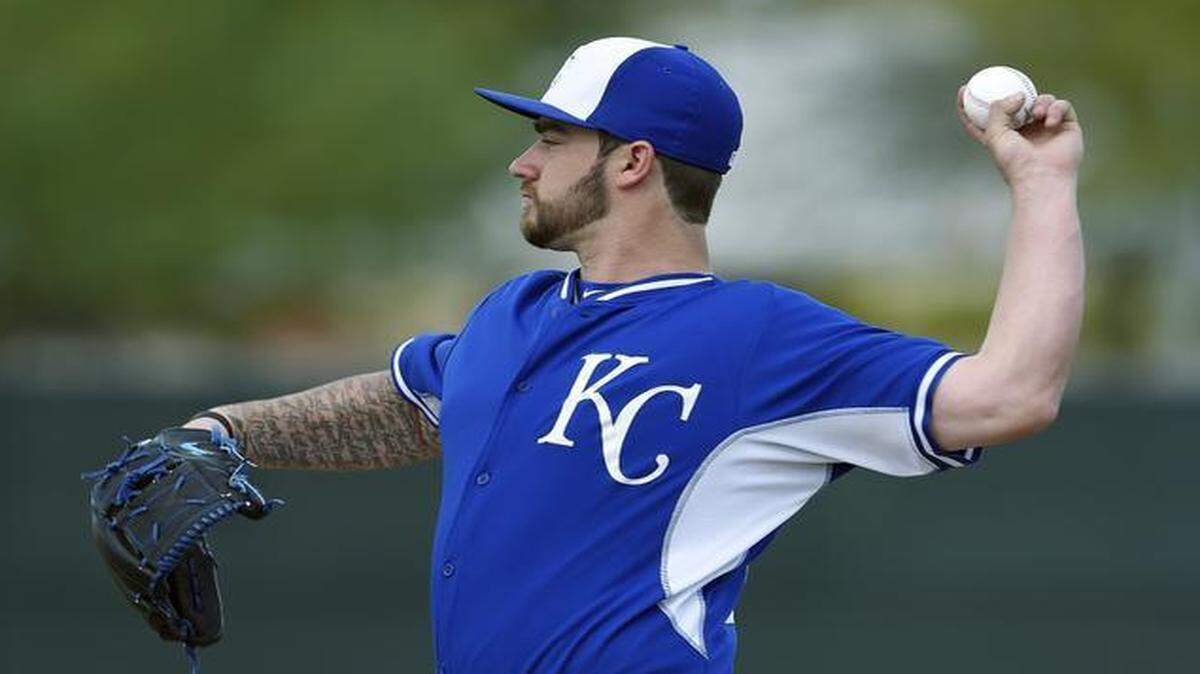
And even as the Royals move into the post-World Series realm of trying to sustain instead of attain, it’s a question they soon will be confronting anew in the form of left-handed phenom Brandon Finnegan.
Finnegan, their top draft pick a year ago and a key cog in their American League championship, is a gaudy neon temptation to start the season in the Royals bullpen — particularly if lefty Tim Collins’ ligament injury announced on Friday proves to be season-ending.
Surrendering to that enticing impulse would be exactly the wrong thing to do … and counter to the most fundamental principle that got the Royals back on track.
The reason they’ve been able to reap what they’ve sown is because they’ve had the discipline, even courage, to let it grow first.
In some cases, such as with first baseman Eric Hosmer, third baseman Mike Moustakas and shortstop Alcides Escobar, that development took place largely at the major-league level, even if it was a struggle.
But despite Finnegan’s prodigious success last season, his best next phase of development is to toil as a starter at Class AAA Omaha.
Now, maybe one day it will turn out Finnegan is best-suited to be a reliever.
But in the here and now of the embryonic stages of his career, in the context of the Royals’ most vital needs on the near horizon, the 21-year-old ideally projects in the rotation.
So it’s hard to see how using him in middle relief every few days instead of harnessing his starting stuff at Class AAA Omaha would best cultivate his talent.
Yet within the organization, this is and will be a matter of considerable debate. That was bluntly articulated by manager Ned Yost when he was asked Friday about the big-picture considerations of Finnegan.
“The only picture is winning baseball games,” Yost said after the Royals’ 11-9 exhibition victory over Cleveland at Goodyear Ballpark. “If he helps us do that, that’s the big picture.”
To that way of thinking, Finnegan undoubtedly is one of the Royals’ top 25 players and top 10 pitchers, and thus belongs with the team when it opens the season.
If he can help in any way at all now, the idea is, he should be part of it.
Moreover, there’s the oddity of producing for a World Series-bound team only to go back to the minors.
Finnegan to a large degree already has proven he’s a major-leaguer, and there is a legitimate school of thought he’d get something important out of continuing to be in that environment.
But it also would be less than optimal.
No decisions need to be made yet, of course.
And any number of circumstances can change between now and then as they apply to Finnegan, who is being stretched out as a starter, has yet to pitch in a game here and is more eager to please than make any sort of plea himself.
“I’m going to continue to work my butt off and try to do whatever they want me to,” said Finnegan, who lamented Collins’ injury. “At the end of the day, it’s me coming in and giving it all I’ve got. Whatever happens, happens, it’s out of my hands, it’s out of their hands.”
Actually, it’s entirely in the hands of the Royals, who are trying to take advantage of what may be a fleeting window of opportunity but need to pay heed to what’s in the best interests of the organization’s stability.
And that’s to nurture Finnegan to be the best and most valuable version of himself he can be in the long run.
Meanwhile, it’s not like there aren’t some other potential left-handed bullpen prospects, including 6-foot-7 former Miami Marlin Brian Flynn, 24, and Franklin Morales, 29, who is coming off a suspect season (5.37 ERA) largely as a starter for Colorado but has made 186 career relief appearances.
Moreover, even Yost isn’t insistent he needs a left-hander in a bullpen that already is stocked.
Whenever Luke Hochevar is ready to start the season, he’ll join Jason Frasor to help set up the devastating closing combination of Kelvin Herrera, Wade Davis and Greg Holland.
It’s not as if Finnegan couldn’t pitch in the bullpen now and still become a starter later, of course.
But what’s the logical reason to delay or stifle the broader development of Finnegan for what seems a relatively minimal role?
So far, Moore’s Royals have been built by prioritizing patience and the long run with a mix of seizing the moment.
See: Wil Myers and James Shields.
You could say that trade signaled a shift in focus from development to production.
But the two really are entwined in the end, especially for a team whose small-market baseline dictates that home-grown players are the lifeblood — whether it’s to keep stocking the team or to trade for need.
The Royals took this long-term approach when it was the hardest thing to do.
It wasn’t always popular, because how could long-suffering fans distinguish the difference between what was just another rebuilding effort and actual results?
And at times in an increasingly need-it-now world of entitlement, it came at the direct expense of more immediate gratification.
But it worked.
And now they seem best-served to stay that course to sustain their direction, tempting as it might be to do otherwise.
To reach Vahe Gregorian, call 816-234-4868 or send email to vgregorian@kcstar.com. Follow him on Twitter: @vgregorian. For previous columns, go to KansasCity.com.
This story was originally published March 6, 2015 at 7:45 PM.