
Mellinger Minutes: One more Mondi point, the NCAA’s (and KU’s) future, Chiefs’ O-line
If we’re not there already, there will come a time when the focus will be a LITTLE less on Adalberto Mondesi’s injuries and a little more on the organization that employs him.
If Mondesi’s ability to stay healthy does not drastically improve there will be questions about the Royals’ support, the player’s daily maintenance program, and the risk in tying so much of the future to a player who has not stayed healthy for a full, non-Covid-shortened season since he was a teenager.
For me, the view is pretty clear: the Royals and Mondesi need to do everything possible to figure out if his training needs to change, if he needs to play through some pain, if he’s simply not built for the merciless grind of a 162-game season* or whether he is simply the unluckiest man in professional sports.
* And eventually, the Royals hope, 20 or so games after that.
Royals head trainer Nick Kenney is widely respected, and should be assisted by performance science and every other resource the club can deploy. The answer should guide the future, with possibilities ranging from a position switch to planned days off to simply requiring more stretching and massages and prep work than any athlete on the planet.
Because right now all we know are the following three truths: Mondesi is far too talented (and under club control three more years) to give up on, he’s injured far too often to count on, and the player and team cannot keep doing exactly what they’ve been doing.
A friend has made the Byron Buxton comparison, and it’s terrific. Buxton was the second overall pick in 2012 and the consensus No. 1 or No. 2 prospect before the 2014, 2015 and 2016 seasons.
In the last four seasons Buxton has missed games because of a groin strain, migraines, fractured toe, strained wrist, wrist contusion, concussion, dislocated shoulder, labrum surgery, a sprained foot, hip strain and this week a fractured hand from being hit by a fastball.
Not including his first season, when he was called up in June, Buxton has averaged 71.5 games per season. Through the first four weeks or so he was being mentioned as a way-too-early MVP candidate, but the hip strain kept him out six weeks and now the hand is expected to cost another month or so.
Buxton is enormously talented — he’s a terrific defender and is slashing .282/.322/.581 with 33 home runs and 21 stolen bases in 153 games starting in 2019 — but has missed far too much time for the Twins to count on him.
Buxton’s situation is worse than Mondesi’s in at least one way: he’s 18 months older, and is under club control for just one more year.
This isn’t brought up to make you feel better, or worse. This is just context. The Royals are not the only team frustrated with injuries. Mondesi is not the only elite talent unable to stay healthy. There’s a starkly relevant example in the same division.
A lot of you are tired of this, and trust me, I get it.
But I keep thinking back to 2010, when Alex Gordon was older than Mondesi is now, and lot of fans were tired of him, too. He was injured too much, and underperforming when he played. There was some talk around town that the Royals should trade him for whatever they could get, and if that didn’t work, then cut him.
The Royals didn’t do that, of course, and for the next five years Gordon was the most valuable left fielder in baseball — 12th among all players, according to FanGraphs’ WAR. The Royals and Gordon won two pennants and a World Series together. The team memorialized Gordon’s locker. Someday there might be a statue.
This is not me saying Mondesi will achieve the same path.
This is me saying we don’t yet know he won’t.
But the Gordon example is relevant beyond the optimism. Gordon’s ascent was kickstarted by a position switch, one he often referenced in helping reset him mentally and putting a jet pack to his career.
The Royals came to believe they could not continue the status quo and expect the change they desired. The club has to be close to that point with Mondesi.
It doesn’t have to be as dramatic as a position switch. But something has to change. He’s too talented and valuable for anything else.
This week’s reading recommendation is Andy on the Rays’ player-centric, ruthless paradox and the eating recommendation is the pork tenderloin at Kitty’s Cafe.
Thanks to everyone who’s listened to our Mellinger Minutes For Your Ears podcast, and here is a big warm invitation to start if you haven’t already. We’re out from behind the paywall and free on Apple or Spotify or Stitcher or wherever you get your shows.
If you’re already with us, many thanks! And if you haven’t already, please consider rating and reviewing us. It helps us get the word out.
Reminder: If you’d like to participate in the show — and I’d love for you to do that — please call 816-234-4365 and leave your first name, where you’re calling from, and almost literally any question.
Please give me a follow on Twitter and Facebook and, as always, thanks for your help and thanks for reading.
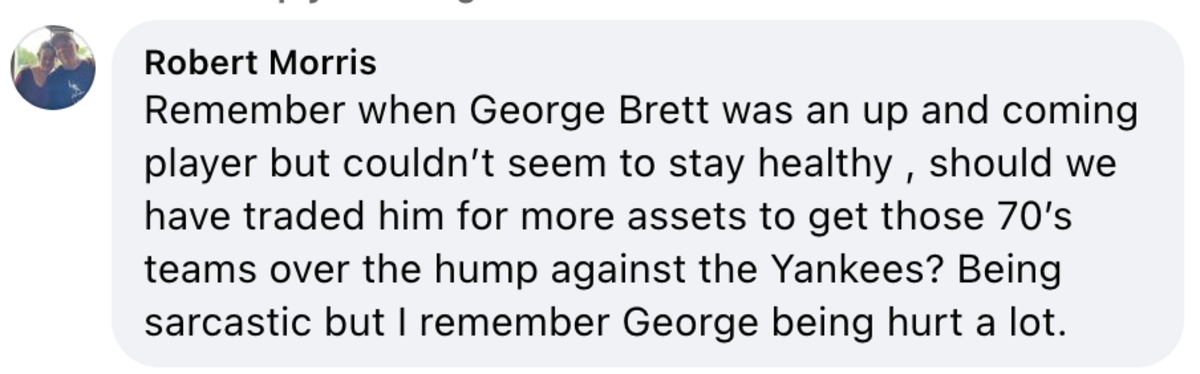
I’ve heard this point made, and it’s true that Brett played 150 games or more in just six of 19 full seasons* but the comparison doesn’t stand up to scrutiny.
* He played in 21, but for our purposes here I’m not including his midseason callup as a rookie in 1973 or the strike year of 1981.
Brett played in 139 games in 1977, and 128 in 1978. He played in just 117 in that magical summer of 1980, and was below 130 five other times. I was born too late to remember most of Brett’s career, but I do remember the occasional yeah-but-he’s-always-hurt stuff.
Except, by the time Brett played in “just” those 139 games in 1977 he’d already had consecutive 159-game seasons, including 1976 when he won a batting crown and finished second in MVP voting.
Brett made the opening day roster 19 times in full seasons, and in those seasons averaged 137 games. Mondesi has not played 137 games once.
So if your point is that Mondesi isn’t the first athlete to struggle with health, well, sure. But let’s be careful about the comparisons.
This is complicated and demands nuance and I know a lot of you justifiably have no time for complicated or nuance.
I just can’t get past these truths: he’s too good at baseball to give up on, too injured to count on, and the status quo can’t go on.
Not destroyed, but it ain’t great for the NCAA, and we can (and will) talk about the potential ramifications here but first can we pause for a moment to appreciate the hubris, stupidity, stubbornness, and disillusionment that brought the NCAA here?
The system has been outdated for decades, and at some point in the last 10 to 15 years public sentiment shifted sharply against the NCAA. The bureaucracy — Mark Emmert is the smug face of it, but it’s really the conference commissioners, university presidents, and Board of Governors — had thousands of opportunities to evolve. It refused, some combination of protectionism and selfishness and arrogance.
That has harmed the product and will now make the comeuppance worse.
The 9-0 decision on Monday — and where else in these United States of America can we get nine people to agree on ANYTHING? — does not fundamentally alter the NCAA. The case was simply about schools being able to provide athletes with what was termed “education-related expenses,” which is basically stuff like laptops, educational equipment, internships, etc.
That the NCAA decided to litigate this all the way to the Supreme Court is astonishing. Millions of dollars in billable hours to block a softball player from getting a laptop for schoolwork?
The NCAA did not just lose the case. The NCAA became Tyronn Lue, and the Supreme Court Allen Iverson.
You could almost sense Justice Brett Kavanaugh tapping his palm to the top of his head as he wrote this one:
Nowhere else in America can businesses get away with agreeing not to pay their workers a fair market rate on the theory that their product is defined by not paying their workers a fair market rate. … The NCAA is not above the law.
Again: this particular case is not an enormous moment.
But the enormous moments could come quickly as other lawsuits materialize, using this decision as precedent. It doesn’t take much imagination to see athletes quickly unionizing, then fighting for lifetime healthcare, salaries, and other benefits.
The NCAA deserves every bit of trouble it’s feeling right now. It has been nothing if not slow and out of touch. The NIL stuff is a good example. Why didn’t the NCAA draft rules long ago, after it was obvious to everyone this was coming?
Instead, the NCAA essentially did nothing, and now individual states have moved forward and the NCAA is in the incredible position of perhaps needing a congressional bailout in the form of uniform rules.
The worst of this might be the unintended consequences. The NCAA being forced to operate like a business is coming decades late. If this all happened honestly and in real time the model of football and men’s basketball paying for other sports would have been in harmony.
Money could have been set aside to support other sports. Universities could have paid football coaches $7 million a year instead of $10 million. Staffs could have had two redundant $200,000-per-year administrators instead of six. Weight rooms could have been built to be merely terrific, instead of palaces.
If this goes the way it appears to be going, the NCAA will have successfully ruined one of the best parts of major American sports, and it will have done so out of pure greed, arrogance, and stupidity.
They deserve whatever’s coming. It didn’t have to be this way.
So, some will make this connection.
NCAA rules will continue to shift, and the same way KU did probation and a postseason ban in 1989 for something that was later legalized, the men’s basketball program could again be knocked for rules violations that soon might not be violations.
Doesn’t change anything, though.
I believe the NCAA’s rules are absurd. I believe that the rules already invite — demand, even — shoe companies to invest in high school recruits, and do so in a way that often LEGALLY funnels money to the families of top talent.
I believe that in this context it is ridiculous to punish shoe companies for following incentives, and even more ridiculous to label a sponsor as a booster, since that’s always been the whole point.
But the rules are still the rules. I can think the speed limit is too low in a particular part of town, but that’s a pretty terrible argument in court if I got caught going 15 over.
Well, first, let’s take the worry of insecurity about John Sherman moving the team and let’s put it in a flammable bin and drop a match and watch it burn.
My view — and nobody’s told me this, but I’m sure it’s true — is that Sherman’s group wants to move the team … downtown.
That’s what he wants. He thinks it would be good for Kansas City and good for the Royals. I happen to agree with him enthusiastically, but that’s not the point.
John Sherman is not moving the Royals to some other place. If you’re into nightmare scenarios, then maybe you can think about the efforts to move downtown going nowhere, Sherman becoming frustrated, attendance falling, and the ownership group wanting to get out.
Even then I think they’d target local ties — same as David Glass did — but that’s when some level of uncertainty would bubble up but at this point we’re talking about something that may or may not happen in like 10 years.
So let’s slow down on that.
The Royals are averaging 11,973 fans through 37 home games. Different stadiums have had different crowd limitations, so I’m not sure how relevant this is, but that average ranks 17th of 30 teams — ahead of the Mets, Red Sox, Indians, and Giants, among others.
That context is worth keeping in mind. From 2013 to 2016 the Royals finished 26th, 25th, 10th, and 12th.
Again: Covid makes these comparisons fuzzy at best.
I’m just making the point that the Royals would be happy finishing 17th in attendance most seasons.
All that said, yes, they want more fans. They’re averaging about 17,000 after Memorial Day, when limitations have been lifted and school has been (mostly) out. I’d expect that number to grow through the summer, but team performance matters here.
The Royals were playing their best in April, when crowds were limited to around 9,000. Then they marked unlimited crowds with an 11-game losing streak.
For me, this is mostly Covid. Still. People have created new habits. We’ve all become much too accustomed to “social distancing,” and part of that is distancing from crowds and events like baseball games. Some people aren’t yet comfortable being in crowds again.
The NFL is probably an exception, because the NFL is the exception to just about every rule. But it would make sense to me for sports teams to largely view this year and going forward as a broad, big reset.
They’ll need to make themselves attractive to and pursue different fans, and they’ll need to do it in different ways. Going to games and being part of crowds is much different now than it was two years ago. Teams need to adapt accordingly.
My guess is that average attendance is significantly higher the rest of the season, but that the early season limitations and ongoing protocols could make it tough to surpass the 1,479,659 total from 2019 — the Royals’ lowest since 2006.
We’re all living a different reality now.
Well, first — hol’ up.
I hope you guys don’t think I ever give you anything other than my honest opinion. I’ll admit my biases when I feel them, and hope you all keep me honest if you think I’m veering. But I can’t remember ever telling you something I didn’t believe.
Anyway.
In the offseason after the AFC Championship Game loss to the Patriots, the Chiefs turned — and I haven’t been able to use this line in a while, so please indulge me — the only defense in the NFL capable of stopping Patrick Mahomes into a legitimate strength.
These things are subjective, but they turned what had to be the league’s worst group of safeties into one of the best. They also added corners, pass rushers, I mean, they went all out.
The circumstances are a little different this offseason with the offensive line because the deficiencies there were more about health than ability but the effect is the same.
The Chiefs turned (by far) their most glaring weakness into a strength. They got younger, stronger, meaner and — at least until they pay Orlando Brown next summer — cheaper.
I want to make sure that nothing I say here comes off as disrespect to Eric Fisher or Mitch Schwartz. Fisher was Andy Reid’s first draft pick, and he developed into a reliable and effective left tackle. Schwartz should never have been available to the Chiefs, but he was, and he played like one of the league’s best right tackles in his five seasons here.
Both should be remembered fondly, and if not for the injuries both would be welcomed starters on the edges of the offensive line.
So this was not a rebuild that the Chiefs chose, but one that forced upon them, and holy smokes. They signed the best available interior lineman, traded for the best available left tackle, drafted an expected day one starter at center, a potential steal at right guard, and gave themselves enough depth and options to make the rest of it work.
You can look at the unknowns. Joe Thuney is the only 100 percent lock, and even he’s changing systems. Orlando Brown has plenty of tape, but he hasn’t played a full season at left tackle and the scheme difference between the Ravens and Chiefs is extreme.
At center, Austin Blythe has a low ceiling and Creed Humphrey is a rookie.
At right guard, Laurent Duvernay-Tardif just sat out a year (and wasn’t as good in 2019). Trey Smith has a lot of potential, but he’s also a sixth-round pick with medical concerns.
At right tackle, Mike Remmers is better for depth than a starter’s position and Lucas Niang is a third-round pick who will be some 20 months removed from his last competitive game.
So, you can play those games if you want, and the Kyle Long injury is a major bummer. He was part of that depth — the contingency plan — to help ensure the Chiefs don’t run out of bodies in 2021 the way they did last year. He’ll be back, but the timeline is uncertain and the injury a reminder of how precarious line depth can be.
But what I see with this line is what has to be one of the best left sides in the league. At center, right guard and right tackle the Chiefs have formed a pattern — a player with the potential of Pro Bowl-type production paired with a guy who has less upside but a higher floor.
That’s pretty good.
There are different ways to think about the offensive line, but I’ve always believed it’s better to have five solid guys than three or four studs with some weaknesses that could be exploited. This is the most balanced the Chiefs line has been in years.
I’m not going to pretend to know the other 31 offensive lines well enough to say where the Chiefs rank in the league, but I do believe this is the best offensive line that Mahomes has played behind.
If that’s true, it continues a pattern of the Chiefs reshaping weaknesses into strengths.
Patrick Mahomes is 25. Andy Reid is 63.
I believe the quarterback will outlast the coach.
This is a natural thing we all do. When a player or coach hits a certain age we start to wonder how long they’ll keep doing it. When that happens, it’s usually true that a team will start to make contingency plans or at least do thought exercises about potential replacements.
I don’t know if the Chiefs are doing that with Reid. I haven’t asked that question. My guess is they haven’t. Reid’s health isn’t amazing, but his energy is, and he talks a lot about how football keeps him feeling young. That affect has to be amplified with this particular group.
None of us know the future. Reid doesn’t know the answer. But I might put the over-under at 5 1/2 more seasons for Reid.
The over would have him coaching at 68 years old. That’s not impossible. Bruce Arians, Bill Belichick and Pete Carroll are each that age or older.
Whenever Reid retires, replacing him will be an enormous challenge for the Chiefs. They will have to decide whether to keep it in the family — surely Eric Bieniemy will be a head coach somewhere by then — or diversify.
If this goes the way a lot of us expect — at least another Super Bowl or two, with consistent success — there will be talk about whether Reid himself should be allowed to choose his successor, and conversations will be had to make sure Patrick Mahomes is on board.
Staying in the family ensures continuity and likely Mahomes’ approval, but risks someone simply trying to act like Reid.
Going outside could be a good way to get different ideas and add to what’s been established, but risks messing with a culture that’s been carefully cultivated.
That will be a fascinating thing to watch and think and talk about. The decision will have an outsized influence on how successful Mahomes is in his 30s.
But even if Reid doesn’t reach my arbitrary over-under, we’re talking about something that is essentially a lifetime from now in NFL years.
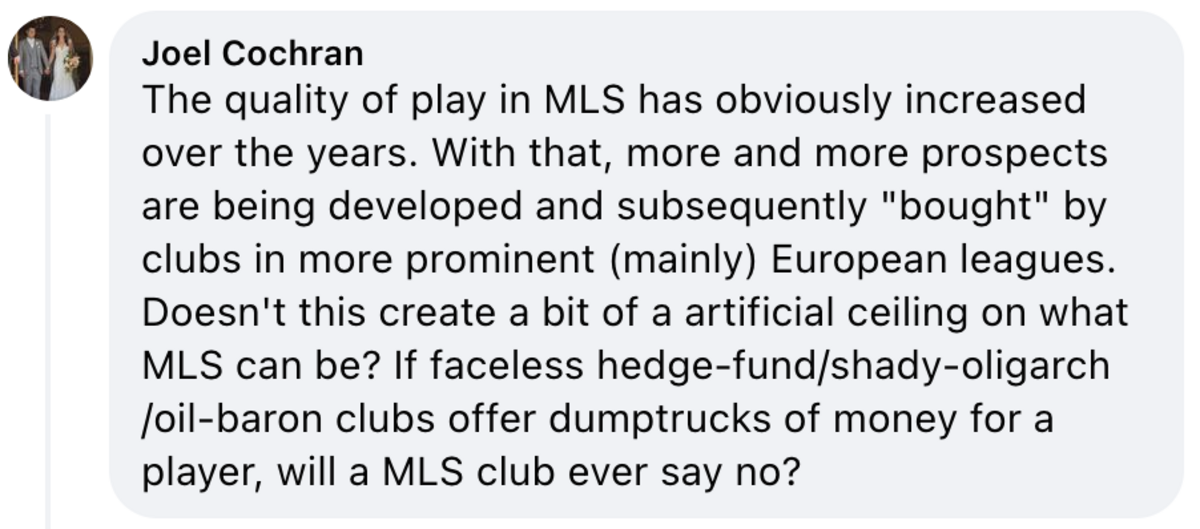
There’s always been a ceiling on what MLS clubs can be. This is not new. MLS has changed, grown, and evolved enough that the ceiling is higher than it used to be.
But we are — at best, I’d reckon — decades from a world in which MLS clubs can outbid or outspend even mid-table European clubs.
This debate is evergreen, but optimistically MLS is sort of a borderline top 10 league in the world. But even if we all agreed on that we’d also have to agree that the difference between No. 10 and Serie A or Bundesliga or La Liga or — heavens — the Premiere League is a little like saying my kid’s scooter is a top 10 mode of transportation at our house when my wife and I both have actual cars.
I’d also point out that the broad strokes of what you’re talking about here also exists in Europe. We can talk all we want about Leicester City, but mid-to-lower table clubs in the Premiere League have almost no chance of competing with Chelsea or Man City consistently. Heck, Arsenal is a huge club — make your jokes, they’re probably funny, but it’s true — with a billionaire owner and they’re now probably closer to a mid-table club than they are a true championship threat.
I see the sales to European leagues as a positive. It’s credibility for MLS. It makes America’s soccer league a more attractive place to play, which should only further raise the talent level. The effect that could have on the USMNT is only one of many reasons this is a good thing.
I also don’t think it’s in MLS clubs’ best long-term interests to not sell these players at the highest possible value. That’s money the clubs can (hopefully) put back into the product, either investing in the pipeline or buying more senior club talent.
I assume this is coming up because of Gianluca Busio’s expected sale, and in the short-term that’ll be rough for Sporting — they’re in in second place in the Western Conference, and Busio is probably their best player — but the club’s success has always been largely due to consistently prioritizing the long-term over the short.
Busio’s sale could essentially pay for the academy, or it could strengthen the club’s infrastructure or buy back talent to replace Busio. Maybe it’s some combination of the three.
But the idea is that you continue the cycle, and build talent on the front end with the idea of a payoff in the back.
I don’t see this as a knock on MLS. I see it as validation that the long-term plans set in place years ago are being realized.
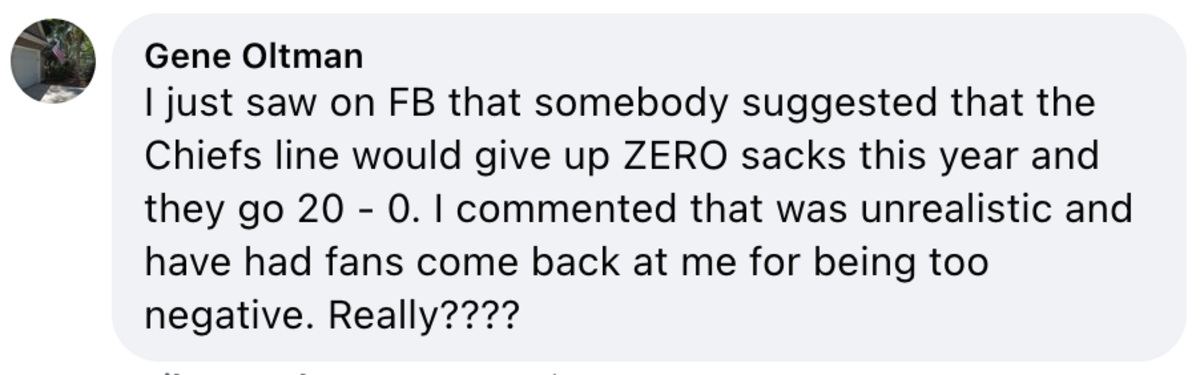
Checks out.
And by that I mean some random person on Facebook, not that the Chiefs line will pitch a shutout and the team won’t lose.
Look, here’s what I think: we should all choose who to respond to or take seriously.
I could do a much better job at that.
The Chiefs will lose games, Mahomes will throw MULTIPLE interceptions, Tyrann Mathieu will get beat, Tyreek Hill won’t be open, and Travis Kelce will drop a pass.
These are my Chiefs hot takes for June.
There’s a lot about journalism that’s just sort of baked into how things are, and some of it makes no sense.
But I can promise you I have no desire to do commercials. No offense to anyone who does them. I respect the hustle, and if that’s what sports columnists were expected to do I’d swallow hard and tell you about some great lawn care service or something.
But I’d tell you I much prefer this way. I like that if I tell you the sunset roll at Prime is fantastic you’ll know that I really believe it.
I am not nearly enough of a journalism snob to tell you that a radio host doing a 30-second read means you should trust me more than them. Again: I respect the hustle.
I’m just telling you I prefer doing it this way. It’s simpler.
I like simple.

Well, fine. David is talking about this tweet, which is unfortunately a true story:
Now, a couple things. First, my dog is the best. She’s 14 years old, and I’ve had her for 11. She is happy and energetic (for her age) and mostly just wants to be comfortable. She’s been acting strange lately, but recently had an all-clear from the vet. I’m trying not to think about the worst possibilities.
Anyway, I’ve started to think of the poop incident this way: most of it was on a wood or tile floor, and I’d rather step in it barefoot than in shoes. Easier to clean.
So that’s how my Monday started.
Then after I came home I found out there was more poop, in other rooms, that my wife had to clean up.
So, all in all, I’ll take my side of the whole thing.
It’s a trick question because I feel like the best scenario for all would be to turn Mahomes into Kiefer Sutherland in Designated Survivor. Let everyone else do the fighting, and then hopefully we win and you and I both survive and then I still have something to write about and you have something to watch.
I’m a ninja over here. I take your question and turn it on its head.
This week I’m particularly grateful for moving from something like an F-double-minus to a solid take-it-pass-fail-because-you’ll-probably-get-a-C-but-maybe-worse-and-you-want-to-protect-your-GPA kind of grade in basic home projects. Like, I’m not fixing anything electrical, or structural. But I’m not *as* useless as I used to be, either.
This story was originally published June 23, 2021 at 5:00 AM.