
Mellinger Minutes: more normal, more Kansas City Royals struggles ... and we get deep
They let us on the field again and I’m here to tell you it felt surreal and awesome and familiar and strange all at the same time.
Surreal — it’s been almost two years since we’ve been allowed on the field pregame at Kauffman Stadium, and you can’t help but think a little about all that’s been changed and lost and done since.
Awesome — the rhythm of the sounds of BP and gloves popping and friendly greetings. Watching on TV or just from the press box it’s possible to forget how big and beautiful the field is.
Familiar — fist bumps from coaches and players, the weird and hard-to-explain commodity of hellos, the time waiting in person and on the field instead of at home in front of a screen.
Strange — we’re on the field, required to have been fully vaccinated, but we’re outside and talking to players who may or may not be vaccinated and we’re required to wear masks?
I don’t know. We’re all guessing. We’re all trying to get on the best we can.
“It’s good to see you guys, welcome back,” Danny Duffy said to a few us. “Welcome back. It feels like you all were holograms.”
I can tell you that Adalberto Mondesi took swings, including some home run derby type hacks from the right side. I can tell you that Duffy seemed pleased with a pre-game bullpen session. I can tell you that most of the position players stayed inside on a hot day after a late night of travel across two time zones.
I’m realizing that this space has become a sort of regular mile marker for the progress back from COVID — the top of the time-suck has celebrated the return of games, then the return of fans, then the return of big crowds, and now the return of some small sliver of the way we can best help you understand and feel connected to your favorite teams.
We still have a long way to go. The good stuff happens in the clubhouse, particularly on the road. It happens when casual conversations can build trust, and trust can turn into stories we haven’t been in position to tell.
I’m desperately hoping we get there soon, but know there will be some resistance from leagues — and, yes, I’m thinking mostly of the NFL here — that have been actively limiting transparency and openness for years.
We’re in a better spot now than we were even just a few weeks ago.
But we’ll hopefully be in a better spot soon.
The world is changing back. We’ll have some things to get used to. It’ll be hard, and we’ll have disagreements, but we’ll all be better for the process. And here I’m not even talking about baseball or media access anymore.
This week’s eating recommendation is the cheese fritters at Rye, and the reading recommendation is Sam Anderson on Kevin Durant and the Nets’ championship push.
Thanks to everyone who’s listened to our Mellinger Minutes For Your Ears podcast, and here is a big warm invitation to start if you haven’t already. We’re out from behind the paywall and free on Apple or Spotify or Stitcher or wherever you get your shows.
If you’re already with us, many thanks! And if you haven’t already, please consider rating and reviewing us. It helps us get the word out.
Reminder: If you’d like to participate in the show — and I’d love for you to do that — please call 816-234-4365 and leave your first name, where you’re calling from, and almost literally any question.
Please give me a follow on Twitter and Facebook and, as always, thanks for your help and thanks for reading.
OK. That’s all my begging. For now.
Thirty?
Nobody knows how this will go, and even as we all know that baseball seasons are 162-chapter books it’s hard not to get caught up in the chapter you’re on at the moment. So at the moment it probably feels like the percentage should be 3, and six weeks ago it probably felt like 70, so maybe I’m just splitting the difference.
But the sober and steady truth is that this team was always capable of going .500 or better, and even capable of competing for and winning a playoff spot.
That was true before the season, and it’s true now.
The trick is that for any of that to happen the Royals would have needed to play well, and get some breaks. The Royals have not played well, and the breaks they’ve received have been mostly strained obliques and bad fastball command and tipped pitches.
The optimism — the 30 percent — mostly rests on the fact that the Royals have not played well and somehow have not yet buried themselves.
Whit Merrifield is slugging .378. Hunter Dozier and Jorge Soler have provided nothing. Michael A. Taylor is not meeting even modest expectations. Brady Singer is seeing some struggles, Lynch and Kowar have been awful, and the bullpen has had rough stretches.
Baseball seasons are about nonstop disaster quelling, and the Royals have been busier in that space than most.
This is a group of players with winning experience, but already we’ve seen an 11-game losing streak and now the current funk.
We’re 40 percent into the season and the Royals have shown themselves to be inconsistent and unable to get themselves out of rough stretches — and that goes for both the pitchers and hitters.
We’ve seen pitchers unable to adjust, and we’ve seen hitters who seem to let one out become more. Those are typically signs of immature teams, or teams still learning to win. The Royals are not a particularly young team, and the roster is loaded with guys who’ve played in World Series.
They have a lot of problems to solve, is what I’m saying.
Seasons can turn quick — good or bad — and we’ve seen that in Kansas City more than most places.
But the Royals have a lot to prove and a gap to close between what they say they are and what they’ve shown themselves to be so far.
We talked about this on the Border Patrol, and I’m hoping to write more about Mondesi soon.
I mentioned this on the show, but would reiterate here that I haven’t talked to anyone specifically about this. Yet.
But I think it’s worth considering.
The team’s answer might be that Mondesi is so supremely talented and so uniquely skilled as a shortstop that they wouldn’t do this. The answer might be that Mondesi’s history of slumps at the plate have always been palatable because of what he brings as a baserunner and especially as a defender at one of the three most important positions.
The answer might be that playing shortstop is specifically important to Mondesi, and that taking that away would send the wrong message and be seen as a lack of confidence.
The Royals obviously know Mondesi better than we do, so whatever the reasons they deserve to be considered fully.
But, yeah, for me it makes sense to at least talk about.
The oblique was really weird, and I’m not sure we ever got a clear explanation of what happened there. But without going through and double checking every injury I think it’s safe to say that most have happened in the field.
So maybe it would make sense to take some physical stress off him. Second base would be the most obvious possibility. Mondesi broke into the big leagues playing second base with Alcides Escobar entrenched at shortstop.
I’d also wonder what he might look like in centerfield. It’s often said that if you can play big league shortstop you can play anywhere on the diamond, and he’d obviously cover a lot of ground. The arm would play.
The risk there would be giving him a new position to learn, and understanding that for most major league baseball players a move to centerfield would add physical stress, not relieve it.
But the Royals had luck with moving a top-shelf prospect from the infield to the outfield once before — at around the age Mondesi is now, actually — and Alex Gordon’s success in left field was often paired with a mental reset of changing positions and moving away from the dirt.
So, I don’t know. I’m not here advocating for that to happen right now.
But I think it’s an interesting conversation.
Watching Wade Davis pitch used to give me goosebumps. It used to make me shake my head in awe. It used to make me wonder how the world anyone would ever get on base against him.
Watching Wade Davis pitch now makes me sad.
There was a burst of 10 or so days in spring training where Davis looked like he used to. The velocity was up, and his fastball looked heavy again. He was spotting it. I wondered if we’d have a fun story to tell.
But we’re now three months from Davis’ 36th birthday, and three years removed from the last time he was an effective big league pitcher.
His velocity is down from his best days, which would be fine except his control isn’t nearly the same either. He’s missing too far outside the zone to get swings, or he’s missing too much over the middle to get outs.
In August 2013, Davis had a 5.67 ERA with 107 strikeouts and 54 walks in 125.1 innings as a starter. Royals fans were furious. Davis had become a punchline. The Royals turned him into a reliever, and for the next two seasons he may have been the best pitcher on the planet.
In the last three years, Davis has a 9.30 ERA with 65 strikeouts and 42 walks in 69 2/3 innings as a reliever. His fastball — once an almost unfair weapon — has graded well below league average during this time.
In 2015, according to FanGraphs, Davis gave up just a 17.6 hard contact rate and seven barrels. That was across 67 1/3 innings.
In 2021, he is giving up a 36.6 hard contact rate and eight barrels. That’s in 22 2/3 innings.
One thing I hate about the sports media ecosystem is when fans or reporters try to tell athletes when to retire. Those decisions are deeply personal to the athletes making them, and the definition of irrelevant to the rest of our daily lives.
Playing major professional sports is a momentary privilege, and nobody should be slammed for wanting to do it as long as they’re able.
All that said, I get where your question is coming from.
The ends are rarely pretty.
There’s been a lot written about this, including this Lynn Worthy piece with JJ Picollo, but the groundwork for this was done last year.
The minor leagues were wiped out, and the big league season cut by 102 games, but guys still worked.
The Royals — and I don’t think they were unique here, but they’re the team I’m most familiar with — gave their guys customized workload plans designed around their own specific roles, experience, injury history and other factors.
An example: a starting pitcher might be told to do three “up downs” once or twice a week, which basically means throwing 15 or so pitches, sitting down to replicate his team’s at bat, then repeating.
JJ Picollo, the Royals vice president and assistant GM for player personnel, called the plan “part science, part just instinctual.” To account for the competitiveness of real games, pitchers earned half credit for simulated innings. The idea was to get guys enough work that a full season would not violate the industry’s general rule of not increasing workloads more than 20 to 30 percent.
Whatever it’s worth, I ran the Royals’ plan by Glenn Fleisig, research director at the American Sports Medicine Institute. Here’s part of what he said:
“That’s a really good idea. There’s no guarantees. I don’t know all the answers. But what you just laid out to me of what the Royals are doing, and probably similar to what other teams are doing, I think that’s a very good idea. The best I could think of.”
Perfect has not existed with Covid, and we know that even in the most controlled settings pitchers get hurt. Nobody can know, for example, whether Danny Duffy would be healthy right now if not for the complications.
I’ve done a little bit of mental evolution on this. I spent much of last season obsessed with how teams would handle the change in workloads, and I still think that’s fascinating and worth monitoring.
But the more I watch and the more I think, I wonder if the bigger problem teams like the Royals have is in the lost games.
In other words: you can manufacture environments for guys to get work, but you can’t manufacture the opportunities for them to face top level competition in true game environments.
You can miss your spot with a fastball in a simulated inning and nobody cares. But if you do the same thing with Jose Ramirez at the plate, you may have just given up a three-run homer.
I can’t help but wonder whether that’s part of the problems here, particularly with the younger pitchers. I understand that others in similar situations are performing better, so this isn’t an excuse. Just maybe an explanation. Even if it’s a frustrating one.
This is probably a stupid thing to say, but maybe 85 percent?
And if the Broncos land Rodgers … 84 percent?
My numbers here are almost certainly too high. It feels like the Chiefs’ window will be open forever, but of course it won’t. The wrong injury at the wrong time can ruin an otherwise championship push. We saw that last season, actually.
But I look at the Chiefs and I see the league’s best quarterback, the league’s best pass-catching tight end, one of the best receivers, one of the best coaches (and staffs), one of the best pass rushers, and one of the best defensive backs.
That’s a hell of a place to start.
There is a lot that can wrong, even beyond injuries. The wrong contract can turn into a pumpkin, or the wrong guy can feel undervalued and either force his way out or lose that extra edge that separates the best at the highest level.
But the Chiefs have too much going for them to bet on this ending without at least one more Super Bowl.
One of the biggest unknowns here is how long Reid will coach. He recently turned 63, and was walking on the field during OTAs with a cane. There’s no indication that’s permanent. Football coaches often use the offseason to lose weight and address the problems that bodies collect after a season of long hours and often short nutrition.
Reid has said — and he has every reason to want this — he wants to coach as long as he can. There is nothing in his history that would indicate he’d be a guy to walk away from football and take up golf or gardening. This is what he does, and who he is. His wife is all in.
So, just spitballing here, let’s say Reid will coach five more seasons.
You don’t think the Chiefs should be able to win one of the next five Super Bowls?
You asked about Rodgers, and I’m probably underrating the effect there, but we don’t know what the Broncos would have to give up in a trade. The cap would get complicated, and I don’t know why we’d think the Broncos would be better than the Packers. They’d still need a better offensive line.
Again: my numbers are probably too high.
Winning one Super Bowl is hard, and unless I’m missing someone the only coach-quarterback combinations to win more than one Super Bowl this century are Belichick-Brady, Tomlin-Roethlisberger, and Coughlin-Manning.
It’s really, really hard.
But I believe Reid-Mahomes are better than at least two of those partnerships.
Now you’re making me sad. Because my answer to the first question is “significant.”
We’ve talked and written a lot about this, and lord knows I’ve done my fair share, but the frustration over the blackout restrictions and limited streaming options distracts from the fact that baseball has a lot of other problems, too.
A lot of other problems that are only going to grow in the future.
The games are too long, the replay system is inexcusably flawed, and the sport is awful at promoting itself and its brightest stars. There remains this sort of protective culture by too many in charge. They too often go to this default system of guarding the status quo, and resisting change.
Baseball is slow and nuanced in a world that has long been increasingly fast and loud.
They need to do a better job promoting the sport and stars through social media and online, and if — *IF* — they are successful there they need to find a way to convert that into fans and revenue.
These are but a tiny crumb of the issues baseball is facing, which means the last thing the sport needs is this unforced error where they limit who can watch — AND PAY TO WATCH — their product in its purest form.
The NFL and NBA are widening the gap, and soccer is quickly gaining ground. All these sports are further fractured by YouTube, TikTok, Twitch, and whatever else I’m not thinking of right now that are adding young users while baseball is indirectly pushing them away.
I don’t know what the future will be. Obviously. Hopefully I’m Chicken Little with this stuff and baseball will find a way to thrive. It’s a great sport, for lots of reasons.
It’s frustrating to see it run this way.
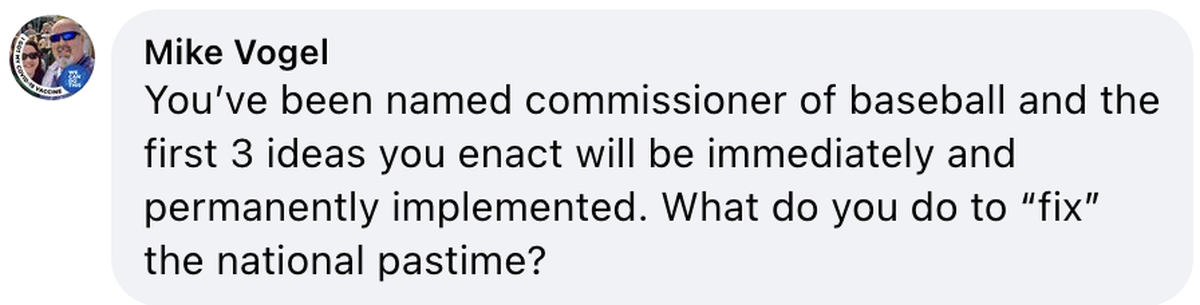
First of all, I hate everything about this new job except for the salary. Do I get Rob Manfred’s salary? Because I’d like to make $11 million a year.
OK, everything that I would do would be aimed at attracting more young fans and making my sport as accessible as possible.
I believe baseball is already doing good work in a lot of areas here, actually. The sport has put real resources into introducing itself to kids, particularly in urban cores. The sport is efforting on looking better online, particularly social media like Instagram, trying to appeal to young fans through highlights and photos.
They need to improve in these areas and more, but you only gave me three ideas, so I’m going after more effectual change that isn’t receiving enough energy.
1. This won’t surprise you, but the first thing I’m doing is paying as many billable hours as it takes to make sure that anyone who wants to watch my games can do it without changing providers.
There are a few ways we could do this. We could require TV partners to offer standalone apps for in-market streamers, or we could break off the weird and antiquated blackout restrictions. This would be my preferred option, because it would bring more people into MLB’s ecosystem, and we’d be the ones controlling the distribution. More fans would be introduced to MLB’s awesome MLB.tv service, which would also be a win.
2. We’d block off some portion of tickets — maybe it’s 5,000 or 10,000 or maybe it’s 10 percent of seats or 20 percent — as family friendly.
The details would need to be worked out, but there has to be a way to get a family of four into a ballpark and fed for $100 or less.
Maybe you have specific areas of the ballpark where adult tickets are $20 if they bring a kid 18 or younger. Kids get in for $10, and every ticket comes with a hot dog and drink. Make it known that the tickets cannot be resold.
Hopefully this appeals to families who aren’t showing up because of the price, or maybe it’s enough to get a family that currently goes once or twice a summer to come out six or seven times.
The research backs up what those of us who love baseball instinctively know, that the more and younger you’re exposed to the sport the more likely you’ll love it later. Some of those kids who are getting in on $10 tickets now are going to own their own business someday and sit in the expensive seats.
3. This one is radical, but I’m taking Joel Sherman’s plan and going with a 174-game season. The details can be tweaked, obviously, but Sherman calls for 146 eight-inning games with 14 doubleheaders (28 total games) with seven-inning games.
This means games are ending comfortably under 3 hours, with more strategic urgency. This is more content for TV partners — while protecting the historical integrity of season long statistics — and more tickets to sell for teams.
This would be a win for younger audiences, which means it would be a win for baseball.

Honestly, not much.
Not NEARLY as much as the general reaction, and I get that it was basically just people all over the internet dunking on Bell, but even that seemed like a bit much.
Let us be clear: Le’Veon Bell does not have the option to play for Andy Reid, and his general lack of production means he may not have any other option but to retire.
We talked early about how long it’s been since Wade Davis was an effective pitcher. Well, it’s been even longer for Bell — 2017, at least, but if you’re of the mind that he averaged just 4.0 yards per carry and the Steelers didn’t feel the need to pay him then maybe 2016.
There are 31 teams without Andy Reid as coach, and none of them have rostered him either.
In other words, this is a player whose opinion of his current value is wildly different than apparently everyone else in football.
He is deflecting that on someone else, blaming his lack of production and appeal on one of the best offensive coaches in recent NFL history.
I wish we all gave less attention to stupidity.
This is a little off the wall, but considering how often he spoke publicly Ned Yost has a case here. For years, he was a sort of punchline, the guy who got fired in the middle of a pennant race and then didn’t win here the first few years either.
When the Royals were below .500 in July 2014, a lot of people here wanted Yost fired, if not worse.
Then the Royals started winning, and all of a sudden he was lovable Ned and the winningest postseason manager in history by percentage, and everything the Royals did worked.
The truth is that Ned was never an idiot, and he didn’t turn into some mythical winner when Salvy pulled a slider six feet off the plate down the third-base line.
Ned was a guy who loved baseball and loved baseball players. He was flawed professionally but had the right temperament for the right team at the right moment.
Scott Pioli oversaw a disastrous stretch of Chiefs history, and I’m not sure anyone called for him to be fired more often or louder than me, but he is also a generous man and heavily invested in the arts, gender equality and civil rights.
People had this idea that Billy Butler was this sort of country meathead who rolled out of bed and swung the bat, but the guy was a bit of a savant, studied the bejeezus out of opposing pitchers, and had this brilliant memory about which pitchers like to use which pitches in which situations.
Jeremy Guthrie was seen as this sort of Most Interesting Man In The World character, but he could be condescending and moody, and wasn’t always realistic about his value.
But — and maybe I’m misreading the room here — my choice would be Eric Berry.
Sometimes it feels like that last year made people forget who the hell Eric Berry is.
All the day-to-day jokes can make people forget that Eric Berry is a five-time Pro Bowler and a member of the Hall of Fame All-Decade team for the 2010s. He made two of his three All-Pro teams AFTER BEATING CANCER.
Eric Berry is a boss. He’s a bona fide badass whose body gave out just before the Chiefs became legitimate Super Bowl contenders.
That’s a shame, and I do believe that if Berry was healthy the Chiefs would have won the 2018 AFC Championship Game and then beat the Rams in the Super Bowl.
I can’t prove that, obviously. But I believe that in my heart.
He’s better than the day-to-day jokes.
You said it, my man.
Every year I look at these resumes and am blown away. These kids are different. They are self-driven, ambitious but generous, brilliant but humble, athletic but studious.
I’ve had the privilege of doing a lot of these profiles over the years and it’s been a wild ride — from a somewhat self-centered pursuit of only caring about writing the best story possible to a realization of just how incredible all these kids are to a more conscious study of the environments in which they tend to thrive to a (now) somewhat self-centered pursuit of trying to learn about everything the parents and support system did.
As Vahe Gregorian told it, Kendra Wait is a Division I volleyball signee who became the first girl to win four individual medals in Kansas Class 6A track history (and did it in about three hours) and finished fourth in her class of 399.
As Sam McDowell wrote, Yaseen El-Demerdash has “national records in swimming, a world championship in a hobby, and an academic scholarship awarded to just 150 kids in the nation.” He essentially created a new course at Blue Valley Southwest, and taught it.
I don’t know how these kids happen. Sometimes I feel like it’s a win if both our kids dress themselves.
The Scholar Athlete program is the best thing The Star does, and I hope these kids are given the recognition they’ve earned but MUCH more importantly I hope other kids read these stories and find some inspiration.
These are the very best of the very best. Every school winner in the metro should be incredibly proud. I can only imagine how their parents feel.
I’m fairly sure Neil had no intention for this to be included, but I am, because I want to clarify something. This all comes up after the following tweet went semi-viral (semiral? Is that a thing?).
Anyway, here it is:
Many people got angry about this and had big reactions so here comes the big ol’ dummy with this one:
I stand by all of that, by the way, but I know that we get a lot of young readers here so if you’ll let me … I have a little more to say.
You can work nothing but 9 to 5 and never on a weekend if you want. That’s fine. You can do that.
You can also chase your passion into a career. That’s cool, too. You can do that, too.
But I don’t know that you can do both.
We all tend to see things through our own experiences, so I’m going to tell you that I gave up a lot of nights and weekends in my 20s. I gave them up to cover games, to do interviews, to fill in on bigger beats when established writers took time off. I did it willingly, and energetically, and looking back the only one I regret is not going to a friend’s wedding because my boss asked if I could cover a Pro Football Hall of Fame induction.
I should have gone to the wedding. I was a 20-something high schools reporter. I didn’t want to say no to any opportunity.
I say that to point out what’s obvious: I’m far from perfect, and my priorities at 25 should not be the expectation.
But overall? I’m happy with my choices. I had a passion. I knew that passion would require long hours and lots of nights and weekends. I was OK with that. It paid off for me. I have a job I always wanted, and now at least a little control over my schedule. This is how I hoped it would work out.
The problem with the original presentation is as a one-size-fits-all. That doesn’t exist in life, and it certain doesn’t exist in how we should pursue our jobs and careers.
There are sacrifices we make with many decisions. You can prioritize your free time in your 20s, but you should know that limits what you can do with your career. You can prioritize your career in your 20s, but you should know that limits what you can do socially.
And there are a thousand shades of gray in between.
I guess the point here is that we need to stop believing there’s one way to do things, and judging others for their decisions. We can be whatever we want. Some of us want control over our nights and weekends when we’re young. Some want a job they love. Some want to make a lot of money.
If you can find one of the three, you’re doing well. Two and you’re gold. I’m not sure you can have all three.
This week I’m particularly grateful for our second grader taking this little bit of life advice to heart. I can see he heard me and is trying to make a few minor changes, and my heart nearly jumped out of my chest when I overheard him saying the same thing to his kindergartner brother the other day.