
Mellinger Minutes: a USMNT soccer thriller, no Julio Jones, Mondesi hurt again, and ice
What have you missed the most over this last year or so?
A lot of you will say live music, and that’s a good answer. There are few things as satisfying as a cold beer in your hand while you sing along with your friends and strangers to your favorite song.
A lot of you will say going to a game in person, and that’s a good answer. Some of the best memories possible come from those unscripted and spontaneous moments that make your arms fly toward the sky.
My answer is more general. My answer is about stress and uncertainty and being a small part of these human experiences — games, shows, restaurants, even just walking around downtown — where we give each other energy.
My answer is about freedom.
That word is used with some hesitation, because we’re not getting into this weird thing where masks became a violation of someone’s liberties. The freedom I’m talking about is the ability to walk into virtually any public space without a mask or a plan or any reason to believe I could get sick or make anyone else sick.
That’s a powerful thing.
This is all hitting me a little harder this week as I returned from a vacation that got canceled last year, and look forward to a few more.
Last week it was a fishing trip that my late father-in-law said he hoped would outlive him. Later it will be taking our kids to a few places they’ve never been, and a few days in Colorado with my oldest friends in the world.
Maybe you’re like me. Maybe you spent the last 14 months trying to make the best of it, and intent on coming out better than you went in.
I failed in some ways on that. With hindsight, I think I tried too hard to ignore missing what was lost, instead of being honest about it. I didn’t have enough patience when the grind wore on others.
But I do know that I did my best. I do know that we found a really good rhythm as a family. I know our kids continued to laugh, our first grader learned to read, and our preschooler grew up. I know I tried every day to be the best I could for you, and the best I could for my family.
Most of all, I know that the year had at least two positive effects for me personally. It provided space to better connect with my wife and our kids, and it provided time to better appreciate the gifts we’re now starting to get back.
I hope you’re like me in at least one sense. I hope you’re able to take the best of the time with limitations, and the best of this renewed freedom and create the best new reality for yourself that you can.
We still have a long way to go, of course. We still have thousands of deaths every week, variants spreading, and millions without vaccines. We’ll talk more below about the ways sports are still not what they will be.
But we’re getting closer. We’re getting closer every day. And my hope is that all of us can find ways to make this new reality better for ourselves and others than the last one.
This week’s eating recommendation is the carne asada at San Antonio, and the reading recommendation is Zak Keefer on what Jim Irsay learned watching his father cripple the Colts.
Thanks to everyone who’s listened to our Mellinger Minutes For Your Ears podcast, and here is a big warm invitation to start if you haven’t already. We’re out from behind the paywall and free on Apple or Spotify or Stitcher or wherever you get your shows.
If you’re already with us, many thanks! And if you haven’t already, please consider rating and reviewing us. It helps us get the word out.
Reminder: If you’d like to participate in the show — and I’d love for you to do that — please call 816-234-4365 and leave your first name, where you’re calling from, and almost literally any question.
Please give me a follow on Twitter and Facebook and, as always, thanks for your help and thanks for reading.
OK. That’s all my begging. For now.
Yeah, we should get into this. What a freaking game.
Let’s do it.
We talked a lot about this on the Border Patrol, but I believe two seemingly conflicted facts can be true at the same time:
- This is the most talent — particularly young talent, because those guys you mention are 18, 22, and 22 years old — that the United States Men’s National Team has ever had.
- The USMNT should not expect anyone to believe in them until they accomplish some of what general American sports fans have been told is coming for years (decades?).
For me, that win is a step below the stoppage time win over Algeria in the 2010 World Cup for games that I won’t forget — and the order is only because of the stage.
This was an enormous moment. Mexico is USA’s soccer big brother. That’s the hurdle. That’s the standard. Mexico has usually been more talented than the USMNT, but it’s always been tougher.
This is just one game, but maybe that’s starting to change. Maybe both of those facts are changing.
The horrendous giveaway leading to a Mexico goal in the opening minutes might have ruined past American teams. This one stayed strong, and perhaps had a favorable whistle, but those goals were earned. The set piece execution was aggressive and relentless and confident. Losing a keeper to a non-contact injury, and then having the backup make THIS save?
This is real, and it’s without precedent. The USMNT has never had a depth of young stars who play for some of Europe’s biggest clubs. The USMNT has never had this many problems to present opponents.
A few paragraphs ago I told you I’ll remember that game for years, and I mean it, but what we don’t know is how that game will be remembered.
Because what do you remember about the Algeria game?
If you’re like me, you remember an enthralling moment — Donovan’s run down the field is iconic — but then what?
Two World Cups later and the Americans were watching from home.
There needs to be more than this, is the point.
This group is capable of way more. This group is capable of being out of World Cup group play, and a legitimate threat to advance. This group is capable of challenging the world’s best on the right day.
But we’ve heard that before. We’ve said that before. The burden of proof is on USMNT.
But they’re earning attention. They’re earning it quickly.
A list?
A list!
The first five that come to mind, and not all of you are going to like all of these …
5. The 2012 Border War drama. I’m cheating here, because this isn’t about a specific game, but that was a wild ride — the backroom stuff, the backstabbing stuff, the Mizzou win in Columbia, the KU comeback in Lawrence, the SEC chant at Sprint Center, all with this backdrop of a generational decision that people on both sides of State Line Road took personally.
We may never have something like that again.
4. The 2013 AFC Wild Card Game. I warned you. Please stop yelling at me. You got your Super Bowl. It’s OK now. But, my goodness, 38-10 turning into 45-44 thanks in part to nearly every Chiefs player getting concussed and the Colts scoring a touchdown when they fumbled off a lineman’s helmet … I’m just telling you, I’ve been in a lot of rough locker rooms, but that was the most emotionally raw place I’ve ever been in professionally. Just brutal.
3. The 2019 AFC Division Round game. Is this me trying to get back in your good graces? Perhaps! The Chiefs had won a playoff game four years earlier, and a home playoff game a year earlier, so I’m not sure how many demons were exorcised that day, but for me this will always be the day that the Chiefs went from Oh My Goodness How Will They Break Your Heart straight into No No It’s OK They Have Mahomes now.
2. The Sirr Parker Game. I probably have this ranked higher than I should, but I happened to be watching this game with a good friend who loves K-State the way you might love your children. I just remember being so happy for him when it looked like the school he loved would go from a borderline existent football program to the national championship within 10 years, and then just being uncomfortably awkward when those dreams went straight into the woodchopper. Bill Snyder is a legend, but I won’t stop thinking of how his national perception might be different if K-State could’ve just tackled Sirr Parker that day.
1. The 2014 AL Wild Card Game. This one’s it for me, and not just because a team much of Kansas City was sick of just a few months earlier brought a playoff game to Kansas City for the first time in 29 years. James Shields said he could literally feel the field shaking from all the noise before the first pitch. Then the place turned into a library when Jon Lester had a 7-2 lead, and then a party when Eric Hosmer tripled and put on his imaginary backpack, and then an entire fan base lost its collective brain when Sal Perez pulled — PULLED — a pitch he had no business even connecting with down the left field line for a forever memory.
I believe I could live to be 200 years old and do this job until my last breath and never — considering the context and history and swings and everything else — write about a game like that again.
Yeah, we’re going to have to talk about this, too.
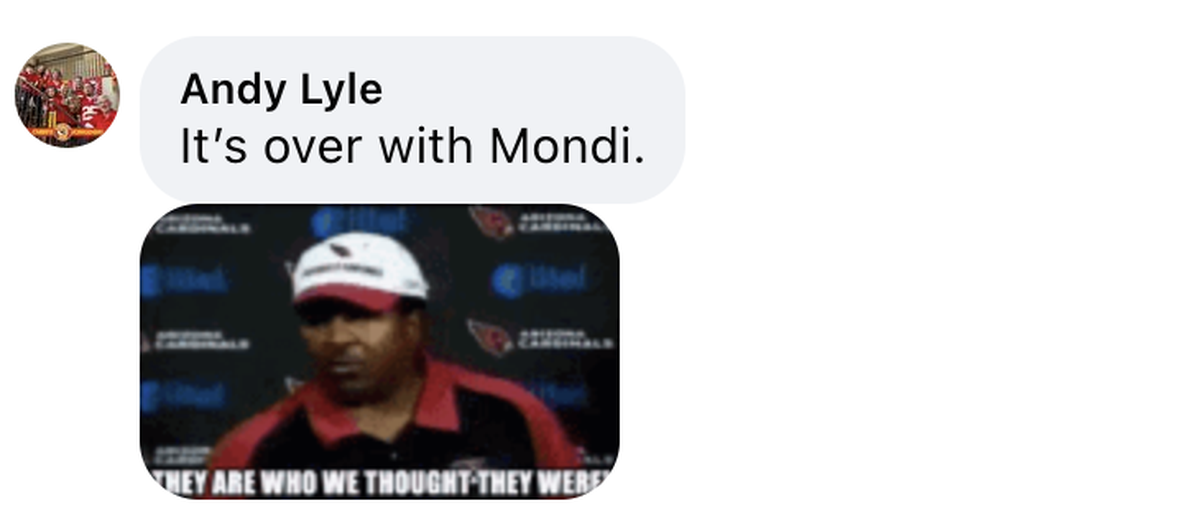
This is a problem.
Mondesi was arguably the best player in baseball last September. He is hitting .372 with a .710 slugging percentage, 24 runs, 24 RBIs, eight home runs and 17 stolen bases in his last 29 games. That’s a pace of 51 games and 88 stolen bases over 150 games.
The problem is that Mondesi has not played more than 102 games since 2014, when he was 18 years old.
This year, he has played seven games, and been on the IL twice.
The Royals have been enamored with his talent since signing him 10 years ago next month. They have promoted him aggressively. They have supported him. They have talked him up, both privately in person and publicly to anyone who would listen.
They have staked a significant portion of their future on him, and have expressed interest in signing him to a long-term extension.
What they’ve received is … less.
There has long been a belief from some that Mondesi does not know the difference between an injury and something he can play through.
The oblique strain before opening day might be bad luck, but the way this hamstring tweak has been handled — with the team being both optimistic and uncertain, a delay of almost a week before going on the IL — has all the signs of something the team believes Mondesi can play through.
Royals head trainer Nick Kenney has a terrific reputation, but this doesn’t mean Mondesi is wrong or soft or anything else. He knows his body better than anyone.
But you can’t help the team from the IL, and shortstop is perhaps baseball’s worst position for uncertainty. Teams always carry backup catchers, but few have more than one defender truly capable of playing shortstop well in the big leagues.
The gap between Mondesi and Nicky Lopez or Hanser Alberto defensively is enormous, but the Royals don’t want to spend limited resources on a player they hope is made redundant.
Mondesi would not be the first or last professional athlete to struggle with which pain to play through. There had been some hope that as he grew older and approached arbitration — this is when players start making big money — that he would find ways to stay in the lineup.
That could still happen. Nobody knows the future, and baseball players often develop in bursts and never in straight lines. He turns 26 next month, which isn’t old, but isn’t quite still young, either.
The Royals control Mondesi’s rights for three more seasons after this, so we are far from make or break.
But the status quo is unsustainable. Either Mondesi shows he can stay healthy, or the Royals have to protect themselves with another viable option at shortstop.
This is really weird. And I wish I had a better answer for you, but what I see is a guy stuck in the self-perpetuating cycle of a big league slump.
He’s set for free agency after this season, and will be 30 when the 2022 season begins. He wanted an extension here, and must know that teams have diminished interest in aging DHs. He has the look of a man trying to hit two home runs on every pitch — and both to left field.
Look at this spray chart, courtesy of the awesome Baseball Savant:
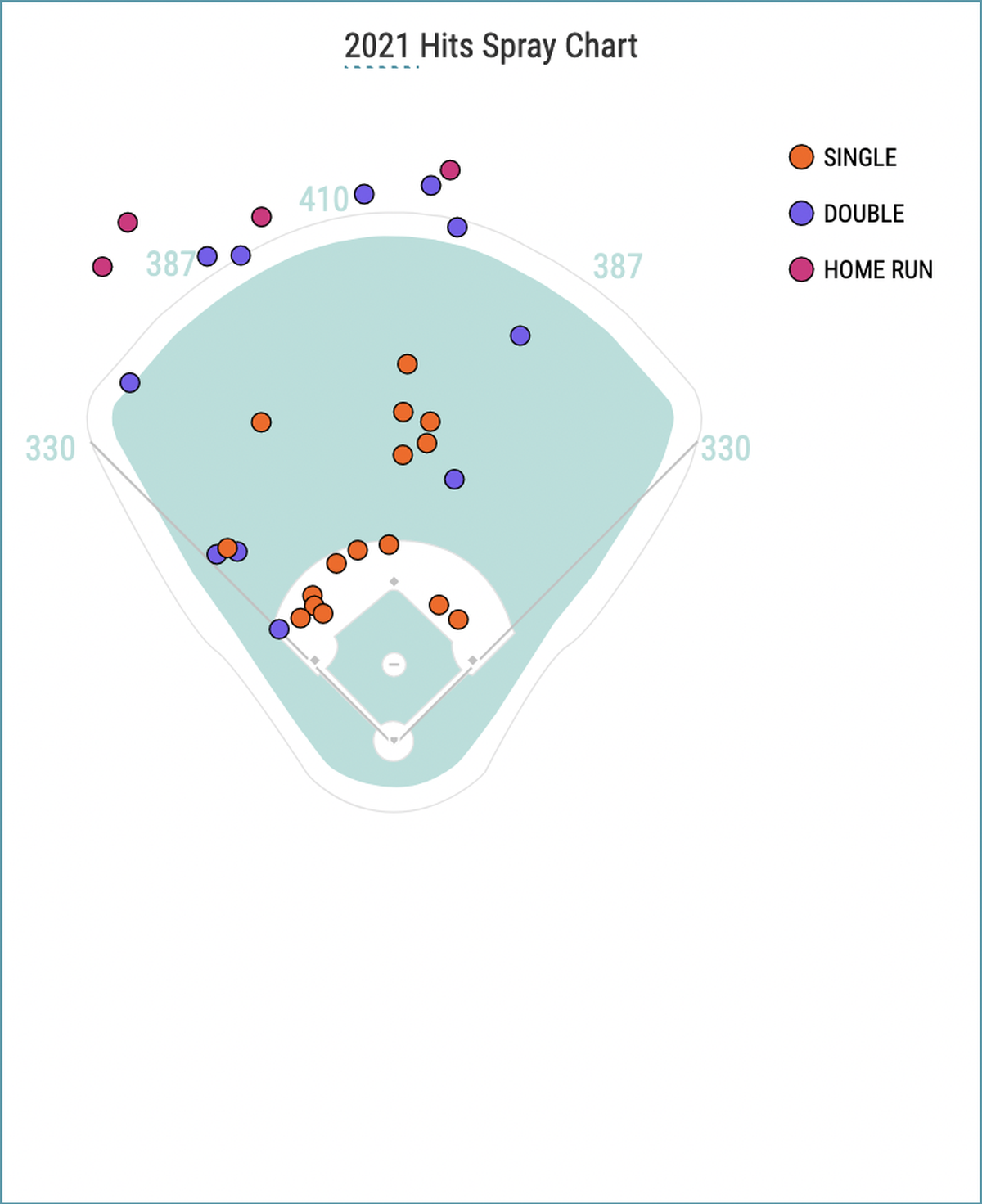
That’s, what, two hits this season fielded by the right fielder? Maybe?
The eye and the supporting numbers paint the problem similarly. Soler is still making hard contact. He’s still barreling. But he’s trying to pull everything, and opposing pitchers know it, which informs how they pitch him and where the fielders are behind him. You don’t mind giving up hard contact if you know where it’s going, and you know your guys are there waiting.
This is all easier said than corrected, of course. Big-league pitchers are freaks, and there are times you have to wonder how anyone ever gets a hit. Going through here with spray charts or video clips doesn’t do much for the guy with a bat in his hands trying to run up hill and against the wind.
But it’s all in there. The hand-eye. The plate discipline. The strength. The bat speed.
Soler can be a good hitter, still. But the context in which he finds himself — pressure of a contract year, trying to pull everything against teams that know he’s trying to pull everything — makes for a tough go.
One thing I’d do is to lock his glove in a safe behind a painting.
Maybe it’s just a coincidence, but in almost exactly even samples — 109 plate appearances as a right fielder; 99 as a DH entering Monday — his OPS is 267 points higher as a DH.
That tracks with Soler’s history in Kansas City. He was 203 points higher as a DH last year, and 202 points higher in 2019. These things can be finicky, but Soler does not strike as the type to demand he play the field.
At the very least, you’d be keeping a sub-average defender out, improving your defense while hopefully improving your offense as well.
That’s where I’d start, anyway.
The Chiefs are a team that will be linked to every available free agency or disgruntled veteran. That’s especially true for offensive players. This is part of what we call The Mahomes Effect.
I’m not bad mouthing it. The game is the game. Besides, it’s fun to imagine Mahomes and Andy Reid with even more weapons.
But we talked about this a few times here and in other places. Jones just never made sense here. It was always simple economics. They would have had to give up too much in draft capital, and then pay him too much in American currency — especially with Orlando Brown and Tyreek Hill due extensions next summer.
The Titans gave up a 2022 second-round pick, and a fourth-round pick in 2023. The Falcons sent a 2023 sixth-round pick along with Jones to make the exchange rates even.
That means the Chiefs would have had to do a second and a third, at least, or perhaps even beat the Titans’ offer with a first.
Look, I am all in on the strategy of trading picks for veterans. I believe it’s smart, particularly for good teams that can be relatively sure they’ll remain good. But you have to pick your spots. You can’t do it every year.
Julio Jones is a fantastic player. He will be voted into the Hall of Fame. But the Chiefs need those picks and the cap space a lot more than they need a 30-year-old receiver coming off a nine-game season and without a strong track record in the red zone.
Bashaud Breeland is a real loss. The Chiefs are in a position where they need to add cornerbacks, not lose them. Breeland didn’t get much shine in Kansas City, but he was an important part of the Chiefs’ success these last two seasons. He was physical, dependable, and confident.
Tyrann Mathieu gets much of the credit for the secondary’s rise, and that’s how it should be. But Breeland was there, too, and losing him means the Chiefs can’t afford injuries or misses on the corners they still have. It could also mean that L’Jarius Sneed moves away from the slot — where he was terrific — to the outside.
Breeland did not get the long-term contract he was presumably seeking, and I don’t know this for sure, but my assumption is that he would have re-signed with the Chiefs for the same one-year and $4 million contract the Vikings offered.
That’s more than he made with the Chiefs in either of the last two seasons, and you don’t pay for sentimentality, but that’s not a cost-prohibitive deal for a guy who’s proven his worth.
I don’t want to overstate this. The Chiefs will win or not based on Patrick Mahomes and the offensive line and the stars they have on both sides of the ball.
But I do think they’ll regret not having Breeland this fall.
Some guy named Posnanski wrote about this recently, but umpires are actually better than ever.
Joe cites data that says missed ball-strike calls are down from 12 percent between 2008 and 2018 to less than 9 percent. Egregious misses are extremely rare. These are facts, and it’s worth mentioning the context that performance has improved as velocity and spin rates have increased.
Umpires are doing a harder job more successfully than ever before.
That’s one side of it.
The other side is that we live in a world in which the types of baseball fans who care about these things can watch a game with a computer in their pocket that will track with relentless detail every missed call by every umpire. We live in a world in which technology exists that would fall short of perfection, but be objectively more successful at calling balls and strikes than the status quo.
These are problems that baseball cannot make go away.
I’m glad you mentioned the doctored baseballs. The commissioner’s office is cracking down on the use of foreign substances — to some effect, it must be said — which is a smart and overdue move for many reasons.
Most of those reasons are more important than ball-strike calls — offense and balls in play are tracking at historical lows, which strikeouts keep going up. MLB changed the balls, and those changes appear to be backfiring.
Hitters have a hard enough time already. Jacob deGrom is out here throwing 94 mph changeups, for crying out loud:
But if pitchers have to rely on nothing more than their talent, then hitters should have a more even chance and the game will look better.
There is no way to know this with certainty, but it would make sense that umpires would miss fewer calls this way, too. But that’s secondary. There are more important things at stake here.
The details could get messy, but the umpiring solution that makes the most sense to me is some sort of hybrid system where we keep the umpires we have — except for CB Bucknor and Angel Hernandez — but help them with technology.
Give them an earpiece that tells them what Statcast says. If the umpire isn’t sure, he goes with the robot.
I’ve been driving to the studio to do the Border Patrol most Mondays for years now, and I think this week was the first time I drove in a silent car, and I did it because I was thinking about this exact question, even before you asked.
I do think it’s important to remember that these are still relatively rare incidents. Hundreds of thousands of fans have been at games as the world reopens and only a few have acted like dolts.
Let’s keep that in mind.
But it’s impossible not to notice. The NBA wore it for a week or so, and now it’s soccer’s turn, with a fan who ran onto the field and others who threw things onto it during the USMNT-Mexico game.
My sense is that the answer is a combination of the factors you mention, but leaning heavier on fans forgetting how to act.
I say that because our country was plenty divided before Covid, but we didn’t have this same level of idiocy.
For more than a year, we’ve been managing this abnormal existence. Restaurants were closed, sports canceled, and then when they came back it was without fans and often without fun.
You ever been around a teenager on the last day of school? Or, better yet, you ever been a teenager on the last day of school?
You might get a rush. You might feel a burst. You might scream or jump or do something you normally wouldn’t.
I think we’re seeing some of that here, and now.
People haven’t been in crowds for more than a year, and maybe they’re anxious, maybe they’re too excited.
I also don’t want to discount the other part of this. Because I do think that as a whole we’re more divided politically and socially than any point in my lifetime. People are angry. They’re blaming each other. They have more ways to express that anger than ever before, which creates a destructive cycle with more anger.
I’d like to be optimistic, but the truth is I think this type of thing will get worse before it gets better.
It should surprise nobody that I am a hard yes on this, and I understand that this view can be seen as self-serving.
So I hope you’ll believe me when I tell you this truth: I miss travel a lot less than I expected.
I’ve always enjoyed traveling. I was hooked on my first airplane ride. I love seeing different places, different people, different architecture and culture and priorities and everything else. I love the mechanics of traveling — the schedule, the airports, the hotels, all of it. My wife calls me Amazing Race whenever we travel, and I do not believe she means it as a compliment.
But this is the truth: seeing difference places and different stadiums and meeting different people has always been one of my favorite parts of this job.
This is also the truth: I don’t miss it nearly as much as I expected.
I am undeservedly fortunate to be in a place in my life where I love being home more than I ever loved travel. This is going to sound morbid and weird but it’s true — every single day I think about the fact that this is one less day I’m going to have with my wife and our kids.
I’d rather spend those days with them, than with strangers on a Southwest connection through Love Field, even though Love Field has a Chick-Fil-A and a Whataburger LITERALLY NEXT TO EACH OTHER.
That’s a long way of getting into this, but I just want you to know where I’m coming from.
Now. Let me answer your question as well as I can.
It does my heart good to hear you say you feel like you’re missing something without media traveling. Not because you’re missing something, to be sure, but because you’re noticing it. That makes me feel good. That makes me feel that those of us lucky enough to have these jobs and these opportunities are making the most of it.
I told you earlier how I feel personally, but here’s how I feel professionally: I hate not traveling, hate not being able to talk to more people face-to-face, and actually that doesn’t do it justice so let me say that I HATE all of it.
I’m not as good at my job like this.
I don’t feel as useful to you like this, and that’s a hard thing to admit.
There’s just so much that’s lost in translation when everything’s done through a screen. We can’t see what’s happening on the sideline or in the dugout, which can inform how we see critical moments and stories. We can’t get to know the humans doing the playing or the coaching, which means we all lose something here.
I’m well aware of how media whining is digested, and I get it. We are lucky to have jobs that many would love, and too many of us are pompous asses about it.
But if you’ve ever believed even one thing I’ve said, please make it this: I do not take even a crumb of personal profit in the type of casual and one-on-one conversations we’re able to have with athletes when clubhouses or locker rooms are open.
I take a ginormous amount of professional pride in making sure those opportunities show up in my work, and help you understand and better connect with the teams you care about.
I am a middle man. I am replaceable. You are the important part of this entire operation. You are irreplaceable.
And your experience is diminished when there are no independent voices or reporters to help bring you the truth and stories you otherwise would not hear.
I hate that. I hate it so much that I would give up days with my wife and kids to be better able to help you.
I don’t know the details of Noami Osaka’s mental health. Neither do you. I think that’s important to keep in mind. We know what we’ve read, or what’s been reported, but we can’t know what’s going on inside of her mind and heart.
Being a professional athlete is a grueling existence. We tend to think of it as all glamour, and that’s how it often looks — money, fame, fans, your successes celebrated by strangers and broadcast across the world.
But there is also an almost literally insane amount of work required. One irony of that life is that if you’re good enough you have doors open that you simply cannot walk through if you want to stay good enough.
It’s hard not to let your self-worth be engulfed in performance. Your identity becomes your last game, or your next one. Sure, you have fans, but you also have new people who want something from you, or, actually — demand something from you.
I don’t know if Osaka struggles with any of that. I’m just trying to establish some context, and tell you that I am not here to dismiss or disparage anyone’s efforts to focus on their mental health.
Press conferences are weird. I am sure they are weird for athletes. I know they are weird for reporters.
If I’m honest, I would tell you that I hate them. They are not completely useless, but they are a place where you get much more propaganda and things someone wishes are true than you get actual truth. And if you get that actual truth, and are tuned in well enough to recognize it, then guess what? A room full of your competition just got the same truth.
But this is the world we’ve all created. We rarely get close to athletes now — this was true even before COVID-19 — so we’ve settled on these crumbs from press conferences or (often edited or ghost written) social media posts.
The idea behind media availability has always been that it’s good for all sides. Athletes and leagues get free exposure, reporters get content, and (most importantly) hopefully fans can feel closer to the games they love.
Media availability is literally written into the CBAs of major sports leagues. Stadiums are required to include space for media. Teams that want to host major events like the Super Bowl must match specifications. Thousands and thousands of athletes at all levels have navigated and even thrived with this relationship.
Again, I don’t know Osaka’s specific situation. I applaud her for sticking up for herself, and doing what she needs to be her best.
But it is really hard for me to understand the logic of drawing the line at press conferences. It’s really hard for me to understand how that’s more pressure than performing, or how questions from experienced and credentialed media can be worse than what some fan might yell from the 13th row.
I say this without arrogance. I’m more than open to hearing where I’m wrong.
I guess this is the most concise way I can think of answering the question:
We need a lot more understanding and respect for mental health, but if answering questions relevant to the interests of fans is too much then maybe there’s something more important to address than press conferences.
This is an interesting question, in part because this is something I’ve thought often about but never tracked.
I’m still typing here — I don’t answer the questions in the same order they post here, if you care — but I believe Twitter is going about 5:1 over Facebook this week. My guess is that it’s usually a little more even, but that Twitter usually wins.
I don’t know that there’s a substantial difference for my tiny corner of the internet. I get more interaction on Twitter, but I’m also more active there. This is anecdotal, but I would say there’s more trolls on Twitter but the trolls on Facebook are more troll-y.
There are probably more funny questions on Twitter, and more nuanced questions on Facebook. But again — that’s probably baked in with Facebook not having a character limit.
I don’t do much with Facebook. I have a personal account, but rarely check it. I’ve made a conscious effort to be more responsive on Facebook, but I just find Twitter to be easier to use and generally more interesting.
The truth is I want to be wherever you are. The readers are the boss, so you tell me where to be and I’ll ask how high I should jump to get there.
My man, it’s terrific.
Again, I took my vacation last week very seriously, so I can’t remember exactly where we left this but I decided to go with this one.
I still think it’s weird that there is essentially no ice maker inventory between $500 and $1,800, but I was having a hard enough time justifying the “cheaper” models.
We redid our kitchen recently, and my only regret is not installing an ice maker. If we did, it would have been easier to justify the more expensive machines but as a one-off I had to make some sacrifices.
And so far the only sacrifice seems to be that the ice won’t stay frozen indefinitely. Which is fine, because I just turn it on for an hour or two to fill the bucket in the fridge and go from there. No more runs to the grocery store for ice, which always had to be the last stop on the errands, because of course you don’t want it melting. No more rationing ice when you’re running low.
Besides, I figure we were spending like $10 per week on bagged ice so this thing should be paying for itself inside of a year.
I use as much ice as I damn well want, and I have to tell you that this must be what superheroes feel like.
You guys, the other day we went to the lake, so I let that beauty do its thing for a few hours and just stopped MANY POUNDS of fresh made ice into my cooler without a care in the world.
The ice doesn’t stay frozen in a drink or cooler as long as I’d like, but that’s OK because I’m not sure if I mentioned this yet but I have an unLIMITED supply of ice now.
I might as well be king.
This week, I’m particularly grateful for these fish tacos the Mellingers are about to crush.